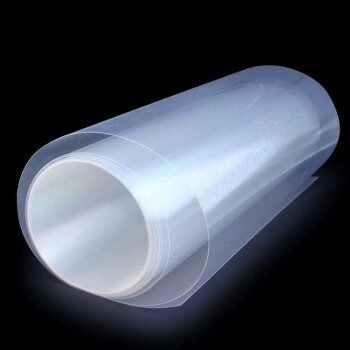
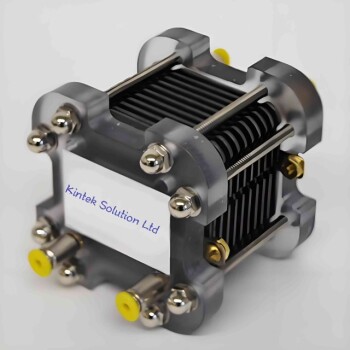
The primary role of an anion exchange membrane (AEM) in a PEC battery system is to act as a selective physical barrier between the working electrode (photoanode) and the counter electrode (cathode). While it physically isolates these components to separate evolved gases, it simultaneously acts as a conductive bridge, allowing ions to pass through to maintain the essential electrical current and electrolyte balance.
The membrane solves the critical engineering challenge of segregating explosive gases while keeping the electrical circuit intact. It ensures the system produces pure hydrogen safely, rather than creating a volatile mix of chemicals.
The Mechanics of Isolation and Conduction
Separating the Electrodes
The fundamental function of the AEM is to physically divide the electrolyzer structure.
It creates a dedicated boundary between the photoanode and the cathode.
This compartmentalization is essential for defining the distinct reaction zones within the cell.
Maintaining Ionic Balance
Despite the physical barrier, the system cannot function if the circuit is broken.
The membrane supports current conduction by permitting the flow of specific ions between chambers.
This ensures the electrolyte ion balance is maintained, allowing the electrochemical reaction to proceed efficiently.
Safety and Purity Implications
Preventing Gas Mixing
During the water-splitting process, hydrogen and oxygen gases are evolved at opposite electrodes.
The AEM serves as a strict blockade, preventing these two gas streams from crossing over and mixing.
Eliminating Explosion Risks
The combination of hydrogen and oxygen in a confined space presents a severe safety hazard.
By effectively isolating the gases, the membrane eliminates the potential risk of explosion within the electrolyzer.
Ensuring Hydrogen Purity
Beyond safety, the quality of the output is paramount.
The membrane prevents oxygen from contaminating the hydrogen stream.
This guarantees that the harvested hydrogen product maintains high purity, making it suitable for downstream usage.
Understanding the Operational Balance
The Isolation-Conduction Trade-off
The membrane must perform two opposing tasks simultaneously.
It must be impermeable enough to stop gas molecules but permeable enough to transport ions.
If the membrane is too restrictive, current conduction suffers; if it is too porous, gas purity and safety are compromised.
Making the Right Choice for Your Goal
To maximize the effectiveness of a PEC battery system, you must view the membrane as the stabilizer of your reaction.
- If your primary focus is System Safety: Ensure the membrane provides complete physical isolation to eliminate any risk of hydrogen and oxygen interaction.
- If your primary focus is Output Quality: Rely on the membrane’s barrier properties to prevent cross-contamination and guarantee a high-purity hydrogen product.
The anion exchange membrane is the essential component that transforms a volatile chemical process into a stable, safe, and productive energy system.
Summary Table:
| Feature | Function in PEC Electrolyzer | Impact on System |
|---|---|---|
| Physical Barrier | Separates photoanode and cathode | Defines distinct reaction zones |
| Ion Conduction | Permits flow of specific anions | Maintains circuit and electrolyte balance |
| Gas Isolation | Prevents H2 and O2 crossover | Eliminates explosion risks and ensures safety |
| Purity Control | Blocks oxygen contamination | Guarantees high-purity hydrogen output |
Elevate Your PEC Research with KINTEK Precision
Maintaining the delicate balance between ionic conductivity and gas isolation is critical for stable electrochemical systems. KINTEK specializes in high-performance laboratory equipment, offering the tools you need to optimize your PEC battery and hydrogen research. From advanced electrolytic cells and electrodes to precision high-temperature reactors, our comprehensive portfolio supports researchers in achieving superior results with safety and efficiency.
Ready to upgrade your laboratory setup? Contact us today to explore our range of consumables, cooling solutions, and specialized reactors tailored for your green energy innovations!
References
- António Vilanova, Adélio Mendes. Optimized photoelectrochemical tandem cell for solar water splitting. DOI: 10.1016/j.ensm.2017.12.017
This article is also based on technical information from Kintek Solution Knowledge Base .
Related Products
- Anion Exchange Membrane for Laboratory Use
- Proton Exchange Membrane for Batteries Lab Applications
- Customizable PEM Electrolysis Cells for Diverse Research Applications
- FS Electrochemical Hydrogen Fuel Cells for Diverse Applications
- Polyethylene Separator for Lithium Battery
People Also Ask
- What is the role of an Anion Exchange Membrane (AEM)? Boost Safety and Efficiency in Photoelectrochemical Systems
- What role do ion exchange membranes play in zero-gap CO2 reduction? Master the Engine of Selective Transport
- What is the role of an ion exchange membrane in MCCA Kolbe electrolysis? Enhance Purity & Safety in Your Lab
- What should be considered when selecting an ion exchange membrane? Key Factors for Optimal Performance
- Why are ion exchange membranes essential in electrochemical cell configurations? Optimize Cell Efficiency and Safety