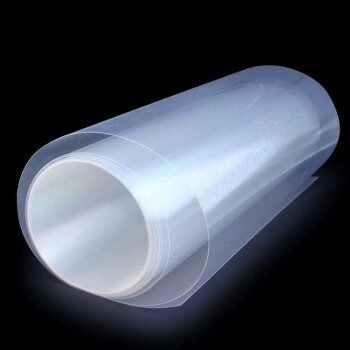
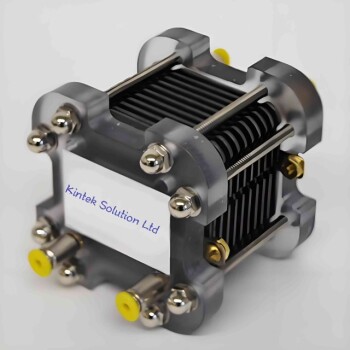
H-type electrolytic cells offer versatile compatibility with multiple classes of ion-exchange membranes. To accommodate precise experimental needs, these cells can be fitted with cation exchange membranes, anion exchange membranes, or proton exchange membranes. Your specific choice is determined by the properties of the ions in your solution and the unique requirements of your electrochemical reaction.
The core function of the membrane is to selectively isolate reaction zones; it must permit specific ions to migrate between the anode and cathode chambers while strictly preventing the bulk mixing of electrolytes.
The Architecture of Ion Selectivity
Defining the Separation Zone
The H-type cell consists of two distinct parts: an anode chamber and a cathode chamber.
Controlling Ion Transport
The ion-exchange membrane serves as the critical barrier between these two chambers.
Its primary role is to create a selective pathway. It allows target ions to migrate for the reaction to proceed while blocking other species to maintain chemical distinctness in each chamber.
Available Membrane Options
Cation Exchange Membranes
These membranes are designed to allow positively charged ions to pass through the barrier.
Select this type if your reaction requires the transfer of cations from the anode to the cathode (or vice versa) without moving anions.
Anion Exchange Membranes
These membranes selectively permit the transport of negatively charged ions.
They are the correct choice when your experimental design relies on the migration of anions to balance the charge between the two chambers.
Proton Exchange Membranes
This is a specific subset of membranes optimized for the transport of protons ($H^+$).
These are frequently utilized in experiments involving hydrogen evolution or specific fuel cell modeling applications where proton conductivity is the variable of interest.
Common Pitfalls in Installation
Avoiding Dry Installation
A common mistake is installing a dry membrane directly into the cell.
You should always soak the membrane in the electrolyte for a period before installation. This ensures it is fully wetted, which prevents damage and facilitates a smoother setup.
Protecting Fragile Components
H-type cells are typically constructed from glass, making them inherently fragile.
Handle the cell with extreme care during membrane insertion. Ensure connections are tight and reliable, but do not apply excessive force that could fracture the glass or tear the membrane.
Correct Positioning
The membrane must be positioned precisely to separate the reaction zones effectively.
Using a small amount of electrolyte or lubricant during the installation process can help slide the membrane into the correct position without inducing mechanical stress.
Optimizing Your Experimental Setup
To ensure accurate data and equipment longevity, match your membrane choice to your specific ion transport goals.
- If your primary focus is cation transport: Select a cation exchange membrane to strictly allow positive ions to migrate between chambers.
- If your primary focus is anion transport: Utilize an anion exchange membrane to facilitate the movement of negatively charged species only.
- If your primary focus is hydrogen ion mobility: Choose a proton exchange membrane to ensure high-efficiency proton conduction.
- If your primary focus is equipment safety: Always pre-soak your membrane to ensure flexibility and prevent structural damage during installation.
Success in H-type electrolysis relies not just on the cell itself, but on the precise matching of the membrane type to the ions driving your reaction.
Summary Table:
| Membrane Type | Target Ion | Key Applications |
|---|---|---|
| Cation Exchange (CEM) | Positively charged ions | Metal recovery, general electrolysis |
| Anion Exchange (AEM) | Negatively charged ions | Hydroxide transport, alkaline fuel cells |
| Proton Exchange (PEM) | Hydrogen ions ($H^+$) | Hydrogen evolution, acidic fuel cell research |
| Pre-soaked Membrane | All types | Prevents structural damage and ensures conductivity |
Elevate Your Electrochemical Research with KINTEK
Precision matters in ion transport. At KINTEK, we specialize in providing high-quality H-type electrolytic cells, specialized electrodes, and ion-exchange membranes designed for rigorous laboratory standards. Whether you are focusing on battery research, hydrogen evolution, or chemical synthesis, our comprehensive range of laboratory equipment—from high-temperature furnaces to precision electrolytic cells—ensures your experiments yield reliable, repeatable data.
Ready to optimize your H-type cell setup? Contact us today to consult with our specialists and find the perfect membranes and consumables for your specific research needs.
Related Products
- Proton Exchange Membrane for Batteries Lab Applications
- Customizable PEM Electrolysis Cells for Diverse Research Applications
- H Type Electrolytic Cell Triple Electrochemical Cell
- Anion Exchange Membrane for Laboratory Use
- H-Type Double-Layer Optical Electrolytic Electrochemical Cell with Water Bath
People Also Ask
- What is the function of a proton exchange membrane in a PEC cell? Enhancing CO2 Reduction Safety and Efficiency
- What initial steps are required before using a new proton exchange membrane? Ensure Peak Performance and Longevity
- What should be done if a proton exchange membrane is found to be contaminated or damaged? Restore Performance or Replace for Safety
- How should a proton exchange membrane be installed? A Guide to Flawless Assembly for Peak Performance
- What contaminants should be avoided during the operation of a proton exchange membrane? Protect Your PEM from Heavy Metals & Organics