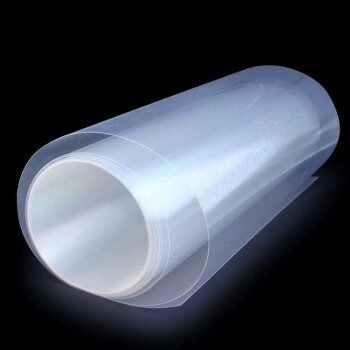
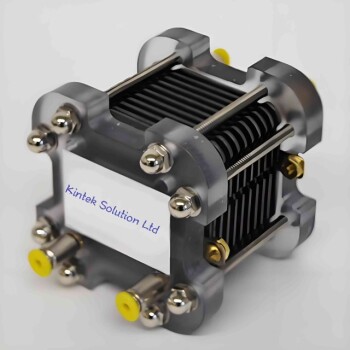
Ion-exchange membranes, such as PEMs or AEMs, serve as a critical physical barrier in flow cell reactors to preserve chemical yields. They function by physically isolating the cathode product zone from the anode zone. This separation effectively blocks the generated hydrogen peroxide from migrating to the anode, where it would otherwise be destroyed through oxidative decomposition.
Core Takeaway By strictly compartmentalizing the reactor, ion-exchange membranes prevent the "chemical short-circuit" of product migration. This isolation ensures hydrogen peroxide remains in the cathode chamber, preventing its destruction at the anode and significantly boosting both Faraday efficiency and final product concentration.
The Mechanism of Preservation
Physical Isolation of Zones
The fundamental role of the membrane is to create regional isolation. It divides the reactor into two distinct environments: the cathode zone and the anode zone.
This physical separation is necessary because the conditions required to create hydrogen peroxide at the cathode are fundamentally different from the conditions at the anode.
Blocking Anodic Migration
Without a membrane, chemical species naturally diffuse through the electrolyte. The membrane acts as a selective blockade against this movement.
Specifically, it stops the hydrogen peroxide generated at the cathode from drifting across the reactor to the anode surface.
Preventing Oxidative Decomposition
The anode is a highly oxidative environment. If hydrogen peroxide reaches this surface, it is unstable and susceptible to oxidative decomposition.
By effectively stopping migration, the membrane eliminates the possibility of this reaction occurring, preserving the molecule intact.
Impact on System Performance
Improving Faraday Efficiency
Faraday efficiency measures how effectively electrical current is converted into the desired product.
When hydrogen peroxide decomposes at the anode, the energy used to create it is wasted. By preventing this loss, the membrane ensures that a higher percentage of the current contributes directly to the final yield.
Enhancing Final Concentration
For a flow cell reactor to be practical, it must produce a solution with a usable concentration of hydrogen peroxide.
Because the membrane prevents the product from being constantly degraded at the anode, the concentration of hydrogen peroxide in the cathode product zone is allowed to accumulate to significantly higher levels.
Understanding the Risks of Omission
The Consequence of Poor Isolation
It is important to understand what happens when this barrier is absent or comprised. In systems without effective ion-exchange membranes, the reactor suffers from crossover.
This leads to a cycle of creation and immediate destruction, where the product formed at one electrode is consumed at the other.
The Ceiling on Yield
Without the physical isolation provided by the membrane, there is a hard ceiling on reactor performance.
No matter how efficient the catalyst is at the cathode, the overall system efficiency will remain low because the anode actively works against the production goal by decomposing the product.
Making the Right Choice for Your Goal
To maximize the performance of your flow cell reactor, you must view the membrane not just as a separator, but as a preservation tool.
- If your primary focus is High Faraday Efficiency: Ensure your membrane selection provides robust physical isolation to minimize any product crossover that leads to wasted energy.
- If your primary focus is High Product Concentration: Utilize a membrane that strictly confines the cathode liquid volume, allowing the hydrogen peroxide to accumulate without migrating to the oxidative anode zone.
The membrane is the guardian of your product, converting raw electrical potential into a stable, high-concentration chemical output.
Summary Table:
| Feature | Function in Flow Cell Reactor | Impact on H2O2 Preservation |
|---|---|---|
| Physical Isolation | Separates cathode and anode zones | Blocks H2O2 from migrating to the oxidative anode |
| Selective Blockade | Limits chemical species crossover | Eliminates the 'chemical short-circuit' of product loss |
| Faraday Efficiency | Optimizes current-to-product conversion | Prevents energy waste by stopping product degradation |
| Concentration Control | Confines cathode liquid volume | Allows for accumulation of high-purity product yields |
Elevate Your Electrochemical Research with KINTEK Precision
Maximize your Faraday efficiency and product concentration with KINTEK’s industry-leading laboratory solutions. We specialize in providing high-performance electrolytic cells and electrodes, alongside advanced ion-exchange membranes designed to prevent crossover and oxidative decomposition in flow cell reactors.
Whether you are scaling hydrogen peroxide production or conducting complex battery research, KINTEK offers a comprehensive range of equipment—from high-temperature high-pressure reactors and CVD systems to ULT freezers and PTFE consumables—tailored to meet the rigorous demands of your lab.
Ready to optimize your reactor performance? Contact our experts today to find the perfect tools for your specific application.
References
- Ao Yu, Yang Yang. Recent advances in electrosynthesis of H<sub>2</sub>O<sub>2</sub><i>via</i> two-electron oxygen reduction reaction. DOI: 10.1039/d4cc01476f
This article is also based on technical information from Kintek Solution Knowledge Base .
Related Products
- Anion Exchange Membrane for Laboratory Use
- Proton Exchange Membrane for Batteries Lab Applications
- Polyethylene Separator for Lithium Battery
- Customizable PEM Electrolysis Cells for Diverse Research Applications
- FS Electrochemical Hydrogen Fuel Cells for Diverse Applications
People Also Ask
- What is the role of an Anion Exchange Membrane (AEM)? Boost Safety and Efficiency in Photoelectrochemical Systems
- What role does an anion exchange membrane play in a PEC battery? Ensure Safe, High-Purity Hydrogen Production
- What role do ion exchange membranes play in zero-gap CO2 reduction? Master the Engine of Selective Transport
- What is the role of an ion exchange membrane in MCCA Kolbe electrolysis? Enhance Purity & Safety in Your Lab
- What should be considered when selecting an ion exchange membrane? Key Factors for Optimal Performance