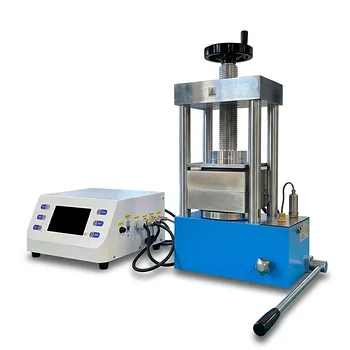
High-pressure reactors for hydrothermal liquefaction (HTL) at subcritical states require robust construction using specific materials like 316 stainless steel and 4140 alloy. These vessels must be engineered to sustain operating temperatures up to 360°C and withstand internal pressures reaching 25 MPa to maintain process stability and safety.
The reactor design must fundamentally balance structural integrity against the aggressive nature of subcritical water, ensuring sufficient pressure is maintained to keep water in a liquid state while it acts as a potent solvent for biomass conversion.
Engineering for Extreme Conditions
Material Selection Requirements
To prevent structural failure, the reactor body must be constructed from high-strength, corrosion-resistant materials. 316 stainless steel and 4140 alloy are the primary specifications for these environments.
These alloys provide the necessary tensile strength to contain high pressures while resisting the corrosive effects of hot, compressed water and biomass byproducts.
Pressure and Temperature Thresholds
The reactor must be rated to operate safely at temperatures ranging from 250°C to 360°C.
Simultaneously, the vessel must maintain internal pressures between 10 and 25 MPa. This pressure capability is non-negotiable, as it prevents water from boiling off, keeping it in the liquid subcritical phase required for the reaction.
The Role of Subcritical Water Chemistry
Water as an Organic Solvent
In this specific pressure-temperature window, the physical properties of water change drastically. The dielectric constant decreases, allowing water to behave similarly to an organic solvent.
This transformation enables the reactor to facilitate the decomposition of complex organic polymers, such as lignin and cellulose, which are otherwise difficult to break down.
Reaction Efficiency
The high-pressure environment increases the ionic product of water, allowing it to function simultaneously as a solvent, reactant, and catalyst.
This promotes critical chemical reactions—specifically hydrolysis, decarboxylation, and deamination—which efficiently convert raw biomass into energy-dense bio-crude oil.
Operational Advantages of the Design
Processing Wet Feedstock
A major technical advantage of these high-pressure specifications is the ability to process wet biomass, such as algae or sludge, directly.
Because the reactor operates with water as the medium, there is no need for energy-intensive pre-drying stages, significantly improving the overall energy balance of the operation.
Understanding the Trade-offs
Corrosion vs. Cost
While 316 stainless steel offers good resistance, subcritical water is highly aggressive and can accelerate corrosion rates compared to standard conditions.
Engineers must monitor wall thickness and potential pitting, as the harsh chemical environment created by decomposing biomass can challenge even robust alloys over time.
Pressure Safety Management
Operating at 25 MPa presents significant safety risks that require rigorous pressure relief systems and safety factors in the design.
The relationship between temperature and pressure is volatile; a slight increase in temperature can cause a rapid pressure spike, necessitating precise control systems to avoid exceeding the reactor's maximum allowable working pressure (MAWP).
Making the Right Choice for Your Goal
When specifying a reactor for your HTL process, your material and design choices should align with your specific operational priorities.
- If your primary focus is longevity and safety: Prioritize the use of 316 stainless steel or higher-grade alloys to maximize corrosion resistance against the acidic byproducts of biomass conversion.
- If your primary focus is process efficiency: Ensure the reactor is rated for the upper limits of the subcritical range (near 360°C and 25 MPa) to maximize the solvent properties of water and bio-oil quality.
Success in hydrothermal liquefaction relies on a reactor vessel that can maintain a liquid phase under extreme heat without succumbing to the corrosive nature of the feedstock.
Summary Table:
| Specification Category | Technical Requirement | Strategic Purpose |
|---|---|---|
| Material Selection | 316 Stainless Steel / 4140 Alloy | Corrosion resistance and high tensile strength |
| Temperature Range | 250°C to 360°C | Enables subcritical water state for organic solvent behavior |
| Pressure Threshold | 10 MPa to 25 MPa | Prevents phase change to steam; maintains liquid state |
| Chemical Processes | Hydrolysis, Decarboxylation | Efficiently converts lignin/cellulose into bio-crude oil |
| Feedstock Support | Wet Biomass (Algae/Sludge) | Eliminates the need for energy-intensive pre-drying |
Elevate Your Biomass Research with KINTEK Precision
Maximize your hydrothermal liquefaction efficiency with KINTEK’s industry-leading high-temperature high-pressure reactors and autoclaves. Our equipment is engineered to withstand the most aggressive subcritical environments, ensuring safety and longevity for your laboratory and pilot-scale operations.
Beyond reactors, KINTEK offers a full suite of laboratory solutions, including:
- High-Temperature Furnaces: Muffle, tube, and vacuum systems for advanced material processing.
- Material Preparation: Crushing, milling, and hydraulic presses for precise sample consistency.
- Specialized Labware: High-durability ceramics, crucibles, and PTFE consumables.
Ready to optimize your HTL process? Contact KINTEK today to consult with our experts on the perfect reactor configuration for your specific research goals.
References
- Salih Genel. Hydrothermal liquefaction of <i>Datura stramonium</i> L.: Influence of temperature and heterogeneous catalysts. DOI: 10.1002/ep.14322
This article is also based on technical information from Kintek Solution Knowledge Base .
Related Products
- High Pressure Laboratory Autoclave Reactor for Hydrothermal Synthesis
- Customizable Laboratory High Temperature High Pressure Reactors for Diverse Scientific Applications
- Customizable High Pressure Reactors for Advanced Scientific and Industrial Applications
- Stainless High Pressure Autoclave Reactor Laboratory Pressure Reactor
- Mini SS High Pressure Autoclave Reactor for Laboratory Use
People Also Ask
- What role does a high-pressure reactor (autoclave) play in the synthesis of NiCuFe-LDH? Master Hydrothermal Growth
- What Role Does a High-Pressure Reactor or Autoclave Play in HA Catalyst Synthesis? Achieve High Surface Area Materials
- What equipment is required for hydrothermal synthesis of Ga0.25Zn4.67S5.08? Optimize Your Semiconductor Production
- What is the function of a high-pressure reactor in the hydrothermal synthesis of boehmite? Expert Process Insights
- What role does an autoclave play in the synthesis of MnO2 nanofibers? Mastering Hydrothermal Growth