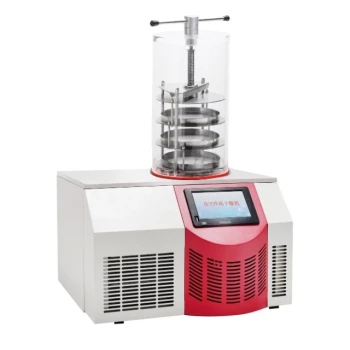
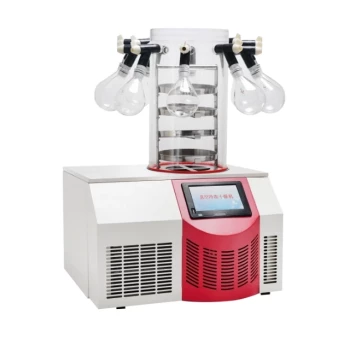
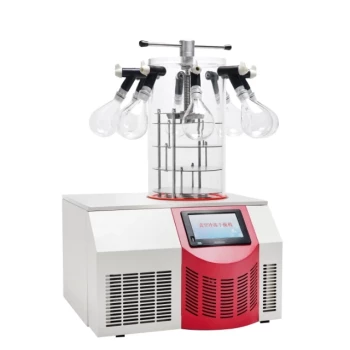
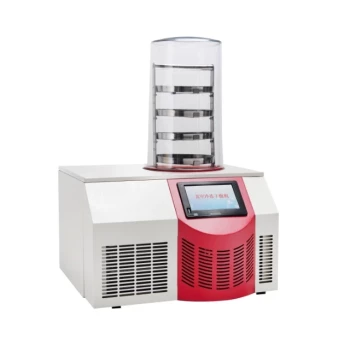
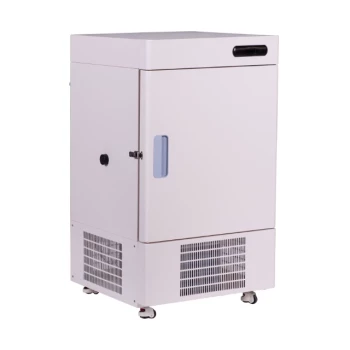
Cold traps and freeze dryers are critical for processing metal oxide precursors because they prevent the physical collapse of the material's nanostructure. By utilizing low-temperature vacuum conditions to remove moisture, these systems ensure the material retains a highly porous framework, which is essential for the high sensitivity required in environmental monitoring sensors.
Core Insight: The superior performance of freeze-dried sensors stems from the elimination of capillary forces. By bypassing the liquid evaporation phase, the process preserves the material's original dispersion, creating a vast surface area optimized for interacting with environmental gases.
The Mechanism of Structural Preservation
The Principle of Sublimation
Freeze dryers operate by inducing sublimation, where moisture transitions directly from a solid (ice) to a gas without becoming liquid.
This is achieved by freezing the metal oxide precursor and then subjecting it to a vacuum.
This specific phase transition is the key to maintaining the material's integrity during the drying process.
Eliminating Capillary Forces
In conventional drying methods, liquid evaporating from pores creates strong capillary forces.
These forces pull the pore walls together, causing the structure to shrink or collapse entirely.
Freeze drying removes the liquid phase from the equation, effectively suppressing these forces and preventing structural collapse.
Preserving Dispersion
Because the structure does not collapse, the initial dispersion state of the nanomaterials in the liquid phase is locked in.
The particles remain separated rather than clumping together, which is common in heat-based drying techniques.
Impact on Sensor Performance
Creating Porous Frameworks
The result of this process is a porous metal oxide framework.
Unlike the dense, collapsed structures formed by conventional drying, these frameworks are open and accessible.
High Specific Surface Area
The porous nature of the material yields an extremely high specific surface area.
For a sensor, surface area is the most critical metric; more surface area means more sites for chemical reactions to occur.
Enhanced Gas Sensitivity
Environmental monitoring requires detecting trace amounts of gases.
The increased surface area significantly enhances the material's sensitivity to gas adsorption, allowing the sensor to detect lower concentrations of pollutants more accurately.
The Trade-off: Conventional vs. Freeze Drying
The Cost of Simplicity
Conventional drying (like oven drying) is simpler and faster, but it comes at a high cost to performance.
It typically leads to agglomeration, where nanoparticles clump into larger masses.
The Density Problem
Agglomerated materials have significantly lower surface areas and fewer active sites for gas detection.
While easier to manufacture, sensors made via conventional drying will inherently lack the sensitivity of their freeze-dried counterparts.
Optimizing for Sensor Sensitivity
To ensure your environmental sensors perform at the highest level, prioritizing the processing method is essential.
- If your primary focus is Maximum Sensitivity: Utilize freeze drying to maximize the specific surface area and gas adsorption capabilities of the metal oxide.
- If your primary focus is Structural Integrity: Rely on sublimation-based drying to prevent capillary collapse and preserve the initial dispersion of the nanomaterials.
By choosing freeze drying, you convert a raw precursor into a high-performance framework capable of precise ecological monitoring.
Summary Table:
| Feature | Conventional Drying | Freeze Drying (Sublimation) |
|---|---|---|
| Phase Transition | Liquid to Gas (Evaporation) | Solid to Gas (Sublimation) |
| Capillary Forces | High (Causes structural collapse) | Eliminated (Preserves nanostructure) |
| Material Density | High / Agglomerated | Low / Highly Porous |
| Surface Area | Low (Fewer active sites) | High (Maximizes gas adsorption) |
| Sensor Performance | Reduced sensitivity | Superior sensitivity and accuracy |
Elevate Your Sensor Research with KINTEK Precision Solutions
Unlock the full potential of your environmental monitoring sensors by preserving material integrity at the nanoscale. KINTEK specializes in advanced laboratory equipment designed for high-performance material science.
Our comprehensive range of freeze dryers and cold traps ensures your metal oxide precursors maintain the porous frameworks and high surface area essential for peak sensitivity. Beyond drying, we support your entire workflow with:
- High-temperature furnaces for precursor calcination.
- Crushing and milling systems for optimal particle size distribution.
- High-temperature high-pressure reactors for specialized synthesis.
- Consumables including ceramic crucibles and PTFE products.
Ready to transform your raw precursors into high-precision frameworks? Contact KINTEK today to find the perfect cooling and vacuum solutions for your laboratory's specific needs.
References
- Tetiana Dontsova, Ihor Astrelin. Metaloxide Nanomaterials and Nanocomposites of Ecological Purpose. DOI: 10.1155/2019/5942194
This article is also based on technical information from Kintek Solution Knowledge Base .
Related Products
- High Performance Laboratory Freeze Dryer for Research and Development
- High Performance Laboratory Freeze Dryer
- Benchtop Laboratory Freeze Dryer for Lab Use
- Benchtop Laboratory Vacuum Freeze Dryer
- Oxygen Probe to Measure Temperature and Active Oxygen Content in Molten Steel
People Also Ask
- Why use a laboratory freeze dryer for microalgae? Preserve Sample Integrity for Accurate Analysis
- What are the technical advantages of using a laboratory freeze dryer for porous carbon precursors? Preserve 3D Networks
- What types of liquid samples can be processed using a laboratory freeze dryer? Preserve Your Sensitive Materials
- How do laboratory freeze dryers support scientific research? Preserve Sample Integrity for Reproducible Results
- Why is a laboratory freeze dryer preferred over traditional heating? Preserve Biochar Structure & Maximize Porosity