Gold-stabilized platinum crucibles are the standard recommendation for preparing crystallized glass because they offer superior mechanical strength and lower wettability compared to pure platinum. This combination prevents sample adhesion and inhibits the volatile loss of alkali metal oxides during the long heat treatments required for crystallization. Consequently, the glass maintains its intended composition, ensuring that room-temperature XRD analysis accurately reflects the material's true equilibrium state.
By reducing surface interaction and preserving volatile components, gold-stabilized platinum crucibles ensure that the precipitated crystal phases are a precise representation of the glass's thermal history rather than an artifact of container contamination or evaporation.
Superior Material Stability During Prolonged Heating
Maintaining Mechanical Integrity
Crystallizing glass often requires extended heat treatments ranging from 48 to 168 hours. Gold-stabilized alloys provide higher mechanical strength than pure platinum, preventing crucible deformation during these long thermal cycles.
Minimizing Sample Adhesion
The addition of gold significantly lowers the wettability of the crucible surface. This "non-wetting" characteristic allows the crystallized glass to be removed easily without sticking to the container walls.
Preventing Cross-Contamination
Because the glass does not adhere strongly to the gold-stabilized surface, the risk of cross-contamination between subsequent melts is drastically reduced. This ensures that the high-purity environment required for sensitive XRD measurements remains uncompromised.
Preserving Chemical and Phase Equilibrium
Inhibiting Volatile Loss
One of the most critical challenges in glass science is the volatile loss of alkali metal oxides at high temperatures. Gold-stabilized crucibles effectively inhibit this loss, keeping the chemical profile of the melt stable over time.
Ensuring Accurate XRD Phase Identification
If alkali metals evaporate during heating, the resulting crystal phases will shift away from the intended composition. By preserving the original chemistry, these crucibles ensure the precipitated phases detected by XRD represent the true equilibrium of the glass.
Facilitating Homogeneous Crystallization
Uniform heat distribution and minimal surface reaction allow for more homogeneous crystallization throughout the bulk of the sample. This leads to clearer diffraction patterns and more reliable quantitative analysis at room temperature.
Understanding the Trade-offs
Temperature Limitations
While gold improves non-wetting properties, it slightly lowers the melting point of the platinum alloy. Users must ensure that their processing temperatures do not exceed the safe working limits of the specific gold-platinum ratio.
Initial Investment Costs
Gold-stabilized crucibles carry a higher upfront cost than standard platinum or ceramic alternatives. However, this is typically offset by their increased lifespan and the higher reliability of the resulting analytical data.
Specific Cleaning Requirements
To maintain the non-wetting surface, these crucibles require specific cleaning protocols to avoid scratching the interior. Physical damage to the surface can create nucleation sites that lead to sample sticking, negating the benefits of the alloy.
Making the Right Choice for Your Goal
To achieve the best results in your glass crystallization studies, consider your primary analytical objective:
- If your primary focus is precise phase identification: Utilize gold-stabilized crucibles to prevent the composition shifts that lead to "ghost phases" or missing peaks in your XRD pattern.
- If your primary focus is high-throughput sample recovery: Benefit from the low-wettability of gold-stabilized alloys to ensure clean, easy removal of solid glass samples after long heat treatments.
- If your primary focus is long-term durability in a busy lab: Choose gold-stabilized options for their superior mechanical strength, which resists the warping and thinning common in pure platinum vessels.
Selecting the appropriate crucible material is not merely a matter of containment, but a fundamental step in ensuring the chemical integrity and reproducibility of your material analysis.
Summary Table:
| Feature | Benefit for Crystallized Glass & XRD |
|---|---|
| High Mechanical Strength | Prevents crucible deformation during long heat treatments (up to 168h). |
| Low Wettability | Ensures easy sample removal without adhesion or cross-contamination. |
| Alkali Preservation | Inhibits volatile loss of metal oxides, maintaining chemical equilibrium. |
| Phase Accuracy | Ensures precipitated crystal phases reflect the true thermal history for XRD. |
Elevate Your Analytical Precision with KINTEK
Ensure the integrity of your material research with KINTEK’s premium gold-stabilized platinum crucibles and high-temperature furnaces. Whether you are performing long-cycle glass crystallization or sensitive XRD analysis, our laboratory solutions—including ceramics, crucibles, and high-purity heating systems—are engineered to prevent contamination and composition shifts.
Why choose KINTEK?
- Superior Durability: Our alloys resist warping and thinning in demanding thermal environments.
- Enhanced Recovery: Non-wetting surfaces ensure clean, high-throughput sample removal.
- Global Support: We provide tailored consumables for researchers and industrial labs worldwide.
Ready to optimize your crystallization workflow? Contact our experts today to find the perfect equipment for your high-precision lab needs!
References
- Erhan Kilinc, Paul A. Bingham. Dynamic high‐temperature crystallization and processing properties of industrial soda–lime–silica glasses. DOI: 10.1111/jace.19602
This article is also based on technical information from Kintek Solution Knowledge Base .
Related Products
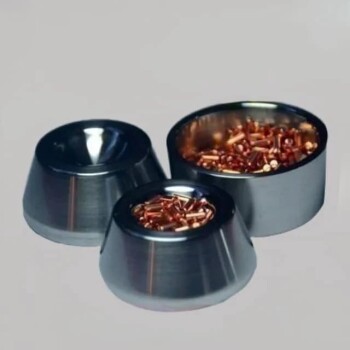
- Electron Beam Evaporation Coating Gold Plating Tungsten Molybdenum Crucible for Evaporation
- High Purity Pure Graphite Crucible for Evaporation
- High Purity Pure Graphite Crucible for Electron Beam Evaporation
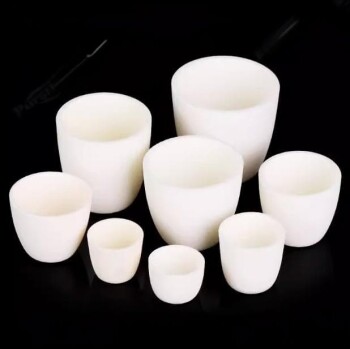
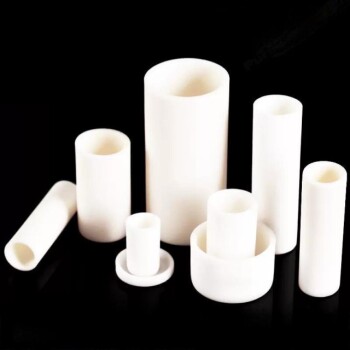
- Arc-Shaped Alumina Ceramic Crucible High Temperature Resistant for Engineering Advanced Fine Ceramics
- Engineering Advanced Fine Ceramics Alumina Al2O3 Crucible With Lid Cylindrical Laboratory Crucible
People Also Ask
- What is the container that holds the metal source material called in e-beam evaporation? Ensure Purity and Quality in Your Thin-Film Deposition
- What materials are used in electron beam evaporation? Master High-Purity Thin Film Deposition
- What is the process of e-beam coating? Achieve High-Purity, Precise Thin Films for Your Lab
- What is e-beam evaporation? Achieve High-Purity Thin Film Deposition for Your Lab
- What is the voltage of e-beam evaporation? Achieve Precise Thin-Film Deposition