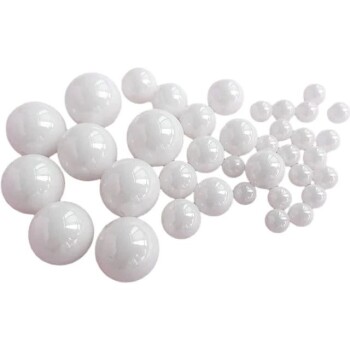
Zirconia is the definitive material of choice for grinding eggshells because it provides the necessary durability to withstand high-energy processing without contaminating the sample. By using zirconia jars and balls, researchers ensure that the eggshell powder retains its original chemical composition, which is essential for accurate downstream applications.
The core value of zirconia lies in its ability to protect sample purity. Its superior wear resistance prevents physical debris from entering the mix, while its chemical inertness ensures the calcium carbonate in eggshells remains unadulterated for processes like gypsum synthesis.
Preserving Sample Integrity
Eliminating Physical Contamination
Zirconia is selected primarily for its extreme hardness and superior wear resistance. Ultrafine grinding involves high-speed milling forces that can easily degrade softer grinding media.
When grinding media wears down, it sheds microscopic particles into the sample. Zirconia resists this abrasion effectively, preventing physical contamination even during the extended milling sessions required for ultrafine powders.
Ensuring Chemical Inertness
Eggshells are rich in natural calcium carbonate, a compound that must remain pure for applications such as gypsum synthesis. Zirconia is chemically inert, meaning it does not react with the sample material.
This neutrality ensures that the chemical structure of the eggshell powder remains exactly as it was in its raw state. There is no risk of leaching or chemical byproducts altering the sample's properties.
Optimizing for Ultrafine Particle Size
Withstanding Long-Duration Milling
Achieving an ultrafine particle size requires subjecting the material to extended periods of high-speed milling. This process generates significant heat and friction.
Zirconia’s structural integrity allows it to endure these harsh conditions without fracturing or degrading. This reliability ensures consistent results over long processing times.
Supporting High-Quality Synthesis
The purity of the ground eggshell directly impacts the quality of the final product, particularly in gypsum synthesis.
Any impurities introduced during the grinding stage would carry over into the synthesis process. Zirconia acts as a safeguard, ensuring the raw material maintains the high purity required for successful chemical conversion.
Common Pitfalls to Avoid
The Risk of Media Wear
A common oversight in milling is underestimating the impact of media wear on sample purity. Using materials softer than zirconia often results in a sample that is a mixture of the target material and grinding dust.
If the grinding balls degrade, the physical mass of your sample may appear to increase, but the chemical purity drops significantly. This "physical contamination" renders the sample useless for precision chemistry.
Ignoring Chemical Reactivity
Selecting a grinding material that is not chemically inert can lead to invisible contamination. Even if the media does not physically break, it may react with the calcium carbonate at a molecular level.
This type of contamination is difficult to detect visually but will skew analytical results and ruin synthesis reactions. Zirconia eliminates this variable entirely.
Making the Right Choice for Your Goal
To ensure your eggshell processing yields usable results, align your grinding media choice with your specific technical requirements.
- If your primary focus is High-Purity Synthesis: Rely on zirconia's chemical inertness to keep the calcium carbonate free from impurities for gypsum production.
- If your primary focus is Process Durability: Leverage zirconia's extreme hardness to prevent media wear during long, high-speed milling cycles.
By standardizing on zirconia, you eliminate the variable of contamination, ensuring your ultrafine powder is defined solely by the quality of your raw material.
Summary Table:
| Feature | Zirconia Performance | Benefit for Eggshell Grinding |
|---|---|---|
| Hardness | Extremely High | Prevents physical debris from entering the powder |
| Chemical Stability | Inert | Protects calcium carbonate purity for synthesis |
| Wear Resistance | Superior | Withstands long, high-energy milling cycles |
| Application | Ultrafine Processing | Ensures consistent, contaminant-free particle sizes |
Elevate Your Milling Precision with KINTEK
Don't let sample contamination compromise your research. KINTEK specializes in high-performance laboratory solutions, providing the industry-leading zirconia grinding jars and balls necessary for ultra-pure results.
Beyond our premium milling media, we offer a comprehensive range of crushing and milling systems, high-temperature furnaces, and hydraulic presses designed to meet the rigorous demands of material synthesis and laboratory preparation. Whether you are performing gypsum synthesis or advanced battery research, our team is ready to provide the durable, inert equipment your workflow requires.
Ready to achieve superior particle size reduction?
Contact KINTEK Experts Today to find the perfect equipment for your laboratory needs.
References
- Md. Sahadat Hossain, Samina Ahmed. Synthesis of gypsum fertilizer from waste eggshells for a sustainable environment. DOI: 10.1039/d2ma00810f
This article is also based on technical information from Kintek Solution Knowledge Base .
Related Products
- Laboratory Jar Ball Mill with Alumina Zirconia Grinding Jar and Balls
- Precision Machined Zirconia Ceramic Ball for Engineering Advanced Fine Ceramics
- Laboratory Jar Mill with Agate Grinding Jar and Balls
- Laboratory Ball Mill Jar Mill with Metal Alloy Grinding Jar and Balls
- Laboratory Four-Body Horizontal Jar Mill
People Also Ask
- What are the primary functions of using a ball mill for BZCY72 powder? Achieve High Purity and Enhanced Sintering
- In what way does a laboratory ball mill affect material properties when modifying PHBV/pulp fiber composites?
- Why is a laboratory ball mill required for ultra-fine fly ash? Unlock Nano-Scale Adsorption Power
- What is the function of a laboratory ball mill in the preparation of AMMCs? Optimize Dispersion & Grain Refinement
- What is the function of a laboratory ball mill in the pretreatment of waste tire char (WTC)? Optimize Material Reactivity