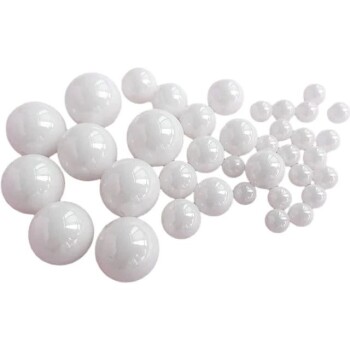
The strategic combination of zirconia grinding balls with different diameters is essential for optimizing the breakdown of carbon nitride from bulk material into uniform nanosheets. By utilizing a mix of sizes, such as 2mm and 0.2mm balls, the milling process simultaneously addresses the need for high-impact crushing of large particles and the fine dispersion of the resulting powder.
Core Insight: Using a single ball diameter forces a compromise between impact energy and contact frequency. Mixing diameters bridges this gap, ensuring that large particles are pulverized while fine powders are kept dispersed, resulting in a superior, uniform particle size distribution.
The Mechanics of Mixed-Media Milling
The Function of Large Balls
Large grinding balls (e.g., 2mm) provide the high impact energy necessary to fracture the initial bulk material.
Because of their greater mass, these balls generate significant kinetic energy upon collision. This energy is required to shatter the coarse carbon nitride agglomerates that smaller media would simply bounce off of.
The Function of Small Balls
Small grinding balls (e.g., 0.2mm) are responsible for fine grinding and dispersion.
Once the large chunks are broken down, the smaller balls fill the voids between the larger media. They provide a much higher frequency of contact points and shear forces, which are critical for refining the powder and preventing the nanosheets from clumping back together.
The Synergistic Effect
When used together, the different diameters creates a continuous reduction cycle.
The large balls handle the "heavy lifting" of size reduction, while the small balls immediately act on the resulting fragments. This prevents the inefficiency of a multi-stage process and ensures the material is treated uniformly throughout the milling run.
Optimizing for Carbon Nitride Properties
Enhancing Dispersibility
Carbon nitride tends to agglomerate (stick together) during processing.
The primary reference notes that the mixed-diameter approach significantly improves dispersibility. The constant agitation by the smaller balls ensures that as nanosheets are formed, they remain separated rather than compressing into new clusters.
Achieving Uniform Distribution
A critical quality metric for carbon nitride nanosheets is a narrow particle size distribution.
If only large balls were used, fine particles would be missed in the void spaces. If only small balls were used, large chunks would remain uncrushed. The combination ensures the final product is consistent, with fewer outliers in size.
The Role of Zirconia
The material choice of the media is just as important as the size.
Zirconia is selected for its high hardness and density. This density allows even the smaller balls to carry enough momentum to be effective, ensuring the milling process remains efficient even at the fine dispersion stage.
Understanding the Trade-offs
Process Complexity
Using mixed media can complicate the post-milling separation process.
Separating the grinding media from the final slurry—and separating the different sizes of balls from each other for re-use—requires more complex sieving or filtration steps than using a mono-sized medium.
The "Cushioning" Effect
There is a risk of diminishing returns if the ratio of sizes is incorrect.
If the volume of small balls is too high relative to the large balls, they may act as a "cushion," absorbing the impact energy of the large balls and reducing the efficiency of the initial crushing phase.
Making the Right Choice for Your Goal
To maximize the efficiency of your ball milling process, consider your specific starting material and desired end-product.
- If your primary focus is rapid size reduction of coarse bulk: Prioritize a higher ratio of large balls (e.g., 2mm) to maximize impact energy and fracture mechanics.
- If your primary focus is high-quality nanosheet dispersion: Ensure a sufficient volume of small balls (e.g., 0.2mm) to increase contact frequency and ensure a narrow particle size distribution.
By balancing impact energy with surface contact area, you transform a crude crushing process into a precise method for material synthesis.
Summary Table:
| Ball Size | Primary Function | Key Benefit | Mechanism |
|---|---|---|---|
| Large (e.g., 2mm) | Bulk Reduction | High Impact Energy | Shatters coarse carbon nitride agglomerates |
| Small (e.g., 0.2mm) | Fine Grinding | High Contact Frequency | Provides shear forces to prevent clumping |
| Mixed Media | Synergy | Uniform Distribution | Continuous cycle of fracturing and dispersing |
Maximize Your Milling Efficiency with KINTEK
Achieving perfect particle size distribution requires the right tools and expertise. KINTEK specializes in premium laboratory equipment, including high-performance crushing and milling systems, sieving equipment, and high-density zirconia grinding media.
Whether you are synthesizing carbon nitride nanosheets or developing advanced battery materials, our comprehensive range of planetary ball mills, PTFE products, and ceramic crucibles ensures your research is precise and repeatable. Our team helps target customers in material science and chemistry achieve superior dispersibility and material integrity.
Ready to optimize your lab's output?
Contact KINTEK today for a customized solution!
References
- Changchao Jia, Jian Liu. Facile assembly of a graphitic carbon nitride film at an air/water interface for photoelectrochemical NADH regeneration. DOI: 10.1039/d0qi00182a
This article is also based on technical information from Kintek Solution Knowledge Base .
Related Products
- Laboratory Jar Ball Mill with Alumina Zirconia Grinding Jar and Balls
- Precision Machined Zirconia Ceramic Ball for Engineering Advanced Fine Ceramics
- Laboratory Jar Mill with Agate Grinding Jar and Balls
- Laboratory Ball Mill Jar Mill with Metal Alloy Grinding Jar and Balls
- High Energy Planetary Ball Mill Milling Machine for Laboratory
People Also Ask
- What are the primary functions of using a ball mill for BZCY72 powder? Achieve High Purity and Enhanced Sintering
- In what way does a laboratory ball mill affect material properties when modifying PHBV/pulp fiber composites?
- Why is a laboratory ball mill required for ultra-fine fly ash? Unlock Nano-Scale Adsorption Power
- What is the function of a laboratory ball mill in the preparation of AMMCs? Optimize Dispersion & Grain Refinement
- What is the function of a laboratory ball mill in the pretreatment of waste tire char (WTC)? Optimize Material Reactivity