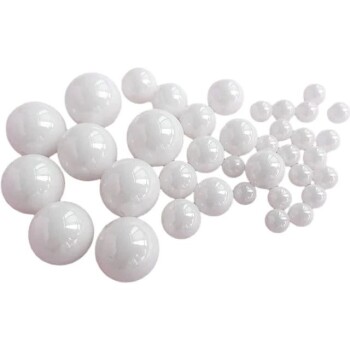
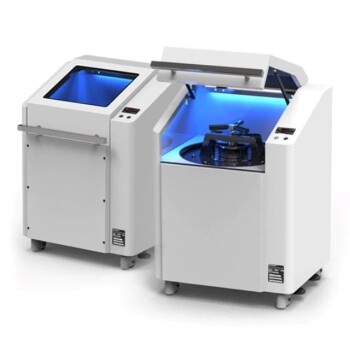
Zirconia grinding balls are the preferred media for milling Li10GeP2S12 (LGPS) because they uniquely balance high impact energy with chemical inertness. This specific combination allows for the aggressive pulverization required to synthesize LGPS without introducing metallic contaminants that would destroy the electrolyte's ionic conductivity.
The Core Insight Success in milling LGPS relies on high-energy mechanochemical synthesis, but the process cannot sacrifice purity. Zirconia is the industry standard because it delivers the necessary kinetic force to refine particles while preventing the introduction of performance-killing impurities like iron or chromium.
The Mechanics of High-Energy Synthesis
High Density Generates Kinetic Force
Milling LGPS is not just about mixing; it is a mechanochemical process. Zirconia balls possess a high density, which generates sufficient impact kinetic energy during rotation to facilitate material amorphization.
Lowering Reaction Activation Energy
The intense impact and shear forces applied by zirconia media significantly reduce the reaction activation energy of the raw materials (Li2S, P2S5, and GeS2). This establishes the necessary foundation for forming the correct crystalline phases during subsequent thermal treatments.
Nanometer-Scale Refinement
To achieve atomic-level mixing, the grinding media must be extremely hard. Zirconia’s exceptional hardness allows it to effectively crush and refine synthesized powders down to the micrometer or nanometer scale, increasing the specific surface area for better reactivity.
The Chemistry of Purity
Chemical Inertness is Critical
Sulfide solid-state electrolytes like LGPS are chemically sensitive. Zirconia is chemically inert, meaning it minimizes chemical interactions with the sulfide precursors during the milling process.
Eliminating Metallic Contamination
Standard grinding media, such as steel, would shed metallic impurities like iron or chromium due to wear. These impurities can trigger side reactions and significantly degrade the electrochemical stability of the final electrolyte.
Preserving Ionic Conductivity
The presence of foreign contaminants is a primary cause of reduced ionic conductivity in solid-state electrolytes. By using zirconia, you ensure that the high purity required for optimal electrical performance is maintained throughout the milling duration.
Understanding the Trade-offs
Wear Resistance vs. Indestructibility
While zirconia is selected for its superior wear resistance, it is not strictly indestructible. During extended high-energy milling (e.g., 5 to 12 hours), minimal wear may still occur.
The Nature of Potential Impurities
The "trade-off" with zirconia is favorable compared to alternatives. If zirconia media does wear, it introduces traces of zirconium oxide (ZrO2), which is generally less detrimental to the electrochemical performance of LGPS than the conductive metallic impurities (Fe, Cr) introduced by steel media.
Making the Right Choice for Your Goal
When setting up your milling protocol for LGPS or similar sulfide electrolytes, consider your specific objectives:
- If your primary focus is Maximizing Ionic Conductivity: Prioritize zirconia media to strictly prevent metallic contamination that hampers ion transport.
- If your primary focus is Process Stability: Rely on zirconia's hardness to maintain consistent particle refinement over long milling durations (5+ hours) without media degradation.
- If your primary focus is Synthesis Efficiency: Utilize the high density of zirconia to generate the kinetic energy needed to lower activation energy and accelerate amorphization.
By selecting zirconia, you are prioritizing the electrochemical integrity of the final solid-state battery cell.
Summary Table:
| Feature | Benefit for LGPS Milling | Why It Matters |
|---|---|---|
| High Density | Increases kinetic impact energy | Facilitates amorphization & reaction |
| Exceptional Hardness | Achieves nanometer-scale refinement | Enhances reactivity & surface area |
| Chemical Inertness | Prevents chemical interactions | Preserves sulfide electrolyte stability |
| Wear Resistance | Eliminates metallic contamination | Protects ionic conductivity (No Fe/Cr) |
Elevate Your Battery Research with KINTEK Precision Solutions
To achieve the highest ionic conductivity in LGPS solid-state electrolytes, the quality of your milling media and equipment is non-negotiable. KINTEK specializes in advanced laboratory equipment, providing high-density zirconia grinding balls, crushing and milling systems, and sieving equipment designed to prevent contamination and ensure atomic-level refinement.
Whether you are working on mechanochemical synthesis or preparing materials for high-temperature furnaces and hydraulic presses, our comprehensive range of tools—from planetary ball mills to battery research consumables—is engineered to meet the rigorous demands of material science.
Ready to optimize your milling protocol and maximize cell performance? Contact us today to discuss how KINTEK’s laboratory solutions can streamline your R&D process.
Related Products
- Laboratory Jar Ball Mill with Alumina Zirconia Grinding Jar and Balls
- Precision Machined Zirconia Ceramic Ball for Engineering Advanced Fine Ceramics
- Laboratory Ball Mill Jar Mill with Metal Alloy Grinding Jar and Balls
- High Energy Planetary Ball Mill Milling Machine for Laboratory
- High Energy Planetary Ball Mill Milling Machine for Laboratory
People Also Ask
- What are the primary functions of using a ball mill for BZCY72 powder? Achieve High Purity and Enhanced Sintering
- In what way does a laboratory ball mill affect material properties when modifying PHBV/pulp fiber composites?
- Why is a laboratory ball mill required for ultra-fine fly ash? Unlock Nano-Scale Adsorption Power
- What is the function of a laboratory ball mill in the preparation of AMMCs? Optimize Dispersion & Grain Refinement
- What is the function of a laboratory ball mill in the pretreatment of waste tire char (WTC)? Optimize Material Reactivity