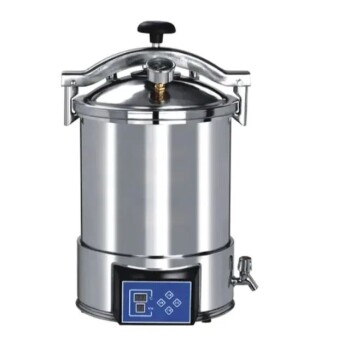
To accurately replicate the primary side environment of a Pressurized Water Reactor (PWR), an autoclave is strictly required to contain the necessary extreme physical conditions. Specifically, it allows researchers to sustain water temperatures around 300°C (up to 360°C) while maintaining the high pressure required to keep water in a liquid state. Beyond thermal physics, it provides the isolated environment needed to strictly control chemical boundary conditions, such as low dissolved oxygen and specific dissolved hydrogen concentrations.
The Core Insight Standard laboratory equipment cannot sustain the thermodynamics of a nuclear reactor without the water boiling off or the chemistry fluctuating. An autoclave is the only reliable tool to observe long-term corrosion kinetics and oxide film evolution under the specific thermo-chemical stresses found in a PWR primary loop.
Replicating Extreme Physical Conditions
Achieving Reactor-Grade Temperatures
The primary function of the autoclave is to simulate the thermal environment of a PWR, typically operating at approximately 300°C.
Without a pressurized vessel, water would boil at 100°C, making it impossible to test materials in the liquid phase required for primary circuit simulation.
Maintaining High Pressure
To keep water in a liquid state at these extreme temperatures, the autoclave must maintain significant pressure (often exceeding 6 MPa or 80 bar).
This pressure is not just a byproduct; it is a critical component of the physical stress applied to materials like SA-508 steel and stainless steel cladding during testing.
Controlling the Chemical Environment
Strict Dissolved Gas Management
Accurate PWR simulation requires maintaining precise chemical boundary conditions, specifically regarding dissolved gases.
The autoclave environment allows for low dissolved oxygen levels and controlled dissolved hydrogen concentrations. These parameters are critical for determining the electrochemical potential and the resulting corrosion mechanism.
Coolant Chemistry Stability
Beyond gases, the autoclave facilitates the inclusion of specific chemical additives found in reactor coolant, such as boron, lithium, and zinc.
By maintaining these concentrations over long periods, researchers can observe how the coolant chemistry interacts with the material surface to form or degrade protective oxide films.
Ensuring Data Integrity
Preventing External Contamination
Advanced autoclaves often utilize inert linings, such as titanium, to ensure the test environment remains pure.
This prevents metal ions from the autoclave body itself from leaching into the water, which would otherwise contaminate the solution and invalidate the corrosion data for the test specimen.
Dynamic Flow Simulation
In "refreshed" autoclave systems, a circulating flow loop continuously updates the solution within the vessel.
This mimics the dynamic flow of a primary coolant loop, preventing the local accumulation of impurities or salts that occurs in static tests.
Understanding the Trade-offs
While autoclaves are essential, the method of deployment introduces specific variables that must be managed.
Static vs. Refreshed Systems
A static autoclave is simpler but risks chemical stratification; as corrosion occurs, the local chemistry near the sample changes, potentially skewing long-term data.
A refreshed (circulating) system provides higher accuracy by constantly renewing the chemistry, but it requires complex pumping systems capable of handling high pressures and temperatures.
The "Vessel Effect"
If the autoclave material is not significantly more corrosion-resistant than the sample (or lined with an inert material like titanium), the vessel itself will corrode.
This effectively turns the vessel into a "sacrificial anode" or a source of contamination, altering the electrochemical measurements of the actual test specimen.
Making the Right Choice for Your Goal
To ensure your corrosion data is applicable to real-world PWR operations, align your equipment choice with your specific testing parameters:
- If your primary focus is basic screening of material compatibility: A static autoclave may suffice, provided the test duration is short enough to avoid significant chemical drift.
- If your primary focus is precise kinetic data or oxide film evolution: You must use a refreshed (circulating) autoclave system to prevent impurity accumulation and simulate coolant flow.
- If your primary focus is trace analysis of the oxide layer: Ensure the autoclave utilizes a titanium lining or similar inert material to eliminate background contamination from the vessel walls.
Ultimately, the validity of your corrosion data depends entirely on the autoclave's ability to maintain thermodynamic and chemical stability over time.
Summary Table:
| Feature | PWR Requirement | Autoclave Capability |
|---|---|---|
| Temperature | 300°C - 360°C | High-thermal heating & stability |
| Phase Control | Liquid phase at >100°C | Pressurization (up to 80+ bar) |
| Chemistry | Low Oxygen / Controlled Hydrogen | Isolated, gas-tight environment |
| Purity | No external metal contamination | Inert linings (e.g., Titanium) |
| Coolant Flow | Continuous circulation | Refreshed/Dynamic flow systems |
Elevate Your Nuclear Research with KINTEK Precision
To achieve valid corrosion kinetics and oxide film data, your lab requires the highest standards of thermodynamic and chemical stability. KINTEK specializes in advanced laboratory solutions, including high-temperature high-pressure reactors and autoclaves specifically designed to simulate extreme environments like the PWR primary loop.
Whether you need titanium-lined vessels for trace analysis or refreshed systems for dynamic flow simulation, our expert team provides the equipment and consumables—from ceramics to precision shakers—to ensure your data integrity.
Ready to upgrade your testing capabilities? Contact us today to discuss your custom reactor needs!
References
- Sung Woo Kim, Hong-Pyo Kim. EVALUATION OF GALVANIC CORROSION BEHAVIOR OF SA-508 LOW ALLOY STEEL AND TYPE 309L STAINLESS STEEL CLADDING OF REACTOR PRESSURE VESSEL UNDER SIMULATED PRIMARY WATER ENVIRONMENT. DOI: 10.5516/net.07.2011.054
This article is also based on technical information from Kintek Solution Knowledge Base .
Related Products
- Portable High Pressure Laboratory Autoclave Steam Sterilizer for Lab Use
- Stainless High Pressure Autoclave Reactor Laboratory Pressure Reactor
- Desktop Fast High Pressure Laboratory Autoclave Sterilizer 16L 24L for Lab Use
- Mini SS High Pressure Autoclave Reactor for Laboratory Use
- Laboratory High Pressure Steam Sterilizer Vertical Autoclave for Lab Department
People Also Ask
- Why is a laboratory high-pressure autoclave sterilizer necessary? Ensure Accuracy in Antibacterial Research
- What is the role of a laboratory high-pressure autoclave in the conversion of furfural to piperidine? Optimize Yields
- What are the two types of autoclave used in the laboratory? Gravity vs. Pre-Vacuum Explained
- What precautions should be taken during autoclave in laboratory? A Complete Safety Guide to Prevent Burns and Explosions
- What extreme conditions does a laboratory autoclave simulate? Testing Wear Resistance of Nuclear Fuel Cladding