The application of continuous uniaxial stacking pressure is the fundamental mechanical stabilizer for Nb2O5 solid-state batteries. Without this external force, the rigid internal components cannot accommodate the physical changes that occur during operation, leading to rapid performance degradation.
Core Takeaway Solid-state electrolytes lack the fluid ability to fill gaps created when active materials change size. Continuous pressure (typically exceeding 2 MPa) is required to forcefully maintain physical contact between the electrode and electrolyte, preventing the formation of voids that block ion transport and cause capacity fade.
The Physical Challenge: The "Breathing" Electrode
To understand why pressure is non-negotiable, you must first understand the behavior of the active material at the microscopic level.
Volume Expansion and Contraction
During the cycling process (lithiation and delithiation), active materials like Nb2O5 undergo significant physical changes. They effectively "breathe"—expanding when ions enter the lattice structure and contracting when ions leave.
The Rigidity Mismatch
In a liquid battery, the electrolyte flows to fill any space created when the electrode shrinks. In a solid-state battery, the electrolyte is rigid.
When the active material contracts without external pressure, it pulls away from the solid electrolyte. This physical separation creates microscopic gaps or voids at the interface.
How Hydraulic Pressure Solves the Problem
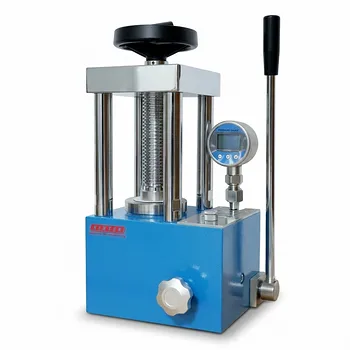
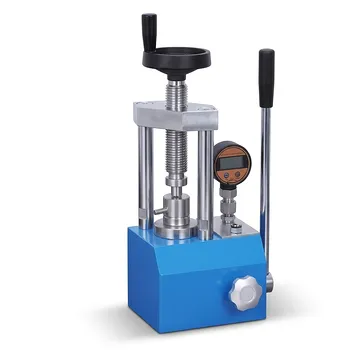
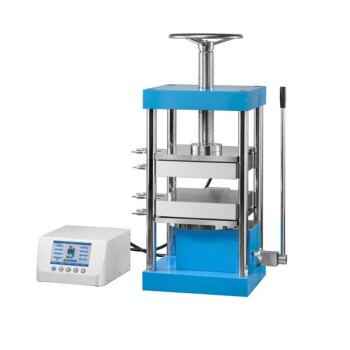
Hydraulic presses or pressure molds are used to apply a continuous uniaxial force to counteract these chemo-mechanical effects.
Maintaining Interface Integrity
By applying continuous stacking pressure, typically exceeding 2 MPa, you mechanically force the active material and the solid electrolyte to remain in contact.
This external force effectively "follows" the contraction of the material. It ensures that even as the Nb2O5 particles shrink, the electrolyte interface is pressed tight against them.
Preventing Ionic Isolation
The primary failure mode in unpressurized solid-state cells is contact failure.
If a void forms between the particle and the electrolyte, ions can no longer bridge that gap. The active material on the other side of the void becomes electrically isolated and contributes nothing to the battery's capacity.
Ensuring Structural Homogeneity
Beyond the particle level, pressure prevents macro-level failures. It consolidates the monolithic battery structure, preventing the delamination of entire layers.
This is critical for minimizing interfacial impedance and ensuring that the resistance within the cell does not increase irreversibly over time.
Distinct Pressures for Distinct Stages
It is vital to distinguish between the pressure required for manufacturing versus the pressure required for cycling.
Fabrication: High-Pressure Densification
During the initial creation of the cell (cold-press molding), extreme pressure is used—often as high as 370 MPa.
The goal here is densification: eliminating internal porosity, reducing grain boundary resistance, and ensuring cathode particles are tightly embedded within the electrolyte to begin with.
Operation: Continuous Retention Pressure
During cycling, the pressure requirement is lower (often > 2 MPa) but must be continuous.
The goal here is retention: counteracting volume changes to maintain the contact established during fabrication. A static mold is often insufficient; the system must be capable of maintaining pressure dynamically as the cell breathes.
Making the Right Choice for Your Goal
The application of pressure is not a "one-size-fits-all" parameter; it depends on the stage of your battery development.
- If your primary focus is fabrication and assembly: Use high-pressure regimes (e.g., ~370 MPa) to maximize density and minimize initial grain boundary resistance.
- If your primary focus is cycle life testing: Implement a hydraulic jig capable of maintaining > 2 MPa continuously to prevent contact loss during lithiation/delithiation cycles.
- If your primary focus is diagnosing failure mechanisms: Compare cycled cells with and without pressure to distinguish between chemical degradation and mechanical contact failure.
Ultimately, continuous pressure substitutes for the lack of fluidity in solid electrolytes, acting as the bridge that keeps the battery's internal chemistry connected and functional.
Summary Table:
| Pressure Type | Purpose | Typical Force | Key Benefit |
|---|---|---|---|
| Fabrication (Cold-Press) | Densification & Porosity Removal | ~370 MPa | Reduces grain boundary resistance and maximizes density. |
| Cycling (Operation) | Contact Retention | > 2 MPa (Continuous) | Counteracts volume expansion/contraction to prevent voids. |
| Dynamic Adjustment | Mechanical Stability | Variable | Maintains interface integrity as the electrode 'breathes'. |
Advance Your Solid-State Battery Research with KINTEK
Don't let mechanical contact failure compromise your battery performance. KINTEK specializes in precision laboratory equipment designed to meet the rigorous demands of solid-state research. From high-pressure hydraulic pellet presses and isostatic presses for cell fabrication to specialized pressure molds for dynamic cycling, we provide the tools necessary to stabilize your electrochemical interfaces.
Our comprehensive range includes:
- Hydraulic Presses & Molds: Achieve up to 370 MPa for perfect densification.
- High-Temperature Equipment: Muffle, tube, and vacuum furnaces for material synthesis.
- Advanced Battery Tools: Electrolytic cells, electrodes, and consumables for precise testing.
Ready to optimize your Nb2O5 battery cycling? Contact our experts today to find the perfect mechanical stabilization solution for your lab.
Related Products
- Heated Hydraulic Press Machine with Heated Plates for Vacuum Box Laboratory Hot Press
- Automatic High Temperature Heated Hydraulic Press Machine with Heated Plates for Lab
- Manual High Temperature Heated Hydraulic Press Machine with Heated Plates for Lab
- Heated Hydraulic Press Machine with Integrated Manual Heated Plates for Lab Use
- 24T 30T 60T Heated Hydraulic Press Machine with Heated Plates for Laboratory Hot Press
People Also Ask
- Why is a heated laboratory hydraulic press necessary for composite laminates? Achieve Void-Free Structural Integrity
- Why is the heating function of a laboratory hydraulic press essential for MEA assembly in DEFC? Optimize Cell Bonding
- What technical conditions does a heated hydraulic press provide for PEO batteries? Optimize Solid-State Interfaces
- What are heated hydraulic presses used for? Molding Composites, Vulcanizing Rubber, and More
- What is the core function of a laboratory heated hydraulic press in CSP? Revolutionize Low-Temp Ceramic Sintering