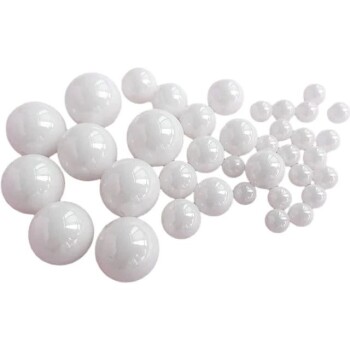
The use of zirconia grinding balls is strictly necessary to solve the dual challenge of milling efficiency and chemical purity. Their high density provides the required impact kinetic energy to fracture hard particles like Silicon Carbide (SiC), while their chemical stability ensures that abrasive wear does not introduce foreign contaminants into the mixture.
Core Takeaway Processing advanced ceramics requires a grinding medium that is harder than the powder being milled but chemically compatible with it. Zirconia balls provide the mass needed to pulverize hard agglomerates without adding metallic impurities or foreign oxides that would degrade the material's final properties.
The Physics of Efficient Milling
Generating High Impact Kinetic Energy
To effectively mix and refine hard ceramic powders, the grinding media must possess significant mass. Zirconia is a high-density material, which translates directly into higher kinetic energy during the milling process.
When the balls collide with the powder, this extra mass delivers a forceful impact. This is critical for breaking down harder components, such as Silicon Carbide (SiC), and refining them to the micrometer or nanometer scale.
Ensuring Uniform Homogenization
A composite powder containing Hexagonal Boron Nitride (h-BN), SiC, and ZrO2 requires distinct components to be mixed perfectly. The high impact force of zirconia balls prevents the segregation of these powders.
This energy effectively breaks up agglomerates (clumps of particles) that naturally form during handling. A uniform mixture is the prerequisite for achieving a consistent microstructure during the subsequent sintering phase.
Preserving Chemical Purity
The "Like-for-Like" Advantage
A critical reason for using zirconia balls in this specific mixture is that the target composite already contains Zirconia (ZrO2).
All grinding media experience some degree of wear over time. If zirconia balls degrade slightly during the process, the "contaminant" introduced is simply more Zirconia—a material already present in your recipe. This effectively eliminates the risk of introducing a foreign substance.
Superior Wear Resistance
Zirconia is extremely hard and wear-resistant. In long-duration milling operations (which can last several hours), softer media would degrade rapidly.
Zirconia's resistance significantly reduces the volume of wear debris generated in the first place. This maintains the precise stoichiometry (chemical balance) of your h-BN composite powders.
Chemical Inertness
The chemical stability of zirconia prevents it from reacting with the powder components. This is vital for maintaining the "chemical inertia" of the system.
It specifically prevents the introduction of metallic impurities (such as iron or chromium from steel balls), which are notorious for causing side reactions or degrading the electrical and mechanical performance of the final ceramic.
Common Pitfalls to Avoid
The Risk of Low-Density Media
Using lighter media, such as alumina, often results in insufficient impact energy. This leads to incomplete milling, where hard particles like SiC are not fully fractured or dispersed, resulting in a weak final product.
The Danger of Metallic Media
Attempting to mill these ceramics with steel balls introduces metallic contamination. Even trace amounts of metal can act as flaws in the ceramic microstructure, drastically reducing the material's strength and dielectric properties.
Making the Right Choice for Your Goal
To ensure your milling process yields a high-performance composite, align your media choice with your specific processing objectives:
- If your primary focus is Structural Integrity: Use zirconia to ensure sufficient impact energy breaks down SiC particles for a flaw-free sintered microstructure.
- If your primary focus is Chemical Purity: Rely on zirconia to ensure that any inevitable media wear only adds a compatible oxide (ZrO2) rather than foreign contaminants.
The use of zirconia media turns the inevitable physics of wear into a controlled variable, ensuring your composite remains pure and properly refined.
Summary Table:
| Feature | Zirconia Grinding Balls | Impact on h-BN/SiC/ZrO2 Milling |
|---|---|---|
| High Density | ~6.0 g/cm³ | Provides high kinetic energy to fracture hard SiC particles. |
| Chemical Compatibility | Same as ZrO2 component | Eliminates foreign contamination from media wear. |
| High Hardness | Exceptional wear resistance | Reduces debris and maintains precise powder stoichiometry. |
| Chemical Inertness | Non-reactive | Prevents metallic contamination and unwanted side reactions. |
Elevate Your Advanced Material Synthesis with KINTEK
Achieve uncompromising purity and optimal particle size distribution in your ceramic composites. KINTEK specializes in premium laboratory equipment, offering high-performance zirconia grinding media and advanced crushing and milling systems designed for the most demanding research applications.
Whether you are processing h-BN, SiC, or developing the next generation of battery materials, our comprehensive range of high-temperature furnaces, isostatic presses, and PTFE consumables ensures your lab operates at peak efficiency.
Ready to optimize your milling process? Contact KINTEK today to discuss our customized solutions for your laboratory's success!
Related Products
- Laboratory Jar Ball Mill with Alumina Zirconia Grinding Jar and Balls
- Precision Machined Zirconia Ceramic Ball for Engineering Advanced Fine Ceramics
- Laboratory Jar Mill with Agate Grinding Jar and Balls
- Laboratory Ball Mill Jar Mill with Metal Alloy Grinding Jar and Balls
- Laboratory Micro Tissue Grinding Mill Grinder
People Also Ask
- What are the primary functions of using a ball mill for BZCY72 powder? Achieve High Purity and Enhanced Sintering
- In what way does a laboratory ball mill affect material properties when modifying PHBV/pulp fiber composites?
- Why is a laboratory ball mill required for ultra-fine fly ash? Unlock Nano-Scale Adsorption Power
- What is the function of a laboratory ball mill in the preparation of AMMCs? Optimize Dispersion & Grain Refinement
- What is the function of a laboratory ball mill in the pretreatment of waste tire char (WTC)? Optimize Material Reactivity