The Unforgiving Nature of Clarity
In the laboratory, we often mistake durability for invincibility. We assume that because a tool can withstand harsh chemicals or high voltages, it can withstand us.
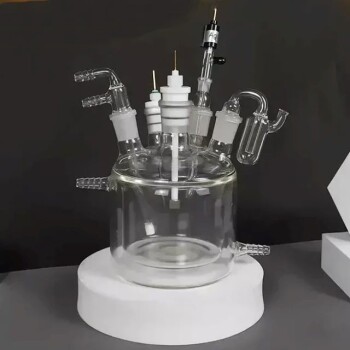
This is the great paradox of the all-quartz electrolytic cell.
Scientifically, quartz is a miracle material. It offers exceptional optical clarity and chemical purity, allowing us to peer into electrochemical processes with zero interference. But physically, it is brutally unforgiving. It tolerates no clumsiness, no thermal impatience, and no cleaning shortcuts.
The difference between a breakthrough experiment and a pile of expensive shards usually comes down to a single moment of inattention.
To master this tool, we must move beyond simple "usage" and adopt a mindset of stewardship. Here is how to navigate the fragility of high-precision science.
The Ritual of Inspection
Most equipment failures happen before the experiment even begins. They happen in the assumption that "it was fine yesterday."
Quartz is brittle. It does not bend; it shatters. A micro-crack, invisible to a casual glance, becomes a catastrophic structural failure once heat or stress is applied.
Before every use, perform a deliberate audit:
- The Physical Body: Scan for micro-cracks or chips. If you find a flaw, the cell is compromised. Do not use it.
- The Optical Window: This is the lens through which you measure truth. Check for smudges or residue. Even a fingerprint is a contaminant that distorts your baseline.
- The Electrodes: Verify they are clean and the geometry is intact.
The Human Element: Handling and Environment
The greatest variable in any lab environment is not the chemical, but the chemist.
Your hands are covered in oils that act as contaminants. Your movements carry kinetic energy that quartz cannot absorb. The discipline here is physical.
The "No-Touch" Policy
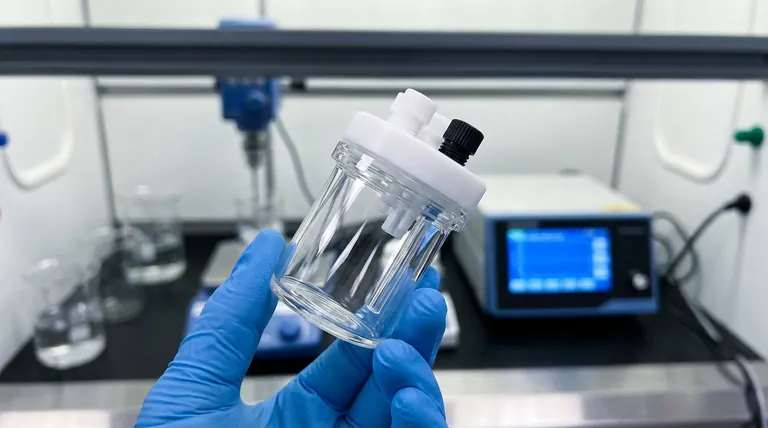
The optical windows are sacred ground. Never touch them with bare hands. Skin oils absorb UV light and alter spectral data. Always use clean gloves, and handle the cell by the frosted body, not the polished faces.
The Thermal Shock Trap
Quartz resists heat, but it hates speed.
We often rush to cool things down or heat things up. Rapid temperature changes create differential expansion—stress that the rigid crystal lattice cannot absorb. The result is immediate cracking.
Treat temperature changes like a deep-sea dive: ascent and descent must be slow and controlled.
The Air We Breathe
Electrolysis is rarely benign. It generates gases and requires electrolytes that are hazardous to human tissue.
Ventilation is not optional. A fume hood is your primary line of defense. If you cannot control the atmosphere, you cannot control the safety of the operator.
The Chemistry of Maintenance
Cleaning is where well-intentioned scientists destroy their equipment.
There is a temptation to scrub hard residues or mix strong chemicals to speed up the process. In the context of a quartz cell, this is destructive behavior.
The Golden Rules of Cleaning:
- Ban Abrasives: A metal brush or a rough pad is a death sentence for an optical window. A scratch is not just cosmetic; it is a permanent data error.
- The Mixing Danger: Never mix acidic and alkaline cleaners (like nitric acid and sodium hydroxide) inside the cell. The resulting exothermic reaction produces heat faster than the quartz can dissipate it. You risk an explosion and the loss of the cell.
- Light Discipline: When the cell is idle, cover it. Prolonged exposure to high-intensity light can degrade the material properties over time.
Aligning Protocol with Purpose
How you handle the cell depends on what you are trying to protect. While all precautions matter, your specific focus dictates your immediate priorities.
- If you prioritize Safety: Focus on ventilation and chemical compatibility. The "Acid + Base" rule is your primary directive.
- If you prioritize Data Integrity: Focus on the optical windows. Gloves, residue checks, and contamination control are paramount.
- If you prioritize Equipment Longevity: Focus on thermal management and gentle physical handling.
Summary of Protocols
Here is the operational framework for maintaining the integrity of your quartz equipment:
| Precaution Category | Key Action | Primary Benefit |
|---|---|---|
| Physical Handling | Handle gently; inspect for micro-cracks | Prevents catastrophic breakage |
| Contamination Control | Wear gloves; avoid touching optical windows | Ensures data integrity and accuracy |
| Thermal Management | Avoid rapid temperature changes | Prevents thermal shock and cracking |
| Chemical Safety | Never mix acidic and alkaline cleaners | Eliminates risk of dangerous reactions |
| Cleaning & Maintenance | Use non-abrasive tools only | Protects quartz surfaces from scratches |
Engineering the Perfect Experiment
The tools we use shape the data we collect. An all-quartz cell is a statement that you care about the purity of your results. It requires a partner who understands both the science and the fragility of the medium.
At KINTEK, we specialize in the high-purity lab equipment that serious research demands. We understand that your equipment is an investment in truth.
Contact Our Experts to discuss how our quartz solutions can elevate your electrochemical analysis while ensuring safety and longevity.
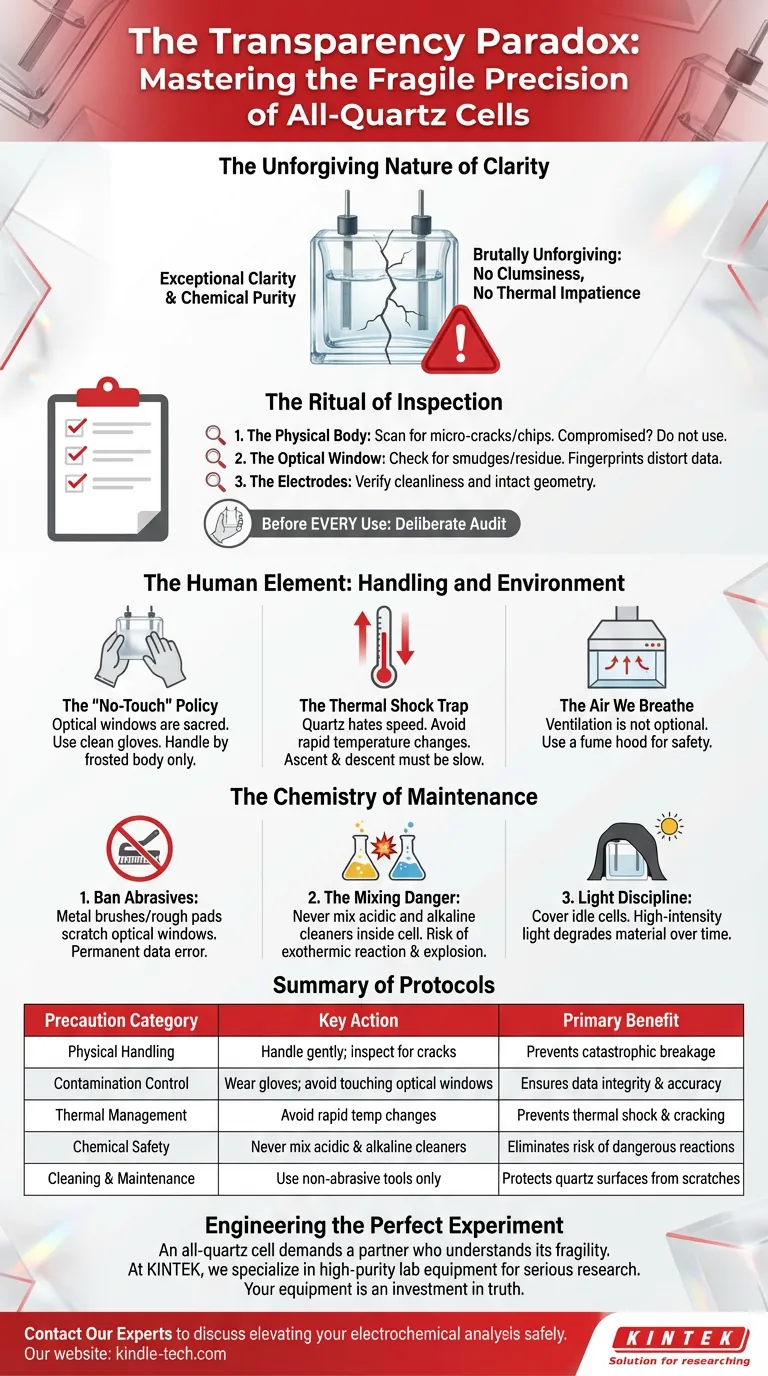
Visual Guide
Related Products
- Quartz Electrolytic Electrochemical Cell for Electrochemical Experiments
- Optical Window Glass Substrate Wafer Quartz Plate JGS1 JGS2 JGS3
- Flat Corrosion Electrolytic Electrochemical Cell
- High Temperature Resistant Optical Quartz Glass Sheet
- Thin-Layer Spectral Electrolysis Electrochemical Cell
Related Articles
- The Architecture of Silence: Why Quartz Defines Electrochemical Precision
- The Geometry of Control: Why Millimeters Matter in Electrochemistry
- The Art of the Empty Vessel: Preparing Quartz Electrolytic Cells for Absolute Precision
- The Architecture of Transparency: Mastering Safety and Precision in Quartz Electrolysis
- Understanding Quartz Electrolytic Cells: Applications, Mechanisms, and Advantages