The Variable You Forgot to Control
There is a fundamental rule in systems engineering: Reliability is the absence of unwanted surprises.
In the laboratory, we obsess over variables. We calculate electrolyte concentrations to the micro-molar. We polish electrodes until they mirror our determination. We regulate current with surgical precision.
But often, we ignore the stage upon which this drama unfolds—the cell itself.
We treat the container as a passive bucket. This is a mistake. In the high-stakes environment of electrochemistry, the material of your cell is not just a holder; it is an active participant in your data’s integrity.
If your cell reacts, leaks current, or clouds your view, your data is noise.
This is why quartz (fused silica) is not a luxury. In demanding applications, it is an engineering necessity.
The Art of Doing Nothing
The most important feature of an electrolytic cell is its ability to do absolutely nothing.
When you are working with strong acids or aggressive bases, standard borosilicate glass can struggle. It may leach trace ions into your solution. In trace analysis or high-purity synthesis, these leached ions are ghosts in the machine—false signals that ruin months of work.
Quartz is chemically agnostic.
Composed of high-purity silicon dioxide (SiO₂), it offers an environment of unwavering chemical stability. It does not judge the electrolyte; it simply holds it.
- It resists corrosion.
- It prevents leaching.
- It ensures the reaction you see is the reaction you planned.
Withstanding the Heat of the Moment
Electrochemistry is rarely a cold process.
Resistance generates heat (Joule heating). High-energy electrolysis pushes temperatures upward rapidly. Standard glass expands when heated. If the expansion is uneven, stress builds up. Eventually, the material fails.
A shattered cell is not just a cleanup problem; it is a safety hazard and a catastrophic loss of samples.
Quartz possesses an incredibly low coefficient of thermal expansion. It can withstand extreme thermal shock that would shatter lesser materials.
It maintains its structural integrity when the heat rises, allowing you to focus on the chemistry, not the containment.
The Electrical Firewall
The principle of electrolysis is simple: direct the flow of electrons through an electrolyte to drive a reaction.
Electricity, however, follows the path of least resistance. If your cell material is conductive or breaks down under voltage, you lose current. You create short circuits. You lose efficiency.
Quartz functions as a superior electrical insulator.
It acts as a firewall, confining the electrical path strictly to the electrolyte. It ensures that every joule of energy you pump into the system is directed toward the chemical transformation you desire, not wasted on the container walls.
The Window into the Invisible
Modern science is rarely about just looking at the end product. It is about understanding the process.
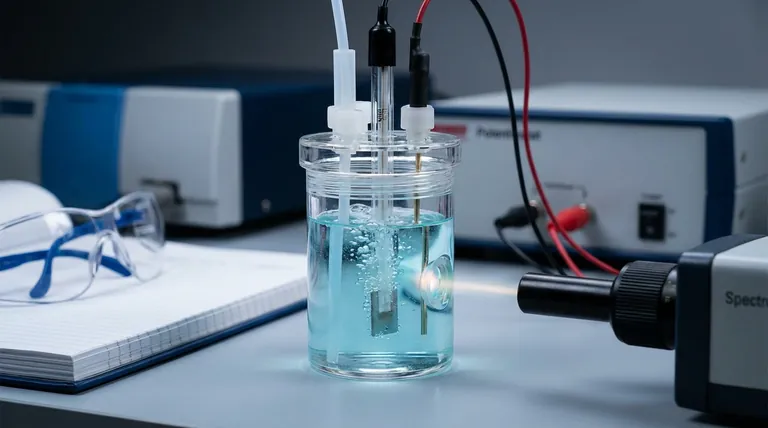
To do this, we use spectroscopy—shining light through the reaction to identify intermediate species in real-time.
Standard glass blocks UV light. It blinds you to a significant portion of the spectrum.
Quartz is optically transparent from the deep ultraviolet (UV) to the infrared (IR). It creates a "clear window" into the molecular world.
This allows for in-situ analysis, letting researchers watch the reaction unfold with clarity that other materials simply cannot provide.
The Hidden Cost of "Good Enough"
If quartz is so superior, why doesn't everyone use it?
Two reasons: Brittleness and Cost.
Quartz is hard, but it is brittle. It requires respect. A drop to the floor is fatal. Furthermore, fabricating high-purity quartz is difficult, making it more expensive than common glassware.
But here is the psychological trap, the kind Morgan Housel warns about in finance: We often confuse "price" with "cost."
The price of a quartz cell is higher. But what is the cost of a failed experiment? What is the cost of contaminated data that leads you down the wrong research path for six months?
Cheap materials are often the most expensive component in a laboratory because they introduce doubt.
Summary of Capabilities
Here is how quartz translates physical properties into engineering advantages:
| Property | The Engineering Advantage |
|---|---|
| Chemical Inertness | Eliminates cross-contamination; creates a "silent" background for reactions. |
| Thermal Resilience | Withstands Joule heating and thermal shock without structural failure. |
| Electrical Insulation | Prevents current leakage; maximizes energy efficiency. |
| Optical Clarity (UV-IR) | Enables full-spectrum spectroscopic monitoring without blind spots. |
Choosing Certainty
You don't buy quartz because you want a fancy container. You buy it because you want the truth.
If your work demands general-purpose utility on a budget, borosilicate glass is a fine tool. But if your work demands precision, purity, and the ability to see the unseen, there is no substitute for quartz.
At KINTEK, we understand the engineer's need for reliability. We don't just supply equipment; we supply the peace of mind that comes from knowing your equipment won't be the variable that fails you.
Whether you are running high-temperature syntheses or delicate analytical studies, our quartz solutions are built to disappear—leaving you with nothing but your results.
Contact Our Experts to discuss how we can help you build a more reliable experimental setup.
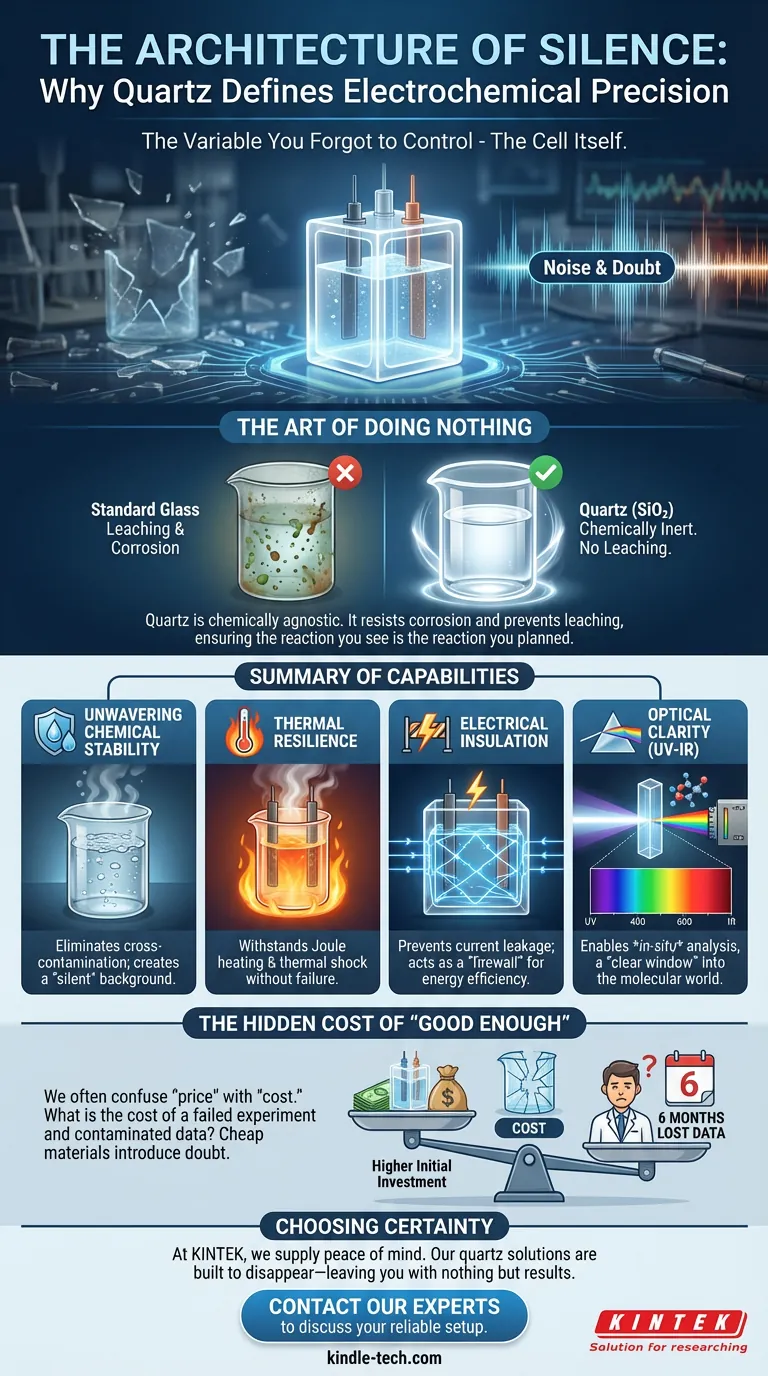
Visual Guide
Related Products
- Quartz Electrolytic Electrochemical Cell for Electrochemical Experiments
- Electrolytic Electrochemical Cell with Five-Port
- PTFE Electrolytic Cell Electrochemical Cell Corrosion-Resistant Sealed and Non-Sealed
- Electrolytic Electrochemical Cell for Coating Evaluation
- Flat Corrosion Electrolytic Electrochemical Cell
Related Articles
- The Geometry of Control: Why Millimeters Matter in Electrochemistry
- The Art of the Empty Vessel: Preparing Quartz Electrolytic Cells for Absolute Precision
- The Architecture of Transparency: Mastering Safety and Precision in Quartz Electrolysis
- Understanding Quartz Electrolytic Cells: Applications, Mechanisms, and Advantages
- The Invisible Variable: Why Cell Geometry Defines Electrochemical Success