The Invisible Framework of Discovery
In the high-stakes world of spectroelectrochemistry, we often obsess over the headline acts. We scrutinize the sensitivity of the spectrometer. We fret over the noise levels of the potentiostat. We spend hours refining the chemical purity of the reagents.
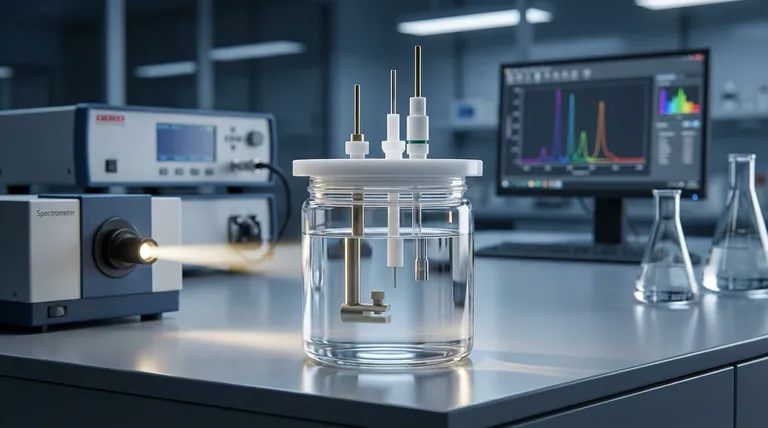
Yet, we often ignore the stage upon which this performance happens: the optical electrolytic cell.
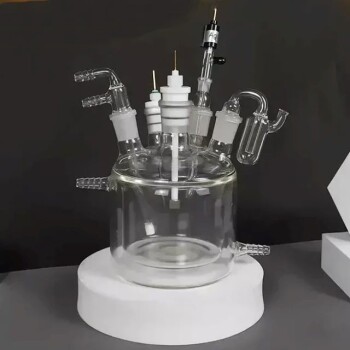
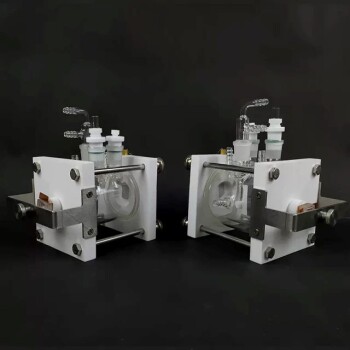
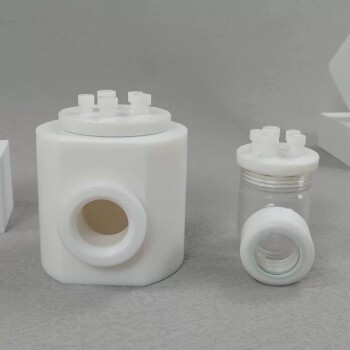
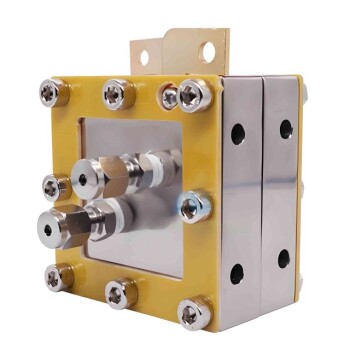
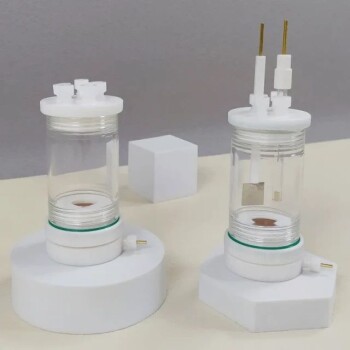
It is easy to view the cell as a mere container—a bucket for chemicals. But to an engineer, a side-window electrolytic cell is not a bucket. It is a controlled environment. It is a system of constraints designed to force nature to reveal its secrets.
When you look at the specifications of a KINTEK cell, you aren't just seeing numbers. You are seeing a codified logic for experimental success.
The Psychology of Volume
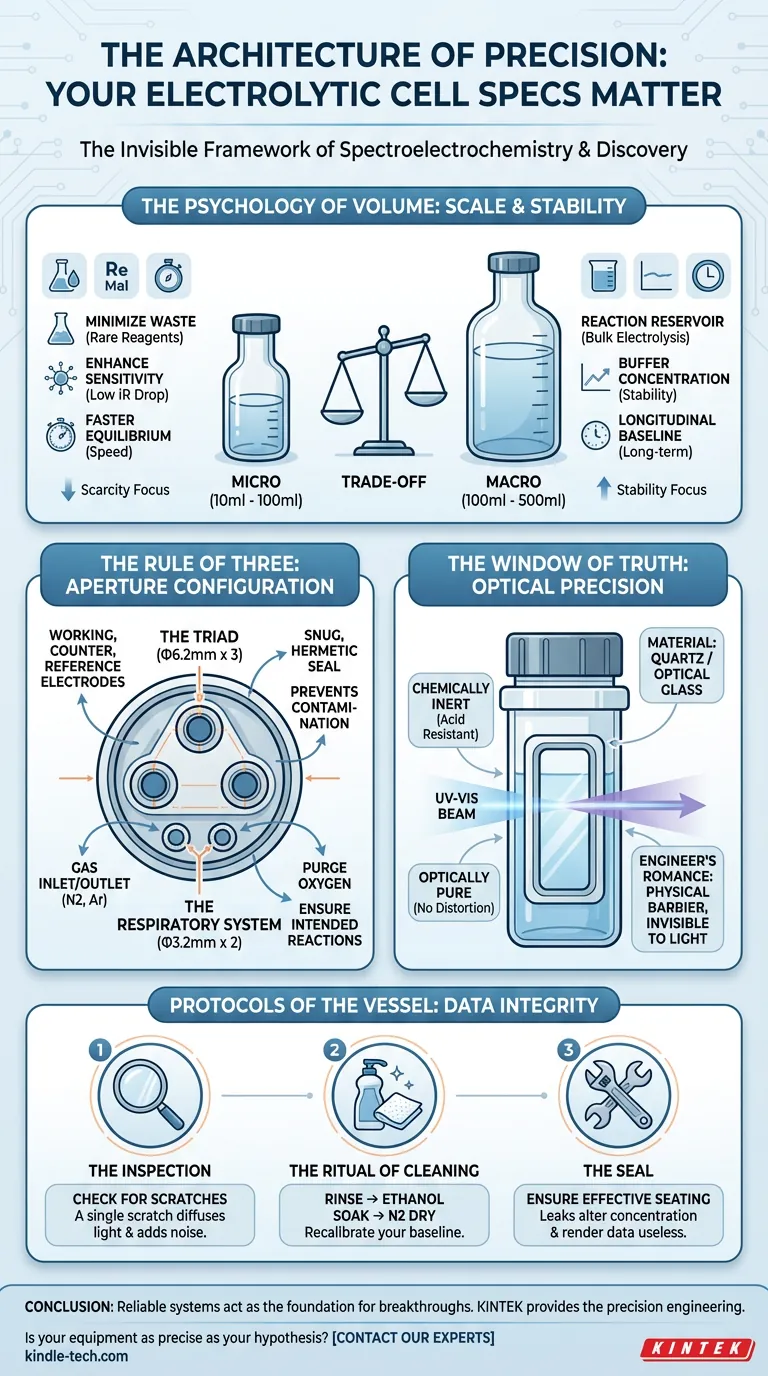
The first decision in any experiment is scale. The typical volume range of 10ml to 500ml represents a fundamental trade-off in research psychology: scarcity versus stability.
The Case for Micro (10ml - 100ml) In analytical chemistry, less is often more. When you are working with rare earth metals or synthesizing expensive organic compounds, volume is a liability.
- Economy: You minimize waste.
- Sensitivity: You reduce the distance between electrodes, minimizing resistance (iR drop).
- Speed: Smaller volumes reach equilibrium faster.
The Case for Macro (100ml - 500ml) Conversely, bulk electrolysis requires a reservoir. If you are studying long-term stability or synthesizing a product, you need a "thermal mass" equivalent for chemistry. A larger volume buffers against rapid concentration changes, providing a stable baseline for longitudinal studies.
The Rule of Three: Aperture Configuration
Standardization is the greatest friend of reproducibility. The aperture configuration of a side-window cell is not arbitrary; it is an architectural homage to the three-electrode system.
Most functional setups follow a strict geometric logic:
- The Triad (Φ6.2mm x 3): These ports are sized specifically for the Working, Counter, and Reference electrodes. Their standardized diameter allows for a snug, hermetic seal—crucial for preventing atmospheric contamination.
- The Respiratory System (Φ3.2mm x 2): These smaller ports act as the lungs of the cell. They allow for the inlet and outlet of inert gases (like Nitrogen or Argon) to purge oxygen, ensuring the reactions you see are the ones you intended, not side reactions with the air in the room.
The Window of Truth
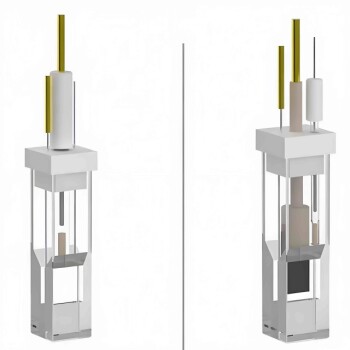
The defining feature of this hardware is the "side window."
Usually crafted from quartz or optical glass, this component represents the intersection of two scientific disciplines. It must be chemically inert enough to survive an acid bath, yet optically pure enough to pass a UV-Vis beam without distortion.
This is the engineer's romance: creating a material barrier that is physical enough to hold liquid but "invisible" enough to let light pass through untouched.
Protocols of the Vessel
The most sophisticated equipment cannot overcome a negligent operator. Atul Gawande often writes that failure usually comes not from ignorance (not knowing enough), but from ineptitude (not applying what we know).
To ensure the integrity of your data, you must treat the cell with the same reverence as the microscope.
- The Inspection: Before every use, check the optical window. A single scratch diffuses light, introducing noise that no software filter can remove.
- The Ritual of Cleaning: Rinse. Soak in ethanol. Dry with nitrogen. This is not just hygiene; it is the recalibration of your baseline.
- The Seal: An electrode that isn't seated effectively creates a leak. A leak changes the concentration. A changed concentration renders your data useless.
The Trade-off: Standard vs. Custom
In engineering, there is always a cost to specificity.
A standard cell (50-100ml, standard ports) is the Toyota Camry of the lab. It works for 90% of drivers. It is reliable, parts are interchangeable, and it gets you where you need to go efficiently.
A custom cell is a Formula 1 car. If you need to insert an oversized pH probe, a thermocouple, or a uniquely shaped working electrode, you must alter the standard architecture. You gain performance in a specific niche, but you lose the "plug-and-play" convenience of standard consumables.
Quick Reference: Cell Specifications
| Feature | Typical Spec | The "Why" |
|---|---|---|
| Volume | 10ml – 500ml | Balances resource scarcity (low volume) vs. reaction stability (high volume). |
| Electrode Ports | 3x (Φ6.2mm) | Standardized fit for Working, Counter, and Reference electrodes. |
| Gas Ports | 2x (Φ3.2mm) | Environmental control (degassing/purging). |
| Window Material | Quartz / Optical Glass | Optical transparency for simultaneous spectroscopic analysis. |
Conclusion
We often think of scientific breakthroughs as moments of pure genius. In reality, they are usually the result of reliable systems working exactly as intended, over and over again.
The side-window electrolytic cell is the foundation of that system. It connects the electrical world to the optical world.
At KINTEK, we understand that your equipment should never be the variable in your experiment. Whether you need a robust standard cell for routine analysis or a custom vessel for a novel application, we provide the precision engineering that allows you to focus on the science, not the setup.
Is your equipment as precise as your hypothesis? Contact Our Experts
Visual Guide
Related Products
- PTFE Electrolytic Cell Electrochemical Cell Corrosion-Resistant Sealed and Non-Sealed
- Super Sealed Electrolytic Electrochemical Cell
- Electrolytic Electrochemical Cell with Five-Port
- H Type Electrolytic Cell Triple Electrochemical Cell
- Electrolytic Electrochemical Cell Gas Diffusion Liquid Flow Reaction Cell
Related Articles
- Electrolytic Batteries A Solution to the Growing Energy Demands
- The Art of Resistance: Why Your Electrolytic Cell Needs Breathing Room
- The Architecture of Invisibility: Deconstructing the "All-Quartz" Cell
- The Architecture of Certainty: Mastering Control in Multifunctional Electrolytic Cells
- The Silent Partner: Why Material Choice in Electrochemistry is a Matter of Trust