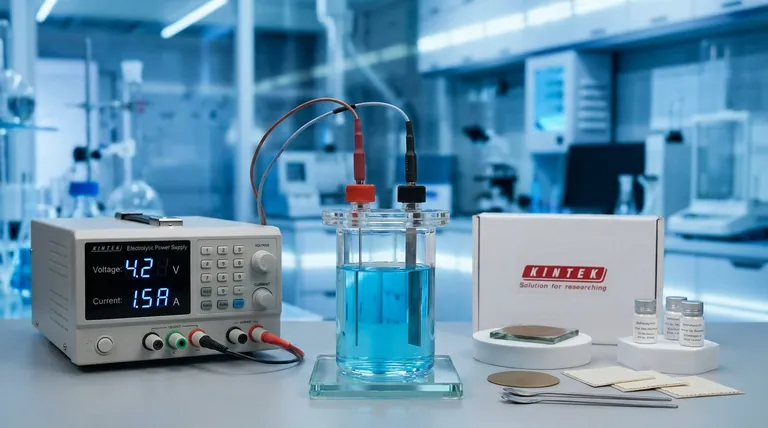
Blog The Silent Geometry of Voltage: Respecting the Limits of Electrolysis
The Silent Geometry of Voltage: Respecting the Limits of Electrolysis

The Silent Geometry of Voltage: Respecting the Limits of Electrolysis

6 days ago

The Illusion of the Buffer

In engineering and laboratory sciences, we often operate with an implicit belief in the "safety factor." We assume that a bridge can hold more than its weight limit, or that a beaker can withstand a few degrees above its rating.

We assume the red line on the dial is a suggestion, not a cliff.

In the world of electrolysis, this mindset is not just wrong; it is destructive. The foundational rule of operating an electrolytic cell is absolute: never exceed the specified electrical limits of your components.

This is not about bureaucratic compliance. It is about physics.

The ratings for current (amperage) and voltage are the boundaries where chemistry functions predictable. Step outside them, and you enter a chaotic state where equipment melts, electrolytes break down, and safety evaporates.

The Symbiosis of Source and Sink

To understand the risk, we must look at the system as a single organism.

The power supply and the electrolytic cell are symbiotic. The power supply pushes energy; the cell consumes it. If the cell demands more than the supply can give, the supply burns out. If the supply forces more than the cell can take, the cell degrades.

There is no isolation here. The failure of one component almost always guarantees the destruction of the other.

The Thermal Runaway (Current)

Current is the measure of flow. In electrolysis, it dictates the rate of reaction. It is tempting to turn the dial up to speed the process down.

But current generates heat.

Every conductor has resistance. According to Joule’s First Law ($I^2R$), doubling the current doesn't just double the heat—it quadruples it.

When you exceed the rated amperage:

  • The Electrolyte Boils: Thermal stress alters the chemical composition.
  • Structural Warping: Seals fail, and plastic casings deform.
  • Electrode Meltdown: The physical structure of the electrode cannot dissipate the energy fast enough.

The Breaking Point (Voltage)

If current is flow, voltage is pressure.

Exceeding the rated voltage is akin to over-pressurizing a pipe. The energy must go somewhere. In an electrolytic cell, excess voltage often results in electrical arcing.

It forces the electrolyte to break down in ways you did not intend. This creates side reactions, producing hazardous gases or contaminating your pure output. You are no longer doing chemistry; you are creating chaos.

The Direction of Entropy: Polarity

There is a third variable, often overlooked in the rush to begin: Polarity.

Electrolysis is strictly directional. The anode (positive) and cathode (negative) are chemically distinct environments.

Reversing the connection is not a minor error. It reverses the entire chemical timeline. An electrode designed to be inert may suddenly begin to corrode and dissolve into your solution.

You don't just lose time. You lose the equipment.

The Engineer’s Discipline: A Strategy for Longevity

How do we prevent this? By shifting our mindset from "maximum capacity" to "optimal reliability."

The most experienced operators do not run their machines at the red line. They understand that longevity is a function of restraint.

The 80% Rule

If your goal is equipment longevity, never run your system at 100% of its rated capacity.

Operate at 80-90%.

This 10-20% buffer reduces thermal stress exponentially. It is the difference between a cell that lasts a month and one that lasts a year.

The Pre-Flight Checklist

Treat your electrolytic setup like an aircraft. Before the switch is flipped, the parameters must be verified.

  • Check the Nameplate: Does the power supply match the cell?
  • Trace the Wires: Is positive connected to positive?
  • Set the Limit: Is the voltage capped below the breakdown threshold?

Summary of Electrical Risks

Parameter The Consequence of Excess The Strategy
Rated Current Overheating, warping, seal failure. Run at 80-90% of max rating.
Rated Voltage Arcing, hazardous gas, side reactions. Never exceed the hard limit.
Polarity Electrode corrosion, process reversal. Verify connections twice.

Precision is the Only Safety

In electrolysis, safety is not a separate feature. It is the natural result of precision.

At KINTEK, we understand that the quality of your results depends on the reliability of your tools. Our lab equipment and consumables are engineered to handle precise electrical loads, giving you the control you need to stay within the safe "green zone" of operation.

Do not leave your chemical processes to chance or inferior components.

Contact our experts today to discuss how KINTEK can help you build a safer, more efficient, and longer-lasting electrolytic system.

Visual Guide
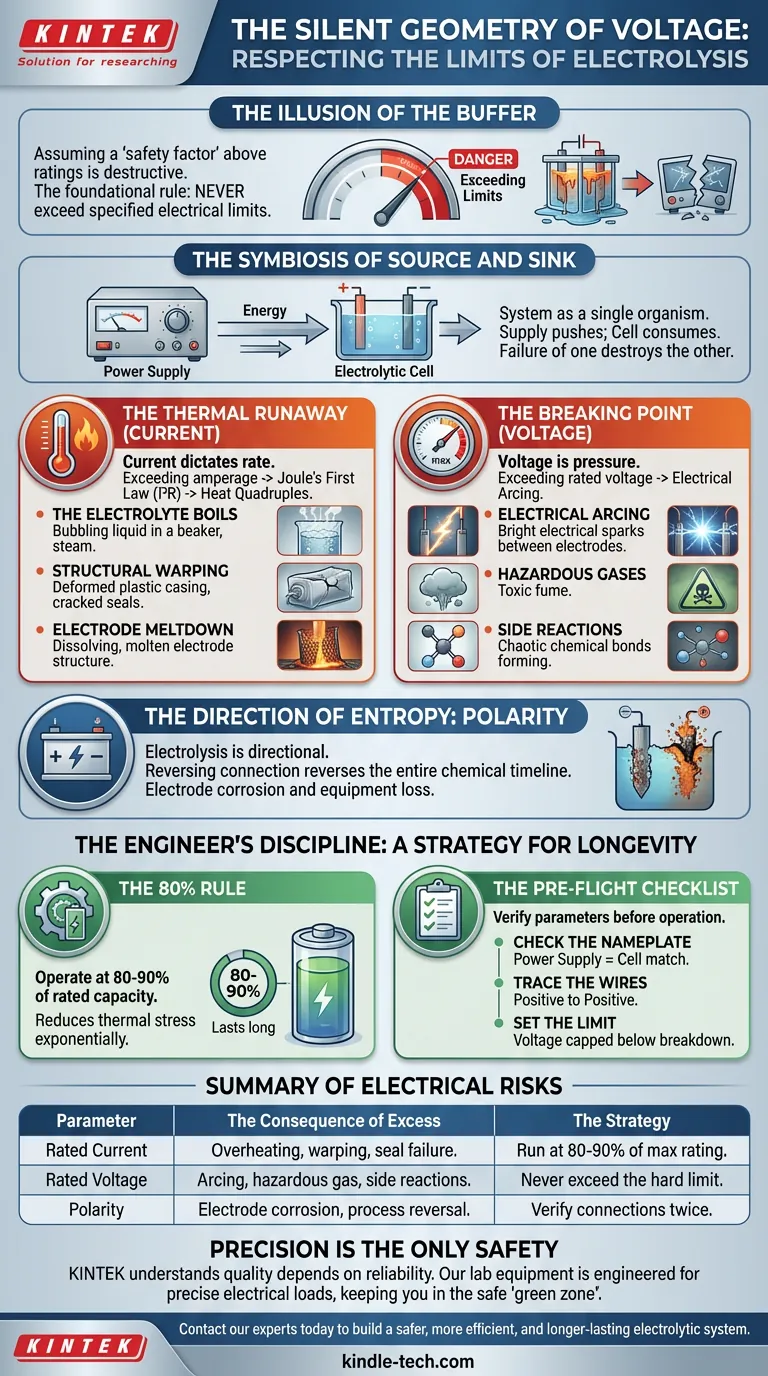
The Silent Geometry of Voltage: Respecting the Limits of Electrolysis Visual Guide

Related Products

Related Articles

Related Products

Electrode Polishing Material for Electrochemical Experiments

Electrode Polishing Material for Electrochemical Experiments

Looking for a way to polish your electrodes for electrochemical experiments? Our polishing materials are here to help! Follow our easy instructions for best results.

Glassy Carbon Sheet RVC for Electrochemical Experiments

Glassy Carbon Sheet RVC for Electrochemical Experiments

Discover our Glassy Carbon Sheet - RVC. Perfect for your experiments, this high-quality material will elevate your research to the next level.

Conductive Carbon Cloth Carbon Paper Carbon Felt for Electrodes and Batteries

Conductive Carbon Cloth Carbon Paper Carbon Felt for Electrodes and Batteries

Conductive carbon cloth, paper, and felt for electrochemical experiments. High-quality materials for reliable and accurate results. Order now for customization options.

Copper Foam

Copper Foam

Copper foam has good thermal conductivity and can be widely used for heat conduction and heat dissipation of motors/electrical appliances and electronic components.

Ultra-Vacuum Electrode Feedthrough Connector Flange Power Electrode Lead for High-Precision Applications

Ultra-Vacuum Electrode Feedthrough Connector Flange Power Electrode Lead for High-Precision Applications

Discover the Ultra-Vacuum Electrode Feedthrough Connector Flange, perfect for high-precision applications. Ensure reliable connections in ultra-vacuum environments with advanced sealing and conductive technology.

Silicon Carbide SiC Thermal Heating Elements for Electric Furnace

Silicon Carbide SiC Thermal Heating Elements for Electric Furnace

Experience the advantages of Silicon Carbide (SiC) Heating Element: Long service life, high corrosion and oxidation resistance, fast heating speed, and easy maintenance. Learn more now!

Custom PTFE Teflon Parts Manufacturer for PTFE Ball Valve Seat

Custom PTFE Teflon Parts Manufacturer for PTFE Ball Valve Seat

Seats and inserts are vital components in the valve industry. As a key component, polytetrafluoroethylene is usually selected as the raw material.

Conductive Boron Nitride BN Ceramics Composite for Advanced Applications

Conductive Boron Nitride BN Ceramics Composite for Advanced Applications

Due to the characteristics of boron nitride itself, the dielectric constant and dielectric loss are very small, so it is an ideal electrical insulating material.

Custom PTFE Teflon Parts Manufacturer for Non-Standard Insulator Customization

Custom PTFE Teflon Parts Manufacturer for Non-Standard Insulator Customization

PTFE insulator PTFE has excellent electrical insulation properties in a wide temperature and frequency range.

Graphite Vacuum Furnace Negative Material Graphitization Furnace

Graphite Vacuum Furnace Negative Material Graphitization Furnace

Graphitization furnace for battery production has uniform temperature and low energy consumption. Graphitization furnace for negative electrode materials: an efficient graphitization solution for battery production and advanced functions to enhance battery performance.

Custom PTFE Teflon Parts Manufacturer for Acid and Alkali Resistant Chemical Powder Material Scoops

Custom PTFE Teflon Parts Manufacturer for Acid and Alkali Resistant Chemical Powder Material Scoops

Known for its excellent thermal stability, chemical resistance and electrical insulating properties, PTFE is a versatile thermoplastic material.

Custom PTFE Teflon Parts Manufacturer for Culture Dish and Evaporation Dish

Custom PTFE Teflon Parts Manufacturer for Culture Dish and Evaporation Dish

The PTFE culture dish evaporating dish is a versatile laboratory tool known for its chemical resistance and high-temperature stability. PTFE, a fluoropolymer, offers exceptional non-stick properties and durability, making it ideal for various applications in research and industry, including filtration, pyrolysis, and membrane technology.

Laboratory Test Sieves and Vibratory Sieve Shaker Machine

Laboratory Test Sieves and Vibratory Sieve Shaker Machine

Efficiently process powders, granules, and small blocks with a high-frequency vibration sieve. Control vibration frequency, screen continuously or intermittently, and achieve accurate particle size determination, separation, and classification.

Small Lab Rubber Calendering Machine

Small Lab Rubber Calendering Machine

Small lab rubber calendering machine is used for producing thin, continuous sheets of plastic or rubber materials. It is commonly employed in laboratories, small-scale production facilities, and prototyping environments to create films, coatings, and laminates with precise thickness and surface finish.

Laboratory Disc Rotary Mixer for Efficient Sample Mixing and Homogenization

Laboratory Disc Rotary Mixer for Efficient Sample Mixing and Homogenization

Efficient Laboratory Disc Rotary Mixer for Precise Sample Mixing, Versatile for Various Applications, DC Motor and Microcomputer Control, Adjustable Speed and Angle.

Vacuum Sealed Continuous Working Rotary Tube Furnace Rotating Tube Furnace

Vacuum Sealed Continuous Working Rotary Tube Furnace Rotating Tube Furnace

Experience efficient material processing with our vacuum-sealed rotary tube furnace. Perfect for experiments or industrial production, equipped with optional features for controlled feeding and optimized results. Order now.

Ultra-High Temperature Graphite Vacuum Graphitization Furnace

Ultra-High Temperature Graphite Vacuum Graphitization Furnace

The ultra-high temperature graphitization furnace utilizes medium frequency induction heating in a vacuum or inert gas environment. The induction coil generates an alternating magnetic field, inducing eddy currents in the graphite crucible, which heats up and radiates heat to the workpiece, bringing it to the desired temperature. This furnace is primarily used for graphitization and sintering of carbon materials, carbon fiber materials, and other composite materials.

Molybdenum Vacuum Heat Treat Furnace

Molybdenum Vacuum Heat Treat Furnace

Discover the benefits of a high-configuration molybdenum vacuum furnace with heat shield insulation. Ideal for high-purity, vacuum environments like sapphire crystal growth and heat treatment.

Vertical High Temperature Graphite Vacuum Graphitization Furnace

Vertical High Temperature Graphite Vacuum Graphitization Furnace

Vertical high temperature graphitization furnace for carbonization and graphitization of carbon materials up to 3100℃.Suitable for shaped graphitization of carbon fiber filaments and other materials sintered in a carbon environment.Applications in metallurgy, electronics, and aerospace for producing high-quality graphite products like electrodes and crucibles.

Rotary Tube Furnace Split Multi Heating Zone Rotating Tube Furnace

Rotary Tube Furnace Split Multi Heating Zone Rotating Tube Furnace

Multi zone rotary furnace for high-precision temperature control with 2-8 independent heating zones. Ideal for lithium ion battery electrode materials and high-temperature reactions. Can work under vacuum and controlled atmosphere.


Leave Your Message