Blog The Geometry of Control: Why Millimeters Matter in Electrochemistry
The Geometry of Control: Why Millimeters Matter in Electrochemistry

The Geometry of Control: Why Millimeters Matter in Electrochemistry

1 week ago

The Invisible Variable

In laboratory science, we often obsess over the invisible. We worry about electron transfer rates, impedance, and the purity of reagents measured in parts per million.

But we rarely stop to admire the vessel that holds it all together.

This is an oversight. In electrochemistry, the quartz cell is not merely a container; it is a boundary condition. It defines the limits of what is possible. The difference between a failed experiment and a breakthrough often lies in the architecture of the cell itself—specifically, the number and size of the holes drilled into its lid.

At KINTEK, we see these specifications not just as dimensions, but as a map of experimental intent.

The Philosophy of the Unsealed Cell

The standard unsealed all-quartz electrolytic cell represents the science of the routine. It is designed for environments where the atmosphere is benign.

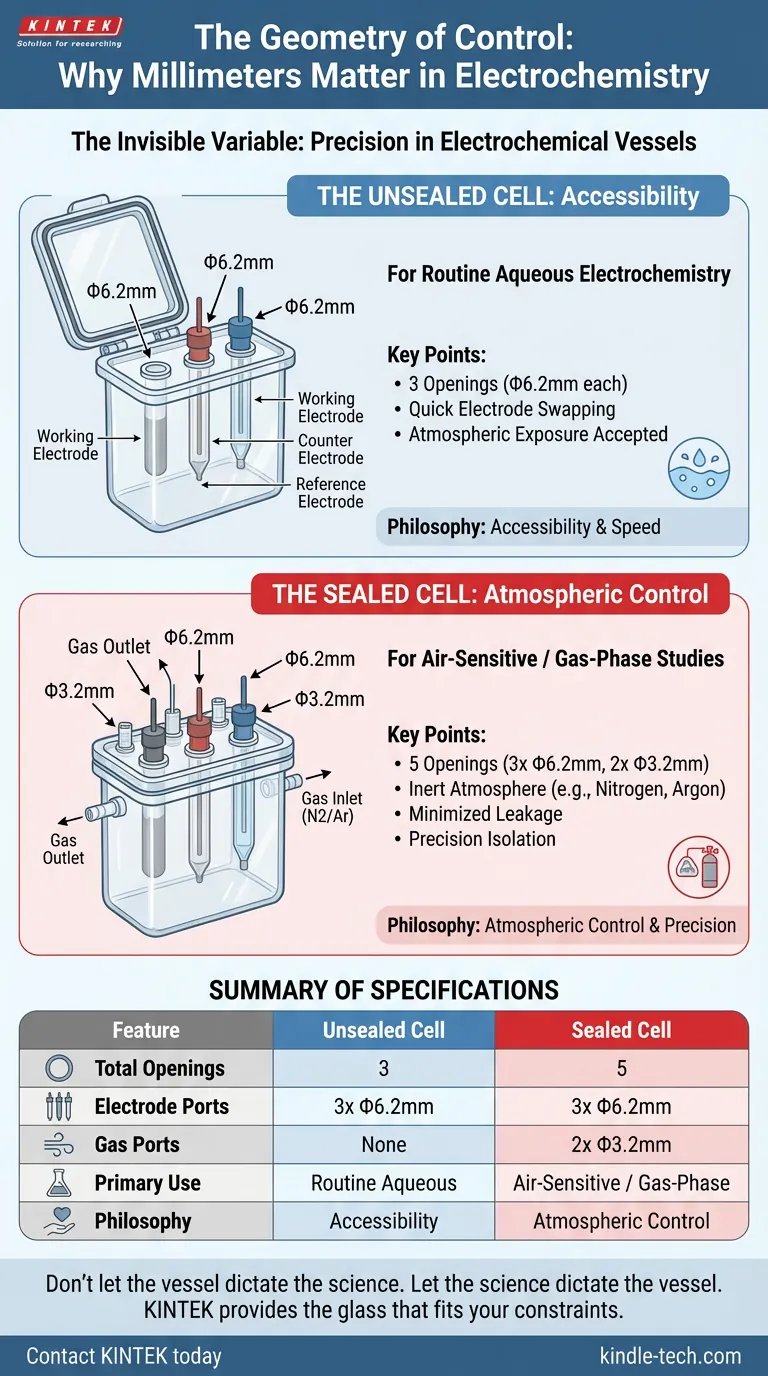
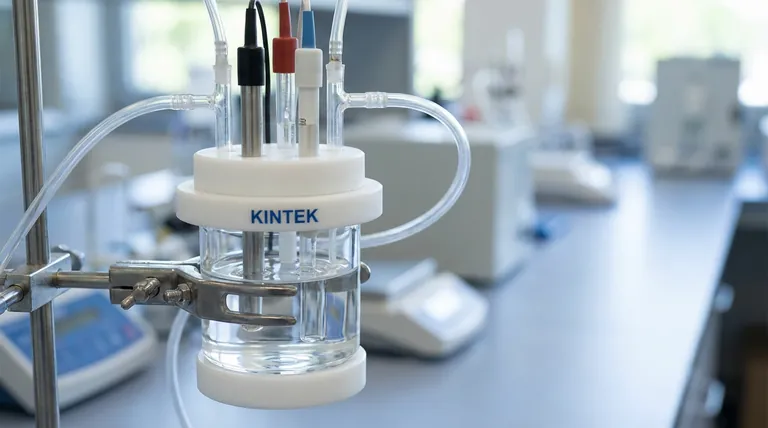
The architecture is deceptively simple. It features three openings.

Each opening has a standardized diameter of Φ6.2mm.

This number is not arbitrary. It is the physical manifestation of the classic three-electrode system:

  • The Working Electrode
  • The Counter Electrode
  • The Reference Electrode

The unsealed cell is a wager. You are betting that the ambient air—the oxygen, the humidity—will not interfere with your chemistry. For general aqueous solutions, this is a safe bet. The large, uniform openings allow for quick electrode swapping and easy cleaning. It prioritizes speed and accessibility.

The Architecture of Isolation

However, chemistry is rarely compliant.

When you move into the realm of air-sensitive materials or organic solvents, the atmosphere becomes a contaminant. Precision requires isolation. This is where the sealed cell becomes necessary.

A sealed cell changes the geometry of the experiment. It increases the port count to five.

It retains the foundation of the unsealed version:

  • Three openings at Φ6.2mm (for the standard electrodes).

But it adds a critical layer of control:

  • Two openings at Φ3.2mm.

These smaller ports are the gatekeepers. They are dedicated to gas inlets and outlets. They allow you to purge the headspace with nitrogen or argon, creating an inert blanket over your reaction.

The difference in diameter—6.2mm versus 3.2mm—is a functional distinction. The larger ports accommodate the bulk of the electrode bodies, while the smaller ports are sized for tight tubing connections, minimizing the surface area for potential leaks.

The Cost of Standardization

Standardization makes science scalable. Knowing that a "standard" cell will fit your electrodes allows you to focus on the data, not the hardware.

However, there is a hidden cost to standardization: rigidity.

Real-world research often drifts outside the margins of "standard." You might need a Luggin capillary to minimize IR drop. You might need to insert a temperature probe or a pH sensor.

In these moments, the standard 3-port or 5-port configuration becomes a limitation.

This is why the best equipment suppliers treat standards as a starting point, not a conclusion. While the Φ6.2mm/Φ3.2mm setup covers 90% of use cases, the remaining 10%—often the most innovative work—requires customization.

Summary of Specifications

To select the right vessel, you must first define the enemy. Is it time (efficiency needed) or the atmosphere (control needed)?

Feature Unsealed Cell Sealed Cell
Total Openings 3 5
Electrode Ports 3x Φ6.2mm 3x Φ6.2mm
Gas Ports None 2x Φ3.2mm
Primary Use Routine aqueous electrochemistry Air-sensitive / Gas-phase studies
Philosophy Accessibility Atmospheric Control

Choosing Your Constraints

Every piece of lab equipment enforces a set of constraints.

An unsealed cell constrains you to stable environments. A sealed cell constrains you to a more complex setup process but grants you freedom from atmospheric interference.

At KINTEK, we provide the glass that fits your specific set of constraints. Whether you need the rugged simplicity of a standard 3-port cell or a custom-designed array for a complex multi-sensor experiment, the goal remains the same: reliable, reproducible data.

Don't let the vessel dictate the science. Let the science dictate the vessel.

Contact KINTEK today

Visual Guide

The Geometry of Control: Why Millimeters Matter in Electrochemistry Visual Guide

Related Products

Related Articles

Related Products

Quartz Electrolytic Electrochemical Cell for Electrochemical Experiments

Quartz Electrolytic Electrochemical Cell for Electrochemical Experiments

Looking for a reliable quartz electrochemical cell? Our product boasts excellent corrosion resistance and complete specifications. With high-quality materials and good sealing, it's both safe and durable. Customize to meet your needs.

Electrolytic Electrochemical Cell with Five-Port

Electrolytic Electrochemical Cell with Five-Port

Streamline your laboratory consumables with Kintek's Electrolytic Cell with five-port design. Choose from sealed and non-sealed options with customizable electrodes. Order now.

Super Sealed Electrolytic Electrochemical Cell

Super Sealed Electrolytic Electrochemical Cell

Super-sealed electrolytic cell offers enhanced sealing capabilities, making it ideal for experiments that require high airtightness.

Double-Layer Water Bath Electrolytic Electrochemical Cell

Double-Layer Water Bath Electrolytic Electrochemical Cell

Discover the temperature-controllable electrolytic cell with a double-layer water bath, corrosion resistance, and customization options. Complete specifications included.

Electrolytic Electrochemical Cell for Coating Evaluation

Electrolytic Electrochemical Cell for Coating Evaluation

Looking for corrosion-resistant coating evaluation electrolytic cells for electrochemical experiments? Our cells boast complete specifications, good sealing, high-quality materials, safety, and durability. Plus, they're easily customizable to meet your needs.

H-Type Double-Layer Optical Electrolytic Electrochemical Cell with Water Bath

H-Type Double-Layer Optical Electrolytic Electrochemical Cell with Water Bath

Double-layer H-type optical water bath electrolytic cells, with excellent corrosion resistance and a wide range of specifications available. Customization options are also available.

Side Window Optical Electrolytic Electrochemical Cell

Side Window Optical Electrolytic Electrochemical Cell

Experience reliable and efficient electrochemical experiments with a side window optical electrolytic cell. Boasting corrosion resistance and complete specifications, this cell is customizable and built to last.

Electrolytic Electrochemical Cell Gas Diffusion Liquid Flow Reaction Cell

Electrolytic Electrochemical Cell Gas Diffusion Liquid Flow Reaction Cell

Looking for a high-quality gas diffusion electrolysis cell? Our liquid flow reaction cell boasts exceptional corrosion resistance and complete specifications, with customizable options available to suit your needs. Contact us today!

H Type Electrolytic Cell Triple Electrochemical Cell

H Type Electrolytic Cell Triple Electrochemical Cell

Experience versatile electrochemical performance with our H-type Electrolytic Cell. Choose from membrane or non-membrane sealing, 2-3 hybrid configurations. Learn more now.

Optical Water Bath Electrolytic Electrochemical Cell

Optical Water Bath Electrolytic Electrochemical Cell

Upgrade your electrolytic experiments with our Optical Water Bath. With controllable temperature and excellent corrosion resistance, it's customizable for your specific needs. Discover our complete specifications today.

PTFE Electrolytic Cell Electrochemical Cell Corrosion-Resistant Sealed and Non-Sealed

PTFE Electrolytic Cell Electrochemical Cell Corrosion-Resistant Sealed and Non-Sealed

Choose our PTFE Electrolytic Cell for reliable, corrosion-resistant performance. Customize specifications with optional sealing. Explore now.

Thin-Layer Spectral Electrolysis Electrochemical Cell

Thin-Layer Spectral Electrolysis Electrochemical Cell

Discover the benefits of our thin-layer spectral electrolysis cell. Corrosion-resistant, complete specifications, and customizable for your needs.

Customizable PEM Electrolysis Cells for Diverse Research Applications

Customizable PEM Electrolysis Cells for Diverse Research Applications

Custom PEM test cell for electrochemical research. Durable, versatile, for fuel cells & CO2 reduction. Fully customizable. Get a quote!

Double Layer Five-Port Water Bath Electrolytic Electrochemical Cell

Double Layer Five-Port Water Bath Electrolytic Electrochemical Cell

Experience optimal performance with our Water Bath Electrolytic Cell. Our double-layer, five-port design boasts corrosion resistance and longevity. Customizable to fit your specific needs. View specs now.

Flat Corrosion Electrolytic Electrochemical Cell

Flat Corrosion Electrolytic Electrochemical Cell

Discover our flat corrosion electrolytic cell for electrochemical experiments. With exceptional corrosion resistance and complete specifications, our cell guarantees optimal performance. Our high-quality materials and good sealing ensure a safe and durable product, and customization options are available.

Customizable Swagelok Type Test Cells for Advanced Battery Research Electrochemical Analysis

Customizable Swagelok Type Test Cells for Advanced Battery Research Electrochemical Analysis

The KINTEK Swagelok-type test cell is a modular, T-shaped device constructed from high-quality, chemically inert materials.

Customizable CO2 Reduction Flow Cell for NRR ORR and CO2RR Research

Customizable CO2 Reduction Flow Cell for NRR ORR and CO2RR Research

The cell is meticulously crafted from high-quality materials to ensure chemical stability and experimental accuracy.

FS Electrochemical Hydrogen Fuel Cells for Diverse Applications

FS Electrochemical Hydrogen Fuel Cells for Diverse Applications

KINTEK's FS Electrochemical Cell: Modular PEM fuel cell stack for R&D and training. Acid-resistant, scalable, and customizable for reliable performance.

Gold Electrochemical Sheet Electrode Gold Electrode

Gold Electrochemical Sheet Electrode Gold Electrode

Discover high-quality gold sheet electrodes for safe and durable electrochemical experiments. Choose from complete models or customize to meet your specific needs.

Button Battery Disassembly and Sealing Mold for Lab Use

Button Battery Disassembly and Sealing Mold for Lab Use

The simple sealing and disassembly mold can be directly used on ordinary tablet presses, which can save costs, is convenient and fast, and can be used to encapsulate and disassemble button batteries. Other specifications can be customized.


Leave Your Message