All Questions
How Does Carbon Coating Work? Achieve Superior Surface Performance For Your Components
Learn how PVD carbon coating creates ultra-thin, durable films to enhance wear resistance, chemical stability, and battery performance.
What Are The Advantages Of Carbon Coating? Enhance Stability & Conductivity For Your Materials
Discover how carbon coating boosts chemical stability, structural integrity, and electrical/ionic conductivity in materials like battery electrodes.
What Is The Use Of Thin Film Semiconductor? Powering Modern Electronics From Microchips To Solar Cells
Discover how thin-film semiconductors enable microprocessors, displays, solar cells, and advanced sensors through precise atomic-layer deposition.
Can Graphite Hold A Charge? The Key To Modern Battery Technology
Discover how graphite's unique layered structure enables it to store energy electrochemically, making it the essential anode in lithium-ion batteries.
Can Carbon Nanotubes Be Used In Batteries? Boost Battery Performance With Conductive Nanotubes
Explore how carbon nanotubes enhance lithium-ion batteries, improving energy density, charging speed, and lifespan as a superior conductive additive.
What Are The Applications Of Carbon Nanotubes For Energy Storage? Enhancing Battery Performance And Durability
Discover how carbon nanotubes boost lithium-ion batteries by improving conductivity, enabling faster charging, and supporting next-gen materials like silicon anodes.
Can Carbon Nanotubes Store Energy? Unlock High-Power, Long-Life Energy Storage
Explore how carbon nanotubes enhance supercapacitors & batteries with superior conductivity, surface area, and strength for advanced energy storage solutions.
What Are The Applications Of Carbon Nanotubes For Energy? Enhance Battery Performance & Energy Infrastructure
Explore how carbon nanotubes improve lithium-ion batteries, strengthen energy infrastructure, and enable next-gen solar and electronics for superior energy solutions.
What Are The Challenges Of Graphene Synthesis? Mastering The Quality, Scale, And Cost Trade-Offs
Explore the key challenges in graphene synthesis, from top-down vs. bottom-up methods to the trade-offs between quality, scalability, and cost for your application.
What Is The Precursor Of Graphene? The Key To Choosing Your Synthesis Method
Explore graphene precursors like graphite and methane. Learn how the choice of starting material affects the quality, cost, and application of the final product.
What Is The Synthesis Method Of Graphene? Top-Down Vs. Bottom-Up Approaches For Your Application
Explore the primary graphene synthesis methods, including Chemical Vapor Deposition (CVD), mechanical exfoliation, and their trade-offs in quality, scale, and cost.
What Are The Real Life Applications Of Graphite? Powering Batteries, Industry, And Technology
Discover graphite's real-world uses: from lithium-ion batteries and steelmaking to aerospace composites and nuclear reactors. Learn how its unique properties drive innovation.
What Does Carbon Coating Do? Enhance Battery Performance With A Multifunctional Layer
Carbon coating improves battery materials by boosting stability, conductivity, and cycle life. Learn its key functions and trade-offs.
What Is The Meaning Of Roll Press? A Critical Step For High-Performance Battery Manufacturing
Learn how a roll press compacts battery electrodes to increase energy density, ensure uniformity, and directly impact battery performance and lifespan.
Related Products

Customizable Swagelok Type Test Cells for Advanced Battery Research Electrochemical Analysis

Warm Isostatic Press for Solid State Battery Research

Battery Lab Equipment 304 Stainless Steel Strip Foil 20um Thick for Battery Test
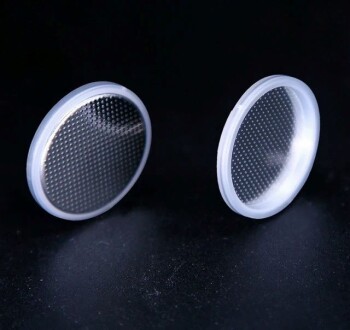
Button Battery Case for Battery Lab Applications
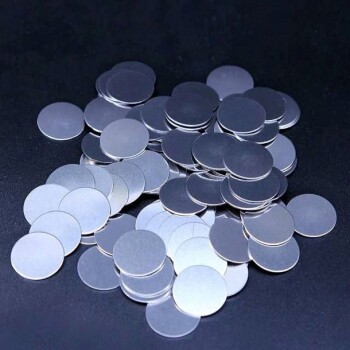
Button Battery Case Gasket for Battery Lab Applications