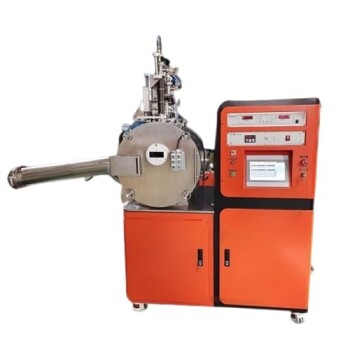
Yes, you can absolutely heat an object in a vacuum chamber, though the methods for doing so are different from what you experience in daily life. Because a vacuum has virtually no air, you cannot use hot air to transfer heat—a process called convection. Instead, you must rely on the two other fundamental methods of heat transfer: direct contact (conduction) and electromagnetic waves (radiation).
The absence of air in a vacuum chamber doesn't prevent heating; it simply changes the rules. Heat transfer must occur through direct physical contact (conduction) or invisible light waves (radiation), making it a precise and powerful tool for science and industry.
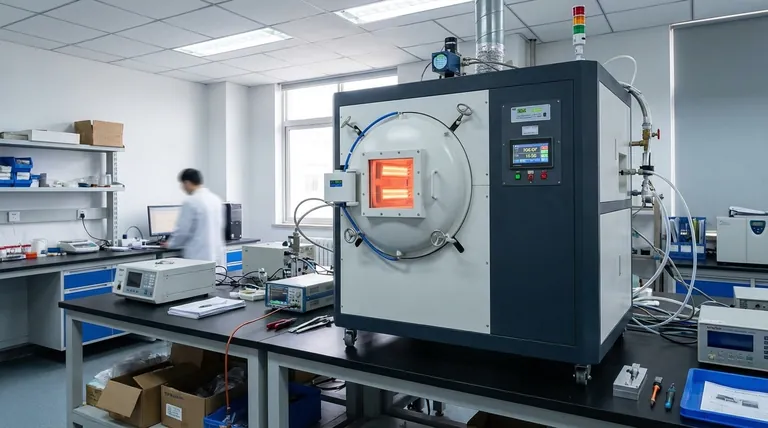
The Challenge: Why Heating in a Vacuum is Different
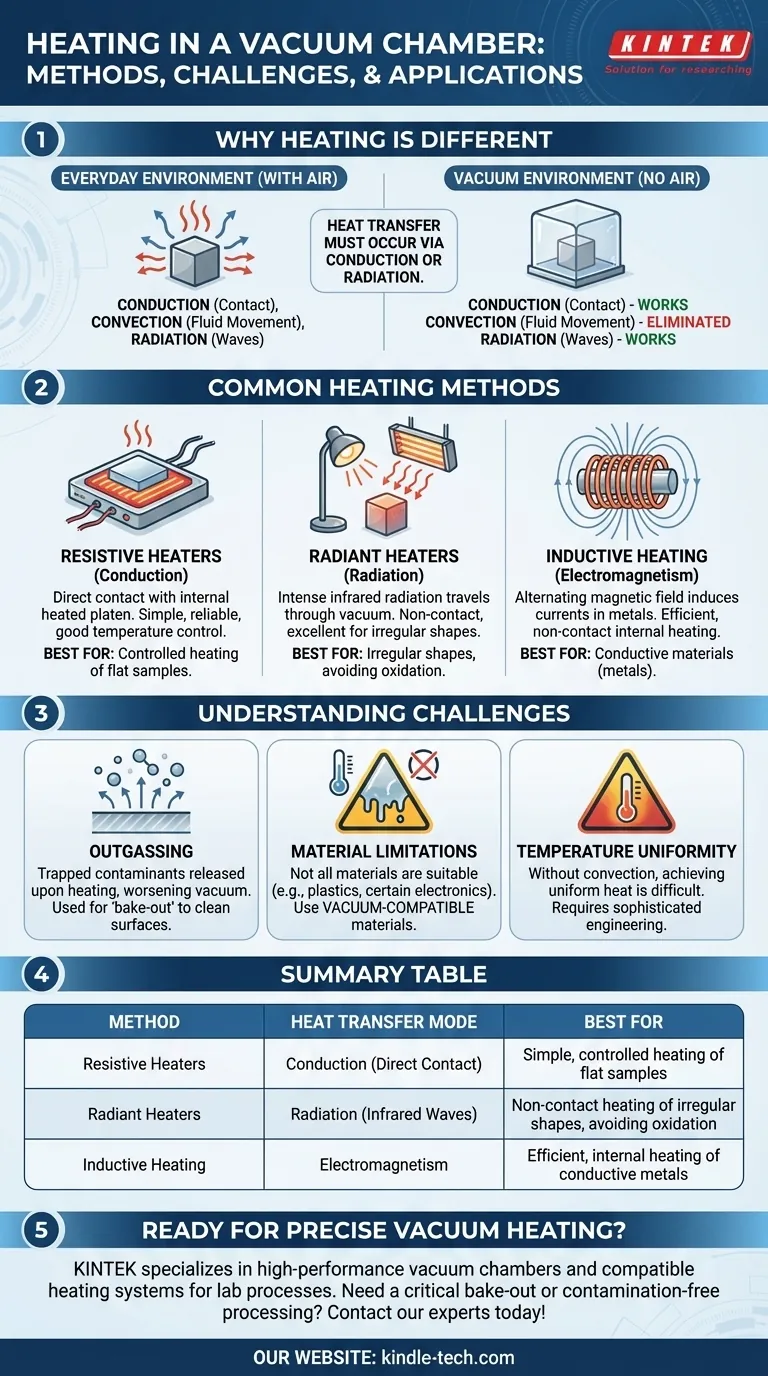
In our everyday environment, heat moves in three ways. Understanding them is the key to understanding how a vacuum changes the game.
Conduction: Heat Through Direct Contact
Conduction is heat transfer through touch. Placing an object on a hot plate heats the object because the vibrating molecules of the hot plate transfer their energy directly to the molecules of the object.
This method works perfectly well in a vacuum.
Convection: Heat Through Fluid Movement
Convection is heat transfer through a moving fluid, like air or water. A standard oven heats the air, and that hot air then circulates and transfers its heat to the food.
This is the mode that is completely eliminated in a vacuum. With no air, there is nothing to circulate and carry the heat.
Radiation: Heat Through Invisible Light
Radiation is heat transfer via electromagnetic waves, primarily infrared radiation. This is how the sun heats the Earth across the empty space, or how you feel the warmth of a campfire from a distance. No medium is required.
This method also works perfectly well in a vacuum and is one of the most common ways to heat objects inside a chamber.
Common Methods for Heating in a Vacuum
Engineers have developed several effective techniques to heat samples precisely in an airless environment.
Resistive Heaters (Conduction)
The simplest method is to place an object on a surface, often called a platen or stage, that is heated from within.
An electrical current is passed through a resistant material (a heating element), which generates heat. This heat is conducted through the platen and into your object. It is reliable and offers good temperature control.
Radiant Heaters (Radiation)
This method uses high-power lamps, such as quartz or halogen bulbs, positioned inside the vacuum chamber.
These lamps emit intense infrared radiation, which travels through the vacuum and is absorbed by the object, causing it to heat up. This is an excellent non-contact method, ideal for heating irregularly shaped objects or materials that cannot touch a hot surface.
Inductive Heating (Electromagnetism)
For conductive materials like metals, induction is a highly efficient, non-contact method.
An external coil generates a powerful, alternating magnetic field. This field passes through the chamber walls and induces electrical eddy currents inside the metallic object, causing it to heat up from within.
Understanding the Trade-offs and Challenges
Heating in a vacuum isn't just a matter of turning on an element; it introduces unique considerations that are often the very reason for using a vacuum in the first place.
The Problem of Outgassing
As you heat an object or the chamber walls, trapped molecules of water, oils, and other contaminants gain energy and are released from the surfaces. This process is called outgassing.
While this temporarily worsens the vacuum pressure, it's often the desired effect. This "bake-out" procedure is essential for cleaning surfaces at a molecular level to achieve ultra-high vacuum (UHV).
Material Limitations
Not all materials are suitable for vacuum heating. Plastics can melt or release enormous amounts of gas, ruining the vacuum. Glues, epoxies, and certain electronics may fail at elevated temperatures.
You must always use materials specifically rated for the temperature and vacuum level you intend to achieve, known as vacuum-compatible materials.
Temperature Uniformity
Without convection to evenly distribute heat, achieving a uniform temperature across an object can be difficult.
Radiant heaters can create hot spots on surfaces directly facing the lamp, while conductive heating relies on perfect contact between the object and the hot plate. Sophisticated engineering is often required to ensure even heating.
How to Apply This to Your Goal
Your choice of heating method depends entirely on what you are trying to accomplish.
- If your primary focus is achieving the highest possible vacuum: You need to perform a system "bake-out" using resistive heaters attached to the outside of your chamber to drive out trapped water vapor.
- If your primary focus is processing a material without oxygen: Non-contact methods like radiant or inductive heating are ideal, as they heat the target cleanly without oxidation or contamination.
- If your primary focus is simple, controlled heating of a flat sample: A heated platen using internal resistive elements (conduction) is often the most direct and cost-effective solution.
Mastering heat transfer in a vacuum allows you to create pristine environments and fabricate materials not possible under normal atmospheric conditions.
Summary Table:
| Method | Heat Transfer Mode | Best For |
|---|---|---|
| Resistive Heaters | Conduction (Direct Contact) | Simple, controlled heating of flat samples |
| Radiant Heaters | Radiation (Infrared Waves) | Non-contact heating of irregular shapes, avoiding oxidation |
| Inductive Heating | Electromagnetism | Efficient, internal heating of conductive metals |
Ready to achieve precise, contamination-free heating for your lab processes?
KINTEK specializes in high-performance lab equipment, including vacuum chambers and compatible heating systems. Whether you need to perform a critical bake-out, process materials without oxygen, or simply heat a sample with ultimate control, our solutions are designed for reliability and accuracy.
Contact our experts today via our Contact Form to discuss your specific vacuum heating requirements and discover the perfect solution for your laboratory's needs.
Visual Guide
Related Products
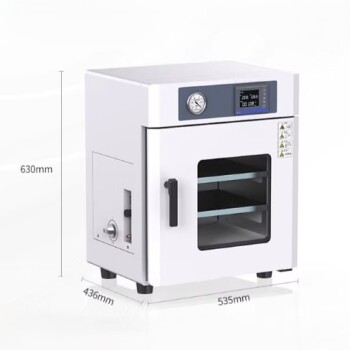
- 56L Vertical Laboratory Vacuum Drying Oven
- 23L Laboratory Vacuum Drying Oven
- Chemical Vapor Deposition CVD Equipment System Chamber Slide PECVD Tube Furnace with Liquid Gasifier PECVD Machine
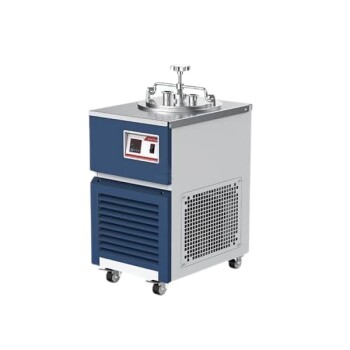
- Vacuum Cold Trap Direct Cold Trap Chiller
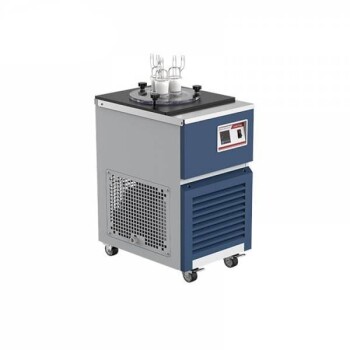
- Vacuum Cold Trap Chiller Indirect Cold Trap Chiller
People Also Ask
- Why is a laboratory vacuum drying oven recommended for rice straw residues? Protect Your Biomass Integrity
- Why is a Laboratory Vacuum Drying Oven recommended for PBAT microspheres? Protect Sensitive Polymer Integrity
- What is the importance of using a laboratory vacuum drying oven? Preserving Slow-Release Microcapsule Integrity
- What role does a laboratory vacuum drying oven play in the preparation of modified multi-walled carbon nanotubes?
- Why is a vacuum drying oven recommended for the post-processing of recovered cadmium sponge? | KINTEK