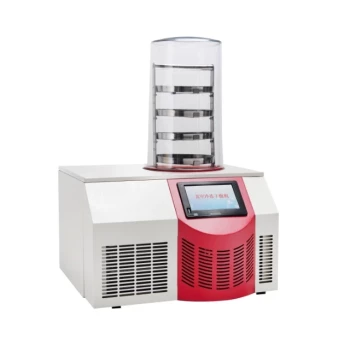
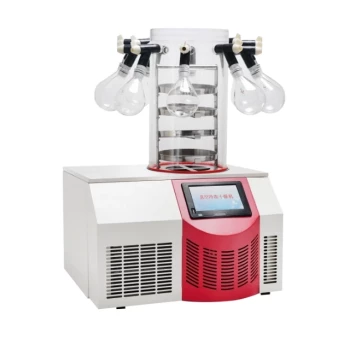
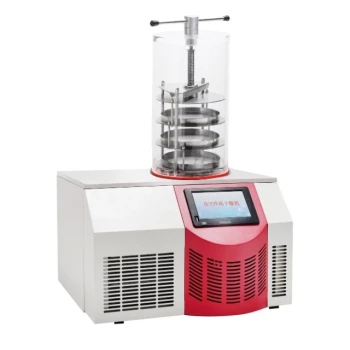
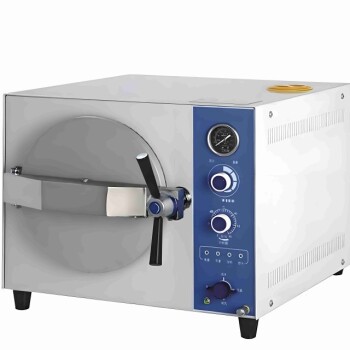
A Laboratory Vacuum Drying Oven is the critical tool for processing PBAT composite microspheres because it decouples drying speed from high heat. By lowering the ambient pressure, the oven reduces the boiling point of residual solvents and moisture, allowing them to evaporate rapidly at safe, low temperatures that do not compromise the delicate biodegradable polymer.
The core advantage is the preservation of material properties: vacuum drying prevents the thermal degradation, oxidation, and structural deformation that inevitably occur when heat-sensitive PBAT microspheres are exposed to standard high-temperature drying methods.
The Mechanics of Low-Temperature Evaporation
Lowering the Boiling Point
The primary function of a vacuum oven is to alter the physical environment of the drying chamber. By creating a vacuum, the boiling points of water and residual solvents, such as ethanol, are significantly reduced.
Efficient Solvent Removal
This allows contaminants to evaporate rapidly without requiring the oven to reach high temperatures. For PBAT microspheres, efficient drying can occur at relatively low settings, such as 60 °C, which would be ineffective at standard atmospheric pressure.
Protecting Chemical Integrity
Preventing Oxidation
Biodegradable polymers like PBAT are highly susceptible to chemical changes when exposed to air and heat simultaneously. The vacuum environment removes oxygen from the chamber, effectively preventing oxidation during the drying process.
Avoiding Thermal Degradation
Long-term exposure to high heat causes polymer chains to break down. By enabling drying at lower temperatures, the vacuum oven prevents the premature thermal degradation of the PBAT material, ensuring the microspheres retain their initial physicochemical properties.
Preserving Physical Morphology
Maintaining Spherical Shape
The physical form of the microsphere is just as important as its chemical composition. High heat can cause the polymer to soften, leading to melting or deformation. Vacuum drying preserves the spherical morphology of the microspheres by keeping the material below its softening point.
Safeguarding the Core-Shell Structure
For composite microspheres, maintaining the internal architecture is vital. The gentle drying process prevents the shell from collapsing or deforming, ensuring the integrity of the core-shell structure remains intact for storage and end-use.
Understanding the Trade-offs
Process Speed vs. Equipment Cost
While vacuum drying is superior for quality, it requires specialized equipment that is generally more expensive and complex than standard forced-air ovens. Additionally, while the drying is faster relative to the temperature used, the batch sizes in vacuum ovens are often smaller, potentially limiting throughput compared to continuous industrial dryers.
Sensitivity to Pressure Settings
The success of this method relies on precise pressure control. If the vacuum is not sufficiently strong, the boiling point will not drop enough to allow for low-temperature drying, potentially forcing the operator to raise the heat and risking the very damage the oven is meant to prevent.
Making the Right Choice for Your Goal
To maximize the quality of your PBAT composite microspheres, align your drying parameters with your specific objectives:
- If your primary focus is Physical Morphology: Prioritize maintaining a low temperature (e.g., 60 °C) to prevent softening and ensure the microspheres remain perfectly spherical.
- If your primary focus is Chemical Stability: Ensure the vacuum level is maximized to eliminate oxygen exposure and remove every trace of residual solvent that could degrade the polymer during storage.
Using a vacuum drying oven is not just a procedural step; it is a quality assurance measure that guarantees the structural and chemical fidelity of your final product.
Summary Table:
| Feature | Vacuum Drying Oven | Standard Forced-Air Oven |
|---|---|---|
| Drying Mechanism | Low pressure / Low temperature | High heat / Atmospheric pressure |
| Material Integrity | Prevents oxidation & degradation | High risk of thermal damage |
| Morphology | Preserves spherical shape | Risk of melting or deformation |
| Solvent Removal | Rapid evaporation at <60°C | Requires high heat for evaporation |
| Oxygen Presence | Minimal (Vacuum environment) | Present (Risk of oxidation) |
Elevate Your Material Research with KINTEK Precision
Maximize the quality of your PBAT composite microspheres and heat-sensitive polymers with KINTEK’s advanced laboratory solutions. From high-performance vacuum drying ovens that preserve delicate morphologies to our comprehensive range of crushing systems, hydraulic presses, and high-temperature reactors, we provide the specialized tools necessary for cutting-edge material science.
Whether you are developing biodegradable polymers, battery technologies, or advanced ceramics, our team is dedicated to providing laboratory equipment and consumables that ensure structural and chemical fidelity. Contact KINTEK today to discuss your specific research needs and discover how our equipment can enhance your lab's efficiency and results.
References
- Jianming Yang, Junwei Gu. Layered Structural PBAT Composite Foams for Efficient Electromagnetic Interference Shielding. DOI: 10.1007/s40820-023-01246-8
This article is also based on technical information from Kintek Solution Knowledge Base .
Related Products
- 56L Vertical Laboratory Vacuum Drying Oven
- 23L Laboratory Vacuum Drying Oven
- Laboratory Scientific Electric Heating Blast Drying Oven
- Benchtop Laboratory Vacuum Freeze Dryer
- High Performance Laboratory Freeze Dryer
People Also Ask
- Why is a laboratory vacuum drying oven recommended for rice straw residues? Protect Your Biomass Integrity
- What role does a laboratory vacuum drying oven play in the preparation of modified multi-walled carbon nanotubes?
- What is the importance of using a laboratory vacuum drying oven? Preserving Slow-Release Microcapsule Integrity
- What role does a laboratory vacuum drying oven play in processing nanoparticle powder samples? Protect Sample Integrity
- Why is a vacuum drying oven necessary for Li2MnSiO4/C battery electrodes? Ensure Stability and Performance.