Yes, but with critical caveats. Induction heating absolutely works on copper, but its unique properties make it significantly more challenging and resource-intensive to heat than magnetic materials like steel. Success depends entirely on using the correct equipment—specifically, systems that operate at a much higher frequency and power level to overcome copper's natural resistance to this heating method.
The very properties that make copper an excellent electrical conductor—low electrical resistance and high thermal conductivity—are the same properties that make it difficult to heat with induction. Overcoming this requires a specialized, high-frequency induction system to generate heat faster than the copper can conduct it away.
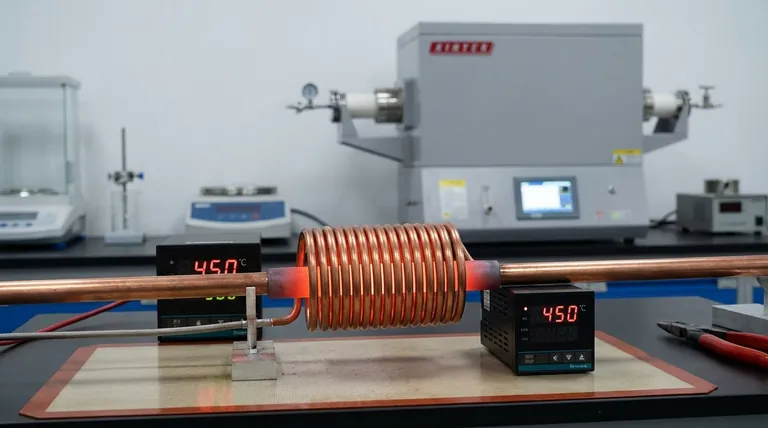
The Physics of Heating Copper via Induction
To understand why copper is challenging, you must first understand the core principle of induction. The process is not about magnetic attraction; it's about electrical resistance.
How Induction Heating Works
An induction heater uses an alternating current running through a copper coil to create a powerful, oscillating magnetic field. When a conductive workpiece (like a piece of steel or copper) is placed inside this field, the field induces electrical currents, called eddy currents, to flow within the material.
The material's own electrical resistance fights against the flow of these eddy currents, generating precise and rapid heat. This is known as Joule heating or I²R losses.
The Challenge: Copper's Extremely Low Resistivity
Steel has relatively high electrical resistivity, which makes it easy to heat. Think of it like pushing a heavy cart on a rough, gravelly surface—your effort easily creates friction and heat.
Copper, by contrast, is one of the best electrical conductors in existence, meaning it has extremely low resistivity. Pushing the same cart on a perfectly smooth, icy surface is a better analogy. Your effort makes the cart move very fast (high current flow), but it generates very little friction (heat).
The Second Challenge: High Thermal Conductivity
Compounding the problem is copper's excellent thermal conductivity. As soon as you begin generating heat in one area, the copper efficiently spreads that heat throughout the part and radiates it into the environment. You are in a race to pump in heat faster than the copper can get rid of it.
The Solution: Tailoring the Equipment for Copper
Overcoming copper's natural properties requires a specific engineering approach. You cannot use the same induction system designed for steel and expect good results.
The Critical Role of Frequency
The solution to low resistivity is to use a high-frequency magnetic field. A higher frequency induces larger and more intense eddy currents. It also takes advantage of the "skin effect," where high-frequency currents tend to flow only in a thin layer on the surface of the conductor.
Concentrating the current in this thin skin effectively increases the material's resistance in that small area, finally allowing for efficient heat generation. For copper, this typically requires frequencies from 100 kHz to several hundred kHz or even higher, compared to the 1-50 kHz often used for steel.
The Need for Higher Power
To win the race against copper's thermal conductivity, the system must have a high power density. A higher power rating (measured in kilowatts) allows the system to generate heat much faster than the workpiece can dissipate it, enabling you to reach target temperatures for applications like brazing, soldering, or annealing.
Importance of Coil Design
With non-magnetic materials like copper, the magnetic field does not get "concentrated" in the part as it does with steel. Therefore, the induction coil must be designed to couple very tightly with the workpiece, meaning it must be very close to the part's surface to ensure the maximum amount of magnetic energy is transferred.
Understanding the Trade-offs
Choosing induction for copper involves acknowledging several key considerations that differ from working with steel.
Equipment Cost and Complexity
High-frequency induction power supplies are generally more complex and expensive than the lower-frequency units used for most steel applications. The investment is greater, which must be justified by the process benefits like speed and repeatability.
Lower Electrical Efficiency
Even with the right equipment, the process of heating copper is inherently less energy-efficient than heating steel. More energy is required to bring copper to the same temperature, which translates to higher operational costs.
Process Sensitivity
Heating copper with induction is more sensitive to variables like coil positioning and part consistency. A small change in the distance between the coil and the part can have a much larger impact on the heating time and final temperature than it would with a steel part.
Making the Right Choice for Your Application
Selecting the right heating approach depends entirely on your specific goal, material, and production needs.
- If your primary focus is brazing or soldering copper components: A properly specified high-frequency induction system is an excellent choice, offering unmatched speed, precision, and repeatability.
- If your primary focus is annealing or stress-relieving copper: Induction works very well, providing rapid and uniform heating when the system is correctly matched to the part geometry.
- If your primary focus is melting large quantities of copper: Induction melting furnaces are standard in industry, but they are highly specialized systems designed specifically to handle the challenges of non-ferrous metals.
- If you are on a tight budget or only need to heat copper occasionally: Other methods, like a simple torch, may be more cost-effective, though they sacrifice the precision, control, and safety of induction.
By understanding the physics at play, you can select the right technology and configure it for precise, predictable results with your copper workpiece.
Summary Table:
| Challenge | Solution | Key Equipment Requirement |
|---|---|---|
| Low Electrical Resistivity | Induce intense surface currents | High-Frequency Power Supply (100kHz+) |
| High Thermal Conductivity | Generate heat faster than it dissipates | High Power Density (kW) |
| Weak Magnetic Coupling | Maximize energy transfer | Tightly-Fitted, Precision Coil Design |
Ready to achieve precise, rapid heating for your copper applications?
KINTEK specializes in high-frequency induction heating systems engineered to overcome the unique challenges of working with non-magnetic metals like copper. Whether you are brazing, soldering, or annealing, our lab equipment delivers the power and control you need for repeatable, efficient results.
Contact our experts today to discuss your specific copper heating requirements and discover the right solution for your laboratory.
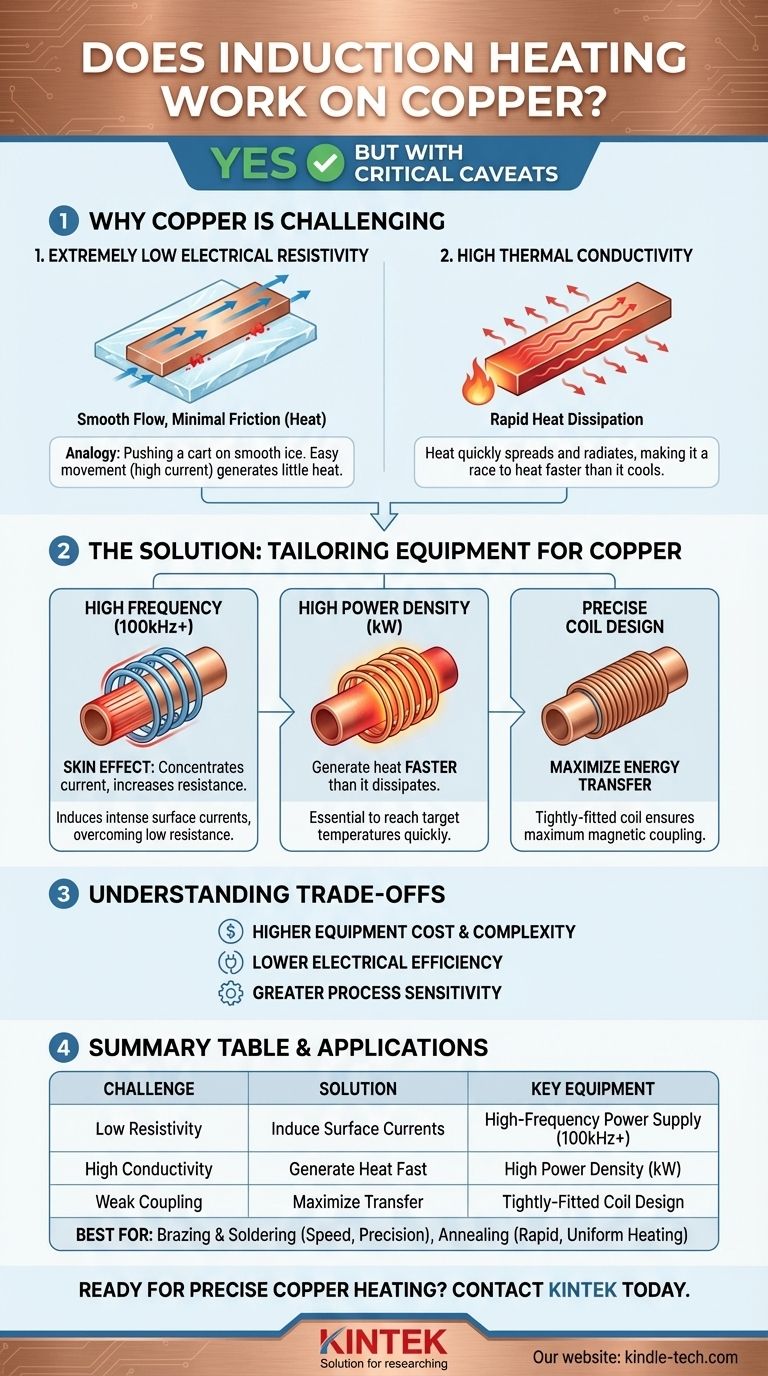
Visual Guide
Related Products
- 600T Vacuum Induction Hot Press Furnace for Heat Treat and Sintering
- Lab-Scale Vacuum Induction Melting Furnace
- Infrared Heating Quantitative Flat Plate Press Mold
- Multi Heating Zones CVD Tube Furnace Machine Chemical Vapor Deposition Chamber System Equipment
- 10L Heating Chilling Circulator Cooling Water Bath Circulator for High and Low Temperature Constant Temperature Reaction
People Also Ask
- What role does a Vacuum Hot Press (VHP) furnace play in the densification of austenitic stainless steel 316 composites?
- What are the advantages of a vacuum hot press furnace for W-50%Cu? Achieve 99.6% Density at Lower Temperatures
- Why is precise pressure control from a vacuum hot press furnace necessary for IZO ceramic targets? Ensure High Density
- What advantages does a vacuum hot press furnace provide for LSLBO ceramic electrolytes? Achieve 94% Relative Density
- What core challenges does a vacuum hot press furnace address? Achieve Superior WCp/Cu FGM Structural Integrity