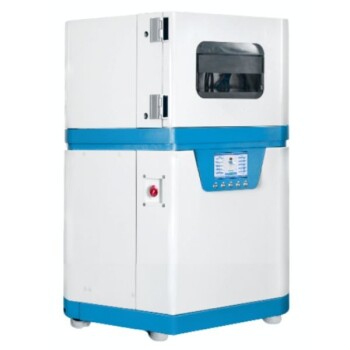
A vacuum hot press furnace facilitates the preparation of high-density LSLBO ceramic electrolytes by simultaneously applying high temperatures and uniaxial mechanical pressure. This dual-application of energy significantly lowers the required sintering temperature and enables the material to achieve a relative density of 94% without the need for sintering additives.
The core advantage lies in the pressure-assisted sintering mechanism, which actively promotes particle rearrangement and plastic flow, resulting in a structural density and purity superior to that of conventional pressureless sintering.
The Mechanics of Pressure-Assisted Sintering
Simultaneous Thermal and Mechanical Stress
Unlike conventional methods that rely solely on thermal energy, a vacuum hot press furnace applies uniaxial mechanical pressure alongside heat.
This combination provides an additional driving force for densification, allowing the ceramic particles to fuse more effectively.
Lowering the Activation Energy
The applied pressure significantly reduces the sintering densification temperature required for the ceramic.
This is critical for LSLBO electrolytes, as it allows the material to densify fully without reaching extreme temperatures that might degrade the material phases.
Enhanced Particle Rearrangement
The mechanical pressure induces plastic flow and rearrangement of the ceramic particles.
This physical movement forces particles into voids and gaps that thermal energy alone might not eliminate, resulting in a much more compact final structure.
Impact on Material Quality
Superior Relative Density
The primary metric of success for solid-state electrolytes is density; higher density typically correlates with better ionic conductivity.
Using a vacuum hot press, LSLBO samples can achieve a relative density of 94%, a figure that is difficult to reach using standard pressureless sintering methods.
Eliminating Sintering Additives
Because the mechanical pressure assists densification, there is no need to introduce sintering additives to lower the melting point.
This results in a purer electrolyte, avoiding the introduction of impurities that could impede lithium-ion conduction or cause chemical instability.
Microstructural Stability
The vacuum environment suppresses the volatilization of unstable elements at high temperatures, preserving the chemical composition of the electrolyte.
Furthermore, the rapid densification at lower temperatures helps create a high-density microstructure while effectively inhibiting excessive grain growth, which is essential for mechanical strength.
Understanding the Trade-offs
Geometry Limitations
Vacuum hot pressing is generally limited to simple shapes, such as flat disks or plates, due to the uniaxial nature of the pressure application.
It is not suitable for creating complex, three-dimensional electrolyte geometries without extensive post-processing.
Scalability and Cost
This is a batch process that is inherently slower and more expensive than continuous sintering methods.
While it produces superior material properties for research and high-performance applications, the throughput is lower compared to conventional box furnaces.
Making the Right Choice for Your Goal
When deciding between vacuum hot pressing and conventional sintering for LSLBO electrolytes, consider your specific performance targets:
- If your primary focus is maximizing ionic conductivity: The vacuum hot press is essential to reduce grain boundaries and achieve the high density (94%) required for optimal performance.
- If your primary focus is material purity: Choose this method to avoid sintering additives, ensuring the electrolyte chemistry remains uncompromised.
- If your primary focus is mass production: Be aware that while the quality is superior, the vacuum hot press method may present bottlenecks in throughput compared to pressureless sintering.
Ultimately, for high-performance LSLBO electrolytes where density and purity are non-negotiable, vacuum hot pressing offers the most reliable path to success.
Summary Table:
| Feature | Vacuum Hot Pressing | Conventional Sintering |
|---|---|---|
| Relative Density | High (Up to 94%) | Moderate to Low |
| Sintering Additives | Not Required (High Purity) | Often Necessary |
| Temperature | Lower Required Temperature | High Temperature Required |
| Mechanism | Thermal + Uniaxial Pressure | Thermal Energy Only |
| Grain Growth | Inhibited (Controlled) | Often Excessive |
| Atmosphere | Controlled Vacuum | Ambient or Gas Flow |
Elevate Your Material Research with KINTEK
Achieve uncompromising material purity and density in your solid-state electrolyte development. KINTEK specializes in advanced laboratory equipment, offering high-performance vacuum hot press furnaces and hydraulic presses designed to meet the rigorous demands of ceramic research.
From high-temperature furnaces and crushing systems to precision battery research tools, our comprehensive portfolio ensures your lab has the cutting-edge technology needed for breakthrough results.
Ready to optimize your sintering process? Contact us today to find the perfect solution for your lab!
Related Products
- Vacuum Hot Press Furnace Heated Vacuum Press Machine Tube Furnace
- 600T Vacuum Induction Hot Press Furnace for Heat Treat and Sintering
- Vacuum Hot Press Furnace Machine Heated Vacuum Press
- Vacuum Hot Press Furnace Machine for Lamination and Heating
- Vacuum Heat Treat and Pressure Sintering Furnace for High Temperature Applications
People Also Ask
- What role does a Vacuum Hot Press (VHP) furnace play in the densification of austenitic stainless steel 316 composites?
- What are the advantages of using a vacuum hot pressing furnace? Superior Densification for 2024Al/Gr/SiC Composites
- What are the advantages of a vacuum hot press furnace for LTPO solid electrolytes? Boost Density and Conductivity
- What core processing conditions does a vacuum hot press furnace provide? Achieve High-Density Cu-SiC/Diamond Composites
- How does a vacuum hot press furnace achieve the densification of ZrB2–SiC–TaC? Unlock Ultra-High Ceramic Density