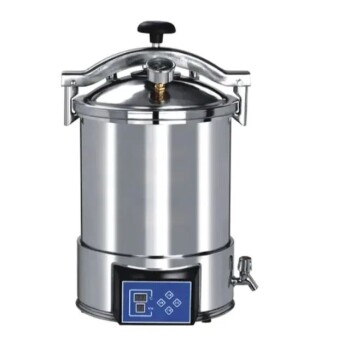
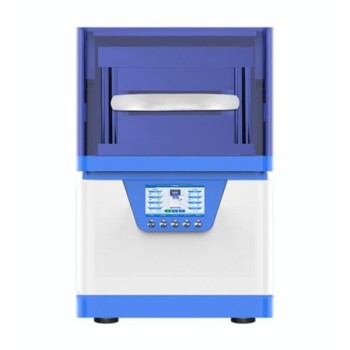
High-pressure autoclaves are utilized primarily to facilitate the hydrothermal or solvothermal synthesis of nanoscale inorganic fillers, such as garnet-type oxide nanowires. These devices provide the necessary sealed, high-temperature, and high-pressure environment required to drive the directional growth of crystals into specific, functional morphologies for use in composite polymer electrolytes.
The core value of using a high-pressure autoclave lies in its ability to control crystal morphology. By enforcing specific environmental conditions, it transforms inorganic materials into nanowires that act as rapid ion transport channels within the final composite electrolyte.
The Role of the Autoclave in Synthesis
Enabling Hydrothermal and Solvothermal Processes
The synthesis of advanced additives often requires reaction conditions that exceed the boiling points of solvents.
High-pressure autoclaves serve as sealed vessels that allow solvents to reach these elevated temperatures and pressures safely. This creates a unique chemical environment where precursor materials can dissolve and react in ways that are impossible under standard atmospheric conditions.
Promoting Directional Crystal Growth
The specific purpose of this high-pressure environment is to influence how the inorganic crystals form.
Rather than growing into random or irregular particles, the conditions inside the autoclave promote directional growth. This is essential for synthesizing specific shapes, such as nanowires, which have distinct structural advantages over spherical particles.
Targeting Garnet-Type Oxide Nanowires
The primary reference highlights the production of garnet-type oxide nanowires as a key application.
The autoclave ensures these oxides develop the high aspect ratio required for their function. This specific morphology is difficult to achieve without the precise containment and thermal energy provided by the vessel.
Impact on Electrolyte Performance
Creating Rapid Ion Transport Channels
The physical shape of the additive directly influences the performance of the composite polymer electrolyte.
When the nanowires synthesized in the autoclave are integrated into a polymer matrix, they create continuous pathways. These pathways facilitate rapid ion transport, significantly improving the conductivity of the electrolyte compared to those using non-optimized fillers.
Operational Considerations and Constraints
Sensitivity to Process Parameters
While autoclaves enable precise synthesis, the process is highly sensitive to the internal conditions.
Variations in temperature or pressure during the holding time can alter the crystal growth direction. If the conditions are not maintained strictly, the resulting filler may lack the nanowire morphology necessary for optimal ion transport.
Batch Processing Limitations
Hydrothermal synthesis in autoclaves is typically a batch process.
This limits the volume of material that can be produced in a single run. For large-scale applications, ensuring consistency across multiple batches of nanowire synthesis remains a critical technical challenge.
Optimizing Synthesis for Electrolyte Applications
To leverage high-pressure autoclaves effectively for composite electrolytes, consider the following strategic alignments:
- If your primary focus is enhancing conductivity: Prioritize reaction parameters that maximize the length and uniformity of the nanowires to create longer ion transport highways.
- If your primary focus is material integration: Focus on the solvothermal conditions that ensure the garnet-type oxides are chemically compatible with your specific polymer matrix.
The high-pressure autoclave is not just a heating vessel; it is the architectural tool that defines the microscopic structure necessary for macroscopic electrolyte performance.
Summary Table:
| Feature | Role in Additive Synthesis | Impact on Electrolyte |
|---|---|---|
| Hydrothermal Processing | Enables reactions above solvent boiling points | Synthesis of high-purity inorganic fillers |
| Controlled Environment | Facilitates directional crystal growth | Formation of high-aspect-ratio nanowires |
| Morphology Control | Transforms oxides into 1D nanostructures | Creates continuous rapid ion transport channels |
| Pressure Stability | Maintains phase consistency during synthesis | Ensures uniform conductivity across the polymer matrix |
Elevate Your Material Research with KINTEK
Precise morphology control is the key to high-performance composite electrolytes. KINTEK specializes in providing the advanced laboratory equipment needed to achieve these results, including high-temperature high-pressure reactors and autoclaves, muffle and vacuum furnaces, and comprehensive battery research tools.
Whether you are synthesizing garnet-type nanowires or developing next-generation polymer matrices, our precision-engineered systems ensure consistent pressure and thermal stability for every batch.
Ready to optimize your synthesis process? Contact our technical experts today to find the perfect autoclave or high-pressure solution tailored to your research goals.
Related Products
- High Pressure Laboratory Autoclave Reactor for Hydrothermal Synthesis
- Mini SS High Pressure Autoclave Reactor for Laboratory Use
- Stainless High Pressure Autoclave Reactor Laboratory Pressure Reactor
- Desktop Fast High Pressure Laboratory Autoclave Sterilizer 16L 24L for Lab Use
- Laboratory High Pressure Horizontal Autoclave Steam Sterilizer for Lab Use
People Also Ask
- What role does a high-pressure reactor (autoclave) play in the synthesis of NiCuFe-LDH? Master Hydrothermal Growth
- What Role Does a High-Pressure Reactor or Autoclave Play in HA Catalyst Synthesis? Achieve High Surface Area Materials
- What equipment is required for hydrothermal synthesis of Ga0.25Zn4.67S5.08? Optimize Your Semiconductor Production
- What is the function of a high-pressure reactor in the hydrothermal synthesis of boehmite? Expert Process Insights
- What role does an autoclave play in the synthesis of MnO2 nanofibers? Mastering Hydrothermal Growth