Knowledge How do you sterilize glassware by autoclave? Master the 3-Step Process for Reliable Sterility
Author avatar

Tech Team · Kintek Solution

Updated 6 days ago

How do you sterilize glassware by autoclave? Master the 3-Step Process for Reliable Sterility


To sterilize glassware by autoclave, you must use a cycle that employs pressurized steam at a minimum of 121°C (250°F) for at least 15-20 minutes. The core process involves properly cleaning and preparing the glassware, loading it to allow for steam penetration, and selecting the correct autoclave cycle—typically a "gravity" or "dry goods" cycle.

The key to successful sterilization is not just heat, but pressurized moist heat. An autoclave works by using steam under pressure to raise the boiling point of water, ensuring that this high-temperature moisture penetrates and destroys all microorganisms, including heat-resistant bacterial spores.

The Core Principle: How an Autoclave Achieves Sterility

Pressurized Steam, Not Just Dry Heat

An autoclave is essentially a highly controlled pressure cooker. By increasing the pressure inside its chamber, it forces water to remain liquid and turn to steam at temperatures far above its normal boiling point.

This superheated steam is the active sterilizing agent. It carries significantly more thermal energy than dry air at the same temperature, allowing for rapid and deep heat penetration.

The Role of Moist Heat

The moisture in the steam is critical. It efficiently transfers heat to any microorganisms present on the glassware.

This process, known as moist heat sterilization, kills microbes by irreversibly coagulating and denaturing their essential proteins and enzymes, a much faster and more effective method than simply baking them with dry heat.

The Three Phases of an Autoclave Cycle

Every autoclave cycle, regardless of the specific setting, proceeds through three fundamental phases. Understanding them is crucial for troubleshooting and ensuring success.

Phase 1: The Purge Phase

Once the door is sealed, the autoclave begins injecting steam into the chamber to displace the cooler, denser air. Air is a poor conductor of heat, and any trapped pockets will create "cold spots" where sterilization fails.

This phase is complete when all air has been flushed out and the chamber is filled only with pressurized steam.

Phase 2: The Sterilization (Exposure) Phase

During this phase, the autoclave's exhaust valve closes, allowing pressure and temperature to ramp up to the desired setpoint (e.g., 121°C and 15 psi).

The sterilization timer only begins once the target temperature is reached. The duration must be long enough for the superheated steam to penetrate the entire load and kill all microbial life.

Phase 3: The Exhaust Phase

Once the sterilization time is complete, the exhaust valve opens to release pressure from the chamber.

For glassware and other dry goods, a relatively fast exhaust is used, often followed by a heated drying phase to remove residual moisture. For sterilizing liquids, a very slow exhaust is critical to prevent the liquid from boiling over.

Understanding the Trade-offs and Limitations

What Not to Autoclave

An autoclave is a powerful tool, but its high heat and pressure will destroy certain materials. Never autoclave:

  • Heat-sensitive plastics: Many plastics will melt or deform. Only use plastics explicitly rated as "autoclavable" (like polypropylene or polycarbonate).
  • Oils and powders: Steam cannot effectively penetrate these water-insoluble substances. Dry heat sterilization is required instead.
  • Corrosive or volatile chemicals: Substances like bleach or solvents can emit toxic fumes and damage the autoclave chamber.
  • Sharp carbon-steel instruments: The high heat and moisture will dull the edges of non-stainless steel blades.

The Risk of Improper Preparation

The most common cause of sterilization failure is human error.

  • Overcrowding the chamber prevents steam from circulating freely, creating cold spots.
  • Using sealed containers creates a risk of explosion as pressure builds inside. Always loosen the caps on bottles by at least a half-turn.
  • Failing to clean glassware first allows dirt and debris to shield microorganisms from the steam. Sterilization is not a substitute for cleaning.

Making the Right Choice for Your Goal

To ensure complete and safe sterilization, match your preparation and cycle selection to the specific items you are processing.

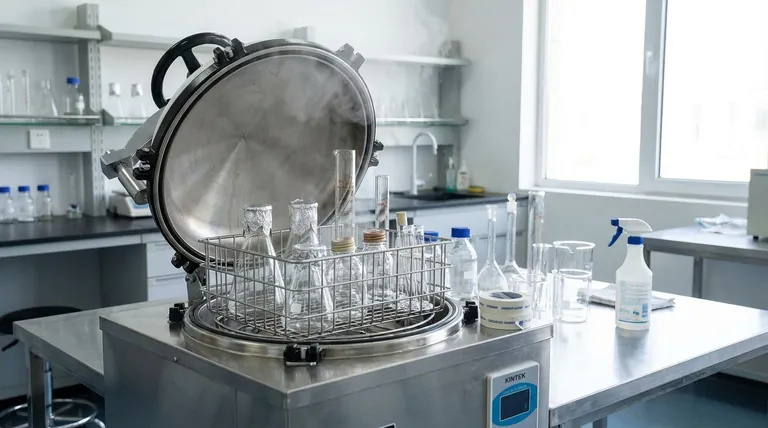
  • If your primary focus is sterilizing empty glassware (beakers, flasks): Ensure items are clean, cover openings with aluminum foil, and use a standard "gravity" or "dry goods" cycle.
  • If your primary focus is sterilizing screw-cap bottles or tubes: Loosen the caps significantly (a half- to full-turn) to allow pressure to equalize, preventing the glassware from shattering.
  • If your primary focus is sterilizing liquids inside the glassware: Use a dedicated "liquid" or "slow exhaust" cycle to prevent the superheated liquid from boiling over violently during depressurization.

Mastering these principles ensures your glassware is a reliable foundation for your work, not a source of contamination.
How do you sterilize glassware by autoclave? Master the 3-Step Process for Reliable Sterility

Summary Table:

Key Factor Requirement
Sterilizing Temperature 121°C (250°F) minimum
Sterilizing Time 15-20 minutes (after reaching temperature)
Recommended Cycle Gravity or Dry Goods cycle
Critical Preparation Clean glassware, loosen caps, allow steam penetration

Ensure your laboratory's glassware is consistently and reliably sterile. KINTEK specializes in providing high-quality autoclaves and lab equipment designed for precise, effective sterilization cycles. Whether you need to process glassware, liquids, or other materials, our solutions deliver the performance and safety your lab requires. Contact our experts today to find the perfect autoclave for your specific laboratory needs.

Visual Guide
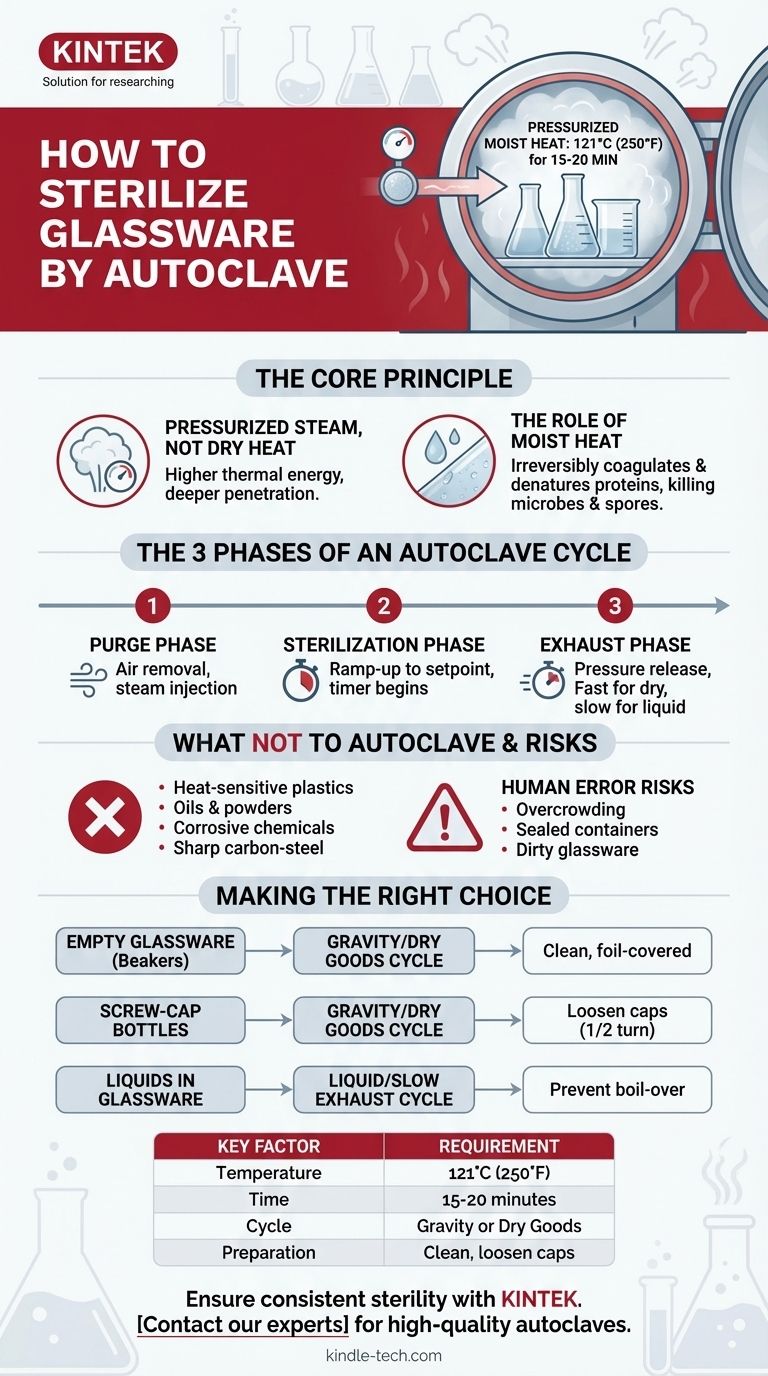
How do you sterilize glassware by autoclave? Master the 3-Step Process for Reliable Sterility Visual Guide

Related Products

People Also Ask

Related Products

Laboratory Sterilizer Lab Autoclave Vertical Pressure Steam Sterilizer for Liquid Crystal Display Automatic Type

Laboratory Sterilizer Lab Autoclave Vertical Pressure Steam Sterilizer for Liquid Crystal Display Automatic Type

Liquid crystal display automatic vertical sterilizer is a safe, reliable and automatic control sterilization equipment, which is composed of heating system, microcomputer control system and overheating and overvoltage protection system.

Laboratory Sterilizer Lab Autoclave Herbal Powder Sterilization Machine for Plant

Laboratory Sterilizer Lab Autoclave Herbal Powder Sterilization Machine for Plant

The herbal powder sterilization autoclave machine for Chinese medicine uses saturated steam for effective sterilization. It utilizes the heat and penetrative properties of steam, achieves sterilization after heat preservation, and maintains a good drying effect with a dedicated drying system.

Laboratory High Pressure Steam Sterilizer Vertical Autoclave for Lab Department

Laboratory High Pressure Steam Sterilizer Vertical Autoclave for Lab Department

Vertical pressure steam sterilizer is a kind of sterilization equipment with automatic control, which is composed of heating system, microcomputer control system and overheating and overpressure protection system.

Portable Digital Display Automatic Laboratory Sterilizer Lab Autoclave for Sterilization Pressure

Portable Digital Display Automatic Laboratory Sterilizer Lab Autoclave for Sterilization Pressure

Portable autoclave sterilization pressure is a device that uses pressure saturated steam to quickly and effectively sterilize items.

Desktop Fast Laboratory Autoclave Sterilizer 20L 24L for Lab Use

Desktop Fast Laboratory Autoclave Sterilizer 20L 24L for Lab Use

The desktop fast steam sterilizer is a compact and reliable device used for rapid sterilization of medical, pharmaceutical, and research items.

Portable High Pressure Laboratory Autoclave Steam Sterilizer for Lab Use

Portable High Pressure Laboratory Autoclave Steam Sterilizer for Lab Use

Portable autoclave sterilization pressure is a device that uses pressure saturated steam to quickly and effectively sterilize items.

Desktop Fast Laboratory Autoclave Sterilizer 35L 50L 90L for Lab Use

Desktop Fast Laboratory Autoclave Sterilizer 35L 50L 90L for Lab Use

The desktop fast steam sterilizer is a compact and reliable device used for rapid sterilization of medical, pharmaceutical, and research items. It efficiently sterilizes surgical instruments, glassware, medicines, and resistant materials, making it suitable for various applications.

Laboratory Sterilizer Lab Autoclave Pulse Vacuum Lifting Sterilizer

Laboratory Sterilizer Lab Autoclave Pulse Vacuum Lifting Sterilizer

The pulse vacuum lifting sterilizer is a state-of-the-art equipment for efficient and precise sterilization. It uses pulsating vacuum technology, customizable cycles, and a user-friendly design for easy operation and safety.

Laboratory Sterilizer Lab Autoclave Pulsating Vacuum Desktop Steam Sterilizer

Laboratory Sterilizer Lab Autoclave Pulsating Vacuum Desktop Steam Sterilizer

The pulsating vacuum desktop steam sterilizer is a compact and reliable device used for rapid sterilization of medical, pharmaceutical, and research items.

Laboratory High Pressure Horizontal Autoclave Steam Sterilizer for Lab Use

Laboratory High Pressure Horizontal Autoclave Steam Sterilizer for Lab Use

The horizontal autoclave steam sterilizer adopts the gravity displacement method to remove the cold air in the inner chamber, so that the inner steam and cold air content is less, and the sterilization is more reliable.

Laboratory Horizontal Autoclave Steam Sterilizer Lab Microcomputer Sterilizer

Laboratory Horizontal Autoclave Steam Sterilizer Lab Microcomputer Sterilizer

The horizontal autoclave steam sterilizer adopts the method of gravity displacement to remove the cold air in the inner chamber, so that the content of steam cold air in the inner chamber is less, and the sterilization is more reliable.

Desktop Fast High Pressure Laboratory Autoclave Sterilizer 16L 24L for Lab Use

Desktop Fast High Pressure Laboratory Autoclave Sterilizer 16L 24L for Lab Use

The desktop fast steam sterilizer is a compact and reliable device used for rapid sterilization of medical, pharmaceutical, and research items.

Lab Sterile Slapping Type Homogenizer for Tissue Mashing and Dispersing

Lab Sterile Slapping Type Homogenizer for Tissue Mashing and Dispersing

The slapping sterile homogenizer can effectively separate the particles contained in and on the surface of solid samples, ensuring that the mixed samples in the sterile bag are fully representative.

Customizable Laboratory High Temperature High Pressure Reactors for Diverse Scientific Applications

Customizable Laboratory High Temperature High Pressure Reactors for Diverse Scientific Applications

High-pressure lab reactor for precise hydrothermal synthesis. Durable SU304L/316L, PTFE liner, PID control. Customizable volume & materials. Contact us!

Heated Hydraulic Press Machine with Integrated Manual Heated Plates for Lab Use

Heated Hydraulic Press Machine with Integrated Manual Heated Plates for Lab Use

Efficiently process heat-pressing samples with our Integrated Manual Heated Lab Press. With a heating range up to 500°C, it's perfect for various industries.

Automatic Laboratory Heat Press Machine

Automatic Laboratory Heat Press Machine

Precision automatic heat press machines for labs—ideal for material testing, composites, and R&D. Customizable, safe, and efficient. Contact KINTEK today!

Low-Temperature Water-Cooled Touchscreen Vibratory Ultrafine Pulverizer

Low-Temperature Water-Cooled Touchscreen Vibratory Ultrafine Pulverizer

Low-temperature water-cooled vibratory pulverizer for ultrafine grinding. Preserves material integrity. Ideal for labs and production. Learn more.

Manual Heated Hydraulic Press Machine with Heated Plates for Laboratory Hot Press

Manual Heated Hydraulic Press Machine with Heated Plates for Laboratory Hot Press

The Manual Heat Press is a versatile piece of equipment suitable for a variety of applications, operated by a manual hydraulic system that applies controlled pressure and heat to the material placed on the piston.

50L Heating Chilling Circulator Cooling Water Bath Circulator for High and Low Temperature Constant Temperature Reaction

50L Heating Chilling Circulator Cooling Water Bath Circulator for High and Low Temperature Constant Temperature Reaction

Experience versatile heating, chilling, and circulating capabilities with our KinTek KCBH 50L Heating Chilling Circulator. Ideal for labs and industrial settings, with efficient and reliable performance.

Double Plate Heating Press Mold for Lab

Double Plate Heating Press Mold for Lab

Discover precision in heating with our Double Plate Heating Mold, featuring high-quality steel and uniform temperature control for efficient lab processes. Ideal for various thermal applications.


Leave Your Message