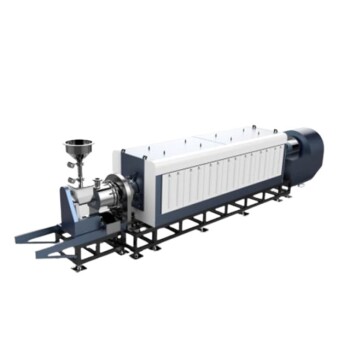
The high-pressure hydrothermal reactor serves as a precision engineering tool that creates a closed, constant environment of elevated temperature and pressure. This forces the aqueous solution into a subcritical state, significantly enhancing the solubility of precursors and driving the rapid dissolution and recrystallization required to synthesize mesoporous hydroxyapatite powders.
By creating conditions that exceed standard boiling points, these reactors enable the controlled self-assembly of crystal structures. This allows for the precise embedding of functional groups and the creation of vast surface areas, properties that are essential for high-performance water purification catalysts.
The Physics of the Reaction Environment
Creating Subcritical Conditions
The reactor maintains a sealed environment where temperatures and pressures rise well above the normal boiling point of solvents.
This pushes the aqueous solution into a subcritical state, a unique phase where the physical properties of water change to favor chemical synthesis.
Enhancing Solubility and Kinetics
In this high-pressure state, the solubility of raw precursor materials increases significantly.
Simultaneously, the reaction kinetics are accelerated, ensuring that reactants interact more efficiently than they would under atmospheric conditions.
Ensuring Phase Purity
The closed system prevents the loss of volatile components and external contamination.
This isolation guarantees high phase purity, ensuring the final hydroxyapatite possesses the correct chemical composition without unwanted byproducts.
Mechanisms of Structural Control
Dissolution and Recrystallization
The primary mechanism facilitated by the reactor is a continuous cycle of dissolution and recrystallization.
Raw materials dissolve in the superheated fluid and precipitate back out in a controlled manner, allowing the material to reorganize into a highly ordered mesoporous structure.
Precision Doping for Catalysis
The reactor allows for the precise introduction of catalytic agents, specifically molybdate anions, into the hydroxyapatite lattice.
Because the environment is stable, these anions are embedded uniformly, which is critical for the material's performance in heterogeneous chemical oxidation reactions.
Regulating Pore Architecture
By manipulating the temperature and exposure duration, operators can fine-tune the pore size distribution.
This control creates a high specific surface area, maximizing the number of active sites available for trapping contaminants like heavy metals.
Understanding the Trade-offs
The Necessity of Precision
While powerful, the hydrothermal process is highly sensitive to process variables.
Slight deviations in temperature or pressure distribution can lead to inconsistent particle morphology or a collapse of the mesoporous structure.
Complexity of Scale-up
Achieving the same level of reproducibility found in laboratory-scale reactors can be challenging when moving to larger volumes.
The stability of the doping process (e.g., introducing molybdate) relies on maintaining uniform conditions throughout the entire vessel, which becomes more difficult as reactor size increases.
Making the Right Choice for Your Goal
To maximize the efficacy of your mesoporous hydroxyapatite, you must tune the reactor parameters to your specific purification target.
- If your primary focus is Adsorption Capacity: Prioritize the dissolution-recrystallization balance to maximize specific surface area and pore volume for trapping ions.
- If your primary focus is Catalytic Activity: Focus on the precise control of molybdate anion concentration and doping stability to enhance chemical oxidation performance.
The high-pressure hydrothermal reactor is not just a heating vessel; it is a sophisticated instrument for molecular architecture, turning raw chemicals into highly specialized purification tools.
Summary Table:
| Key Feature | Hydrothermal Impact on Hydroxyapatite Synthesis |
|---|---|
| Environment | Closed system creating subcritical aqueous phases |
| Mechanism | Rapid dissolution and controlled recrystallization |
| Structural Control | Precise pore architecture and high specific surface area |
| Functionalization | Uniform doping of molybdate anions for catalysis |
| End Result | High phase purity with optimized catalytic activity |
Elevate Your Materials Synthesis with KINTEK Precision
Unlock the full potential of your catalyst research with KINTEK’s advanced high-temperature high-pressure reactors and autoclaves. Whether you are developing mesoporous hydroxyapatite for water purification or engineering complex nanostructures, our reactors provide the stability and precision required for critical dissolution-recrystallization processes.
Why choose KINTEK?
- Unmatched Precision: Maintain exact subcritical conditions for consistent phase purity.
- Versatile Solutions: From lab-scale reactors to full-scale crushing, milling, and cooling systems.
- Comprehensive Portfolio: We offer everything from CVD systems and hydraulic presses to specialized PTFE and ceramic consumables.
Ready to optimize your lab’s efficiency and research outcomes? Contact our technical experts today to find the perfect hydrothermal solution for your target application.
References
- Madalina Cruceru. Small detectors with inorganic scintillator crystals of CsI(Tl) for gamma radiation and heavy ions detection. DOI: 10.21175/rad.abstr.book.2023.32.5
This article is also based on technical information from Kintek Solution Knowledge Base .
Related Products
- Customizable Laboratory High Temperature High Pressure Reactors for Diverse Scientific Applications
- High Pressure Laboratory Autoclave Reactor for Hydrothermal Synthesis
- Customizable High Pressure Reactors for Advanced Scientific and Industrial Applications
- Stainless High Pressure Autoclave Reactor Laboratory Pressure Reactor
- Mini SS High Pressure Autoclave Reactor for Laboratory Use
People Also Ask
- How do high-pressure and high-temperature reactors ensure the effective treatment of lignocellulosic wastewater in WAO?
- What equipment is required for high-pressure high-temperature reactions? Master Extreme Chemistry Safely
- How do you control high pressure in a reactor? A Guide to Safe & Stable Operation
- How does initial oxygen pressure affect the wet oxidation of pharmaceutical sludge? Master Your Oxidation Depth
- Why is argon better than nitrogen for inert atmosphere? Ensure Absolute Reactivity & Stability