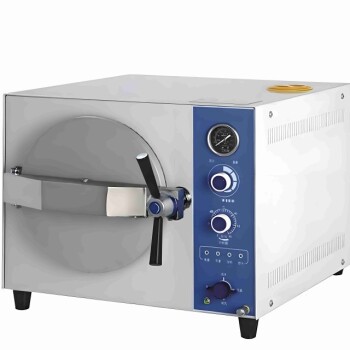
The high-pressure hydrothermal synthesis autoclave is strictly necessary because it generates a sealed, thermodynamic environment that is impossible to replicate under standard atmospheric conditions. This vessel allows reaction temperatures to exceed the boiling point of the solvent, creating the internal pressure required to precisely control the nucleation and growth kinetics of manganese dioxide (MnO2) crystals.
Without this pressurized containment, you cannot force the MnO2 to self-assemble into the specific nanowire structures (high aspect ratios) required for high-performance catalysis.
The autoclave provides the critical high-temperature and high-pressure conditions needed to synthesize specific crystalline phases, such as alpha-MnO2. This directional growth into nanowires maximizes the electrochemical active surface area, which is the primary driver for improved oxygen reduction reaction efficiency in applications like Microbial Fuel Cells.
The Physics of Controlled Growth
Surpassing Atmospheric Limits
In an open beaker, a solvent cannot exceed its boiling point. In a sealed autoclave, however, the pressure generated by heating allows the solvent to remain liquid at temperatures well above its standard boiling point (e.g., 125°C or 150°C).
This creates a subcritical or near-supercritical environment. Under these conditions, the solubility of precursors improves, and reaction rates are significantly accelerated.
Tuning Nucleation and Kinetics
The core challenge in nanomaterial synthesis is controlling how crystals start (nucleation) and how they get bigger (growth kinetics).
The autoclave allows you to manipulate these rates by adjusting temperature, pressure, and fill volume. This control ensures that the MnO2 grows directionally into nanowires or nanorods rather than precipitating as random, amorphous clumps.
Why Morphology Matters for Catalysis
Achieving High Aspect Ratios
The primary goal of using an autoclave for MnO2 is to achieve a high aspect ratio.
This means creating structures that are very long and very thin. This morphology exposes a significantly larger amount of the material's surface to the surrounding electrolyte compared to spherical particles.
Increasing Active Surface Area
Catalysis happens on the surface. By synthesizing nanowires, you drastically increase the electrochemical active surface area.
This allows for more active sites where the Oxygen Reduction Reaction (ORR) can occur. This is directly linked to the enhanced performance seen in Microbial Fuel Cell cathodes and biological oxygen demand (BOD) sensors.
Selecting the Crystalline Phase
Different applications require different crystal structures.
The high-pressure environment facilitates the transformation of precursors into specific polymorphs, such as alpha-MnO2 or beta-MnO2. These phases possess unique tunnel structures that facilitate ion movement, further boosting catalytic activity.
Understanding the Trade-offs
Material Purity and Corrosion
While the autoclave enables high performance, it introduces the risk of contamination. The reaction environment often involves strong oxidants that can corrode the reactor walls.
To mitigate this, PTFE (Teflon) liners are essential. They resist corrosion at high temperatures (e.g., 125°C), ensuring that metallic impurities from the steel vessel do not leach into your catalyst and alter its electrochemical properties.
Complexity of Parameter Optimization
The "sealed black box" nature of an autoclave makes real-time monitoring difficult.
You must rely on precise pre-calculation of filling degrees and temperatures. Slight deviations in these parameters can lead to unintended morphologies, requiring an iterative, trial-and-error approach to perfect the synthesis recipe.
Making the Right Choice for Your Goal
To maximize the utility of your hydrothermal synthesis, align your process parameters with your specific catalytic needs:
- If your primary focus is Maximum Catalytic Activity: Prioritize temperature and pressure settings that favor the formation of alpha-MnO2 nanowires, as their high aspect ratio provides the greatest electrochemical surface area.
- If your primary focus is Catalyst Purity: Ensure your autoclave utilizes a high-quality PTFE liner to prevent corrosion from strong oxidants, which is critical for maintaining the chemical integrity of the MnO2 lattice.
Ultimately, the autoclave is not just a heating vessel; it is a precision tool for forcing chaos into order, turning raw chemicals into highly structured, high-performance nanowires.
Summary Table:
| Feature | Hydrothermal Autoclave Benefit | Impact on MnO2 Nanowires |
|---|---|---|
| Environment | Sealed, high-pressure/high-temperature | Facilitates subcritical solvent states for precursor solubility. |
| Growth Control | Precise nucleation & growth kinetics | Ensures directional growth into high aspect ratio nanowires. |
| Morphology | Controlled crystalline phases (e.g., alpha-MnO2) | Increases electrochemical active surface area for ORR efficiency. |
| Purity | PTFE-lined containment | Prevents metallic contamination and corrosion from strong oxidants. |
Elevate Your Nanomaterial Synthesis with KINTEK
Precision in catalysis starts with the right environment. KINTEK specializes in high-performance laboratory equipment designed to meet the rigorous demands of advanced materials research. Whether you are synthesizing MnO2 nanowires or developing next-generation energy solutions, our high-temperature high-pressure reactors and autoclaves provide the stability and control you need.
From corrosion-resistant PTFE-lined vessels to specialized crushing, milling, and furnace systems, KINTEK offers a comprehensive range of tools—including electrolytic cells, electrodes, and battery research consumables—to drive your innovation forward.
Ready to optimize your hydrothermal process? Contact KINTEK today to find the perfect equipment for your lab!
References
- K. Elangovan, Ramalinga Viswanathan Mangalaraja. Outline of microbial fuel cells technology and their significant developments, challenges, and prospects of oxygen reduction electrocatalysts. DOI: 10.3389/fceng.2023.1228510
This article is also based on technical information from Kintek Solution Knowledge Base .
Related Products
- High Pressure Laboratory Autoclave Reactor for Hydrothermal Synthesis
- Mini SS High Pressure Autoclave Reactor for Laboratory Use
- Stainless High Pressure Autoclave Reactor Laboratory Pressure Reactor
- Laboratory High Pressure Horizontal Autoclave Steam Sterilizer for Lab Use
- Customizable Laboratory High Temperature High Pressure Reactors for Diverse Scientific Applications
People Also Ask
- What role does a high-pressure reactor (autoclave) play in the synthesis of NiCuFe-LDH? Master Hydrothermal Growth
- What Role Does a High-Pressure Reactor or Autoclave Play in HA Catalyst Synthesis? Achieve High Surface Area Materials
- What equipment is required for hydrothermal synthesis of Ga0.25Zn4.67S5.08? Optimize Your Semiconductor Production
- What is the function of a high-pressure reactor in the hydrothermal synthesis of boehmite? Expert Process Insights
- What role does an autoclave play in the synthesis of MnO2 nanofibers? Mastering Hydrothermal Growth