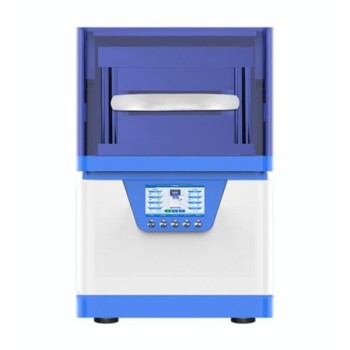
Precision laboratory ovens serve as controlled environments for thermal shrinkage testing, which is critical for determining the dimensional stability of lithium metal battery separators. By exposing separator materials to specific temperature gradients—often ranging from 20°C up to 250°C—researchers can quantify physical deformation and assess the risk of catastrophic battery failure.
The core function of a precision laboratory oven in battery research is to simulate extreme thermal stress to measure separator shrinkage. Identifying materials that maintain dimensional integrity at high temperatures is essential for preventing internal short circuits and ensuring the safety of high-energy-density cells.
Quantifying Thermal Shrinkage and Dimensional Stability
The Role of Controlled Temperature Gradients
Precision ovens allow researchers to heat separator samples through a precise temperature gradient. This systematic heating process helps determine the exact point at which a material begins to lose its structural integrity.
By maintaining a stable environment, the oven ensures that any observed deformation is a result of the material's properties rather than temperature fluctuations. This stability is vital for producing repeatable and peer-reviewed data.
Measuring Dimensional Changes
During testing, separators made of various materials—such as polypropylene (PP), cellulose, or ZnO@C coated composites—are placed within the oven. Researchers measure the "before and after" dimensions to calculate a percentage of shrinkage.
Materials that exhibit minimal dimensional changes at elevated temperatures are prioritized for lithium metal batteries. High thermal stability is the primary defense against internal short circuits caused by the separator pulling away from the electrodes.
Beyond Shrinkage: Performance and Abuse Testing
Activating Ionic Conductivity
In the development of solid-state batteries, precision ovens are used to provide a steady environment, typically between 60°C and 100°C. This specific range is often necessary to activate the ionic conductivity of polymer electrolytes.
Without this controlled heat, the electrolyte may not function efficiently, making the oven an essential tool for evaluating the baseline performance of new battery chemistries.
Thermal Abuse and Recovery
Ovens are also employed for thermal abuse recovery tests, where batteries are pushed to their thermal limits to see if they can recover or if they fail catastrophically. This simulates real-world scenarios where a battery might be left in a hot vehicle or undergo a fast-charging cycle.
These tests help engineers understand the "safety margin" of a separator. It allows them to see how much thermal stress a material can withstand before the mechanical barrier between the anode and cathode is compromised.
Understanding the Trade-offs of Oven-Based Testing
Static vs. Dynamic Stress
One limitation of oven testing is that it often measures static thermal stability. In a real battery, the separator is also under mechanical pressure and exposed to chemical electrolytes that can influence its degradation.
Temperature Uniformity Risks
Even in precision ovens, slight variations in air circulation can lead to "hot spots." Researchers must ensure samples are placed in the isothermal zone of the oven to avoid skewed data regarding shrinkage rates.
Material-Specific Limitations
While some composites like ZnO@C show superior stability at 250°C, they may add weight or complexity to the manufacturing process. Thermal safety must always be balanced against the overall energy density and cost of the battery.
How to Apply These Findings to Your Research
When using a precision laboratory oven to evaluate battery safety, your methodology should align with your specific material goals.
- If your primary focus is standard liquid-electrolyte safety: Utilize the 20°C to 250°C gradient to benchmark the shrinkage rates of PP separators against advanced composite coatings.
- If your primary focus is solid-state battery development: Focus on the 60°C to 100°C range to optimize the ionic conductivity and interface stability of polymer electrolytes.
- If your primary focus is regulatory safety certification: Implement rigorous thermal abuse recovery protocols to determine the absolute failure point of the fully assembled cell.
By precisely controlling the thermal environment, you can transform a standard laboratory oven into a definitive tool for predicting the safety and longevity of next-generation battery technologies.
Summary Table:
| Test Type | Temperature Range | Primary Objective |
|---|---|---|
| Thermal Shrinkage | 20°C – 250°C | Quantify dimensional stability and deformation |
| Ionic Conductivity | 60°C – 100°C | Activate polymer electrolytes in solid-state cells |
| Thermal Abuse | Variable (High) | Determine failure points and recovery margins |
| Stability Benchmarking | Isothermal Zones | Ensure repeatable, peer-reviewed safety data |
Elevate Your Battery Research with KINTEK Precision Solutions
Ensure the highest safety standards for your next-generation energy storage projects with KINTEK’s industry-leading laboratory equipment. Whether you are quantifying separator shrinkage or optimizing polymer electrolyte conductivity, our precision laboratory ovens provide the stable, uniform thermal environments required for repeatable research results.
Beyond ovens, KINTEK offers a comprehensive ecosystem for battery material science, including:
- High-Pressure Reactors & Autoclaves for advanced material synthesis.
- Hydraulic Presses (Pellet, Hot, Isostatic) for electrode and electrolyte preparation.
- Battery Research Tools & Consumables including electrolytic cells and electrodes.
- High-Temperature Furnaces (Vacuum, CVD, Atmosphere) for specialized heat treatments.
Ready to achieve superior thermal safety and performance benchmarks? Contact KINTEK today to discuss your specific lab requirements and discover how our high-performance systems can accelerate your R&D workflow.
References
- Mei Chen, Guoneng Li. ZnO@C Coated Cellulose‐Based Separators Control Lithium Deposition Direction to Stable Lithium Metal Batteries. DOI: 10.1002/smll.202306712
This article is also based on technical information from Kintek Solution Knowledge Base .
Related Products
- 56L Vertical Laboratory Vacuum Drying Oven
- 23L Laboratory Vacuum Drying Oven
- Laboratory Scientific Electric Heating Blast Drying Oven
- 1700℃ Muffle Oven Furnace for Laboratory
- Automatic Laboratory Heat Press Machine
People Also Ask
- Why is a laboratory vacuum drying oven recommended for rice straw residues? Protect Your Biomass Integrity
- What role does a laboratory vacuum drying oven play in the preparation of modified multi-walled carbon nanotubes?
- What is the importance of using a laboratory vacuum drying oven? Preserving Slow-Release Microcapsule Integrity
- Why is a Laboratory Vacuum Drying Oven recommended for PBAT microspheres? Protect Sensitive Polymer Integrity
- What role does a laboratory vacuum drying oven play in processing nanoparticle powder samples? Protect Sample Integrity