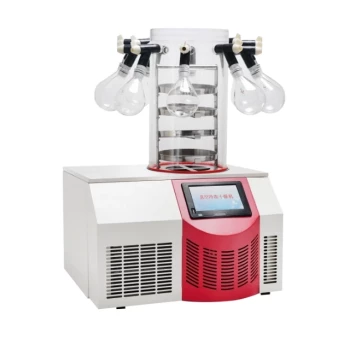
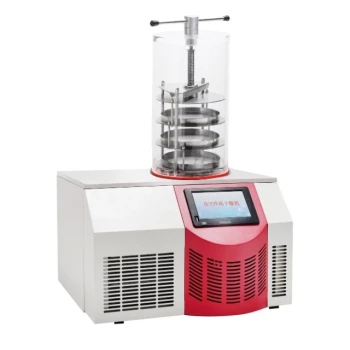
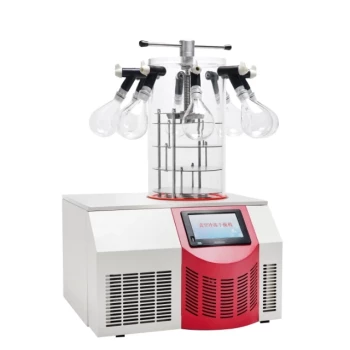
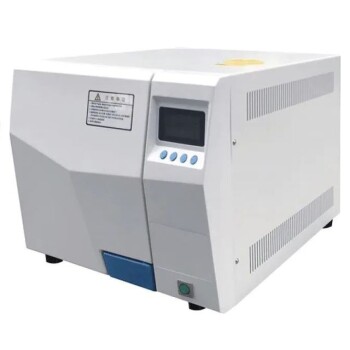
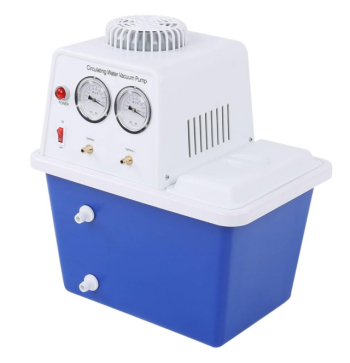
A laboratory vacuum drying oven is the primary safeguard for preserving nanoparticle integrity during the preparation phase. It functions by significantly reducing environmental pressure, which forces solvents—specifically moisture and residual ethanol—to evaporate rapidly at much lower temperatures than would be required at atmospheric pressure.
By decoupling evaporation from high heat, vacuum drying prevents the chemical and structural degradation of nanoparticles while ensuring the complete removal of solvent residues that would otherwise corrupt analytical data.
The Mechanism of Low-Temperature Evaporation
Manipulating Pressure to Reduce Heat
The core function of the vacuum drying oven is to lower the boiling point of solvents.
By reducing the pressure inside the chamber, the oven allows moisture and ethanol to transition from liquid to gas without requiring high thermal energy.
Rapid Solvent Removal
This low-pressure environment facilitates a rapid evaporation rate.
This efficiency ensures that samples are dried thoroughly without being subjected to prolonged processing times.
Preserving Nanoparticle Integrity
Preventing High-Temperature Oxidation
Nanoparticles are highly reactive and susceptible to chemical changes when exposed to heat.
The vacuum oven eliminates the need for high temperatures, thereby preventing the particles from undergoing oxidation during the drying process.
Mitigating Aggregation
When nanoparticles are dried using traditional heat methods, they have a tendency to clump together, or aggregate.
Vacuum drying at lower temperatures maintains the dispersion of the powder, preserving the discrete nature of individual particles.
Optimizing for Analytical Precision
Removing Spectral Interference
For accurate analysis, the sample must be free of contaminants.
The vacuum drying process ensures the total elimination of residual ethanol and moisture, which eliminates interference from solvent peaks in detection results.
Critical Preparation for XRD and FTIR
The dryness achieved by the vacuum oven is a prerequisite for sensitive analytical techniques.
It is specifically required to prepare samples for X-ray powder diffraction (XRD) and Fourier-transform infrared spectroscopy (FTIR), where purity is paramount for valid data.
Common Pitfalls of Alternative Drying Methods
The Dangers of Standard Heating
Attempting to dry nanoparticles without a vacuum usually requires elevating temperatures to drive off solvents.
This approach is a critical error, as it frequently leads to the permanent alteration of the sample through oxidation, rendering it unrepresentative of the original material.
The Cost of Residual Solvents
Insufficient drying leaves behind traces of liquid that distort analytical readouts.
If solvents like ethanol remain on the particle surface, they introduce "noise" into the data, obscuring the true characteristics of the nanoparticle during spectral analysis.
Making the Right Choice for Your Goal
To ensure your nanoparticle research yields valid, reproducible results, apply the following guidelines:
- If your primary focus is Physical Stability: Use vacuum drying to prevent particle aggregation and oxidation, ensuring the powder remains chemically and structurally intact.
- If your primary focus is Analytical Accuracy: Rely on vacuum drying to fully eliminate solvent residues that would otherwise create false peaks in XRD and FTIR data.
The laboratory vacuum drying oven is not just a drying tool; it is an essential instrument for stabilizing reactive materials and validating downstream analysis.
Summary Table:
| Feature | Vacuum Drying Benefit | Impact on Nanoparticle Analysis |
|---|---|---|
| Boiling Point | Lowered via reduced pressure | Rapid solvent removal at low temperatures |
| Temperature Control | Low-heat evaporation | Prevents high-temperature oxidation & degradation |
| Particle Structure | Reduced thermal agitation | Mitigates aggregation (clumping) of particles |
| Purity Level | Total solvent elimination | Removes spectral interference in XRD and FTIR |
| Sample Stability | Oxygen-depleted environment | Preserves the reactive chemical state of powders |
Elevate Your Research Precision with KINTEK
Don't let sample degradation compromise your analytical data. KINTEK specializes in advanced laboratory solutions designed for the most sensitive materials. Whether you are processing reactive nanoparticles or delicate powders, our range of laboratory vacuum drying ovens provides the precise environmental control needed to prevent oxidation and aggregation.
Beyond drying, KINTEK offers a comprehensive portfolio including:
- High-Temperature Furnaces & Reactors: From muffle and tube furnaces to CVD/PECVD systems.
- Sample Preparation: Crushing, milling, and high-precision hydraulic presses (pellet, isostatic).
- Advanced Labware: Specialized ceramics, crucibles, and PTFE products for contamination-free processing.
Ensure valid, reproducible results for your XRD, FTIR, and battery research. Contact KINTEK today to find the perfect equipment for your laboratory and experience the value of professional-grade stability and precision.
References
- Udara Bimendra Gunatilake, Eva Baldrich. Peroxidase (POD) Mimicking Activity of Different Types of Poly(ethyleneimine)-Mediated Prussian Blue Nanoparticles. DOI: 10.3390/nano15010041
This article is also based on technical information from Kintek Solution Knowledge Base .
Related Products
- 56L Vertical Laboratory Vacuum Drying Oven
- 23L Laboratory Vacuum Drying Oven
- Laboratory Scientific Electric Heating Blast Drying Oven
- Benchtop Laboratory Vacuum Freeze Dryer
- High Performance Laboratory Freeze Dryer
People Also Ask
- Why is a laboratory vacuum drying oven recommended for rice straw residues? Protect Your Biomass Integrity
- What role does a laboratory vacuum drying oven play in the preparation of modified multi-walled carbon nanotubes?
- What is the importance of using a laboratory vacuum drying oven? Preserving Slow-Release Microcapsule Integrity
- Why is a Laboratory Vacuum Drying Oven recommended for PBAT microspheres? Protect Sensitive Polymer Integrity
- Why is a vacuum drying oven necessary for Li2MnSiO4/C battery electrodes? Ensure Stability and Performance.