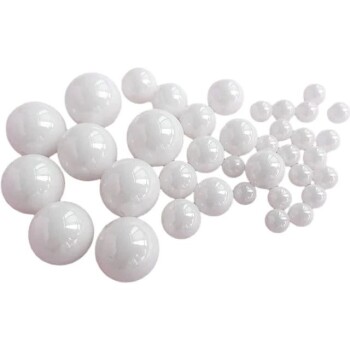
The use of 1mm diameter zirconia milling balls offers a critical dual advantage: superior particle refinement and exceptional chemical preservation. Specifically, the small 1mm diameter enables a finer grinding effect that drastically increases the specific surface area of anode powders, while the zirconia material itself prevents the introduction of performance-killing impurities during the synthesis of SnO2 and Li2SnO3.
The combination of small media size and ceramic inertness is essential for synthesizing high-performance anode materials, as it maximizes reactive surface area without compromising electrochemical stability through contamination.
Optimizing Physical Structure
To achieve the electrochemical properties required for SnO2 and Li2SnO3, you must look beyond simple particle reduction and focus on surface area maximization.
The Impact of Small Media Diameter
Using 1mm milling balls creates a significantly higher number of contact points per volume compared to larger media. This increased contact frequency results in a much finer grinding effect.
Consequently, the process yields a substantial increase in the specific surface area of the anode powders. A higher surface area is typically desirable in battery materials to facilitate better ion transport and reaction kinetics.
Preserving Chemical Purity
The synthesis environment for battery materials is harsh. The choice of zirconia (ZrO2) as the material for the milling balls addresses the deep need for maintaining absolute chemical integrity.
Chemical Inertness and Stability
Zirconia is renowned for its chemical inertness and extreme hardness. Unlike softer or more reactive media, it does not easily react with the precursors or the active materials being synthesized.
This inertness minimizes the introduction of wear-related impurities. Even under high-energy milling conditions, the integrity of the SnO2 and Li2SnO3 is preserved.
Preventing Metallic Contamination
A primary risk in milling is the introduction of conductive contaminants, particularly when using steel media. Steel can introduce iron impurities, which are detrimental to electrochemical performance.
Zirconia acts as a safeguard against this. It ensures that the final product is free from external metallic contamination, thereby protecting the purity and electrochemical performance of the anode material.
Understanding the Trade-offs
While zirconia is the superior choice for high-purity synthesis, it is vital to understand the limitations of the milling process itself to ensure consistent results.
Wear Resistance vs. Wear Elimination
Zirconia possesses high wear resistance, but it is not wear-proof. Over extended milling times, minute amounts of zirconia may still abrade into the mixture.
However, the trade-off is favorable. Because zirconia is chemically inert, any trace contamination is generally less harmful to battery performance than conductive metals like iron, which can cause internal shorts or unwanted side reactions.
Making the Right Choice for Your Goal
When setting up your synthesis protocol for SnO2 or Li2SnO3, select your media based on the specific failure mode you are trying to avoid.
- If your primary focus is Reaction Kinetics: Use 1mm balls to maximize the specific surface area, ensuring faster ion transport.
- If your primary focus is Cycle Stability: Rely on zirconia's inertness to prevent metallic impurities that degrade electrochemical performance over time.
By utilizing 1mm zirconia media, you effectively balance the physical need for fine particle size with the chemical requirement for absolute purity.
Summary Table:
| Feature | Benefit for SnO2 & Li2SnO3 Synthesis |
|---|---|
| 1mm Diameter | Increases contact points for finer grinding and higher specific surface area. |
| High Hardness | Ensures efficient particle refinement and superior wear resistance. |
| Chemical Inertness | Prevents chemical reactions with precursors, maintaining material integrity. |
| Non-Metallic | Eliminates iron contamination risks that cause internal shorts or performance loss. |
| Optimized Kinetics | Facilitates faster ion transport through improved reaction kinetics. |
Elevate Your Battery Research with KINTEK Precision Media
Precision in particle size and absolute chemical purity are non-negotiable for high-performance anode materials. At KINTEK, we specialize in high-quality laboratory equipment and consumables designed to meet the rigorous demands of battery research. From our 1mm zirconia milling balls that ensure superior refinement to our comprehensive range of crushing and milling systems, sieving equipment, and high-temperature furnaces (vacuum, CVD, atmosphere), we provide the tools you need to achieve electrochemical excellence.
Whether you are synthesizing SnO2 or developing next-gen Li-ion components, our experts are ready to assist you with everything from ball mills and planetary mixers to crucibles and ceramic consumables.
Ready to optimize your synthesis protocol? Contact KINTEK today for a customized solution!
Related Products
- Laboratory Jar Ball Mill with Alumina Zirconia Grinding Jar and Balls
- Precision Machined Zirconia Ceramic Ball for Engineering Advanced Fine Ceramics
- Laboratory Jar Mill with Agate Grinding Jar and Balls
- Mini Planetary Ball Mill Machine for Laboratory Milling
- Laboratory Ball Mill Jar Mill with Metal Alloy Grinding Jar and Balls
People Also Ask
- What are the primary functions of using a ball mill for BZCY72 powder? Achieve High Purity and Enhanced Sintering
- In what way does a laboratory ball mill affect material properties when modifying PHBV/pulp fiber composites?
- Why is a laboratory ball mill required for ultra-fine fly ash? Unlock Nano-Scale Adsorption Power
- What is the function of a laboratory ball mill in the preparation of AMMCs? Optimize Dispersion & Grain Refinement
- What is the function of a laboratory ball mill in the pretreatment of waste tire char (WTC)? Optimize Material Reactivity