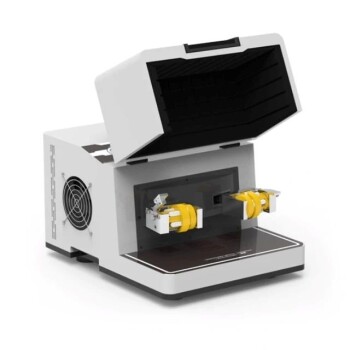
A laboratory-scale ball mill serves as a high-intensity mechanical pretreatment device designed to physically disrupt microalgae biomass. utilizing grinding media, such as glass or ceramic beads, the equipment delivers high-speed impact forces that effectively shatter the cellular structure. This mechanical action results in significant cell size reduction and the destruction of the cell wall's physical integrity.
The primary objective of ball milling is to overcome cell wall recalcitrance—the natural resistance of the cell structure to degradation. By breaching this barrier, the process unlocks internal organic matter, making it accessible for downstream conversion processes like biomethane production.
The Mechanism of Physical Disruption
High-Energy Impact
The ball mill operates by agitating the biomass with dense grinding media (beads). The high speeds generate intense mechanical impact forces that pulverize the microalgae cells.
Increasing Surface Area
As the cell walls are destroyed, the particle size of the biomass is drastically reduced. This reduction significantly increases the specific surface area of the material, exposing more of the biomass to the surrounding environment.
The Biological Impact
Enhancing Enzyme Accessibility
The intact cell wall of microalgae acts as a fortress, preventing external agents from reaching the nutrient-rich interior. Ball milling destroys this defense, allowing microbes and enzymes to penetrate the cell and access the degradable organic matter inside.
Facilitating Energy Recovery
This increased accessibility is directly linked to process efficiency. By ensuring that organic matter is not locked away behind tough cell walls, the pretreatment step enhances the efficiency of biomethane production during subsequent anaerobic digestion.
Understanding the Process Dynamics
The Role of Media Selection
The efficiency of the disruption depends heavily on the grinding media used. The primary reference highlights the use of glass or ceramic beads, which provide the necessary hardness and density to deliver effective impact forces against the biomass.
Physical vs. Chemical Change
It is important to note that a ball mill effects a physical change, not a chemical one. Unlike chemical pretreatments that dissolve components, the ball mill relies on mechanical force to alter the structural state of the biomass to prepare it for biological degradation.
Making the Right Choice for Your Goal
When integrating a laboratory-scale ball mill into your microalgae processing workflow, consider your specific objectives:
- If your primary focus is enhancing biomethane yield: Prioritize milling parameters that maximize cell wall rupture to ensure microbes have full access to the intracellular organic matter.
- If your primary focus is process speed: Focus on the rate of particle size reduction, as increasing the specific surface area accelerates the interaction between enzymes and the biomass.
Effective pretreatment transforms recalcitrant biomass into a readily available feedstock for energy production.
Summary Table:
| Feature | Description of Mechanism |
|---|---|
| Primary Action | High-speed impact using glass or ceramic grinding media |
| Physical Impact | Destroys cell wall integrity and reduces particle size |
| Biological Benefit | Increases specific surface area for enzyme accessibility |
| End Goal | Overcomes cell wall recalcitrance for higher energy recovery |
| Process Type | Purely mechanical/physical pretreatment (non-chemical) |
Maximize Your Biomass Conversion Potential with KINTEK
Are you struggling with cell wall recalcitrance in your microalgae research? KINTEK specializes in high-performance laboratory equipment designed to streamline your pretreatment workflow. Our precision crushing and milling systems, including advanced ball mills, provide the high-intensity impact required to shatter cellular structures and unlock internal organic matter for superior biomethane yields.
From high-temperature furnaces and vacuum reactors to our comprehensive range of PTFE products, ceramics, and crucibles, KINTEK provides the tools necessary for cutting-edge energy research. Whether you are optimizing anaerobic digestion or exploring complex chemical conversions, our team is ready to equip your lab with durable, efficient, and precise solutions.
Ready to enhance your lab's efficiency and recovery rates? Contact us today to find the perfect equipment for your research needs!
References
- Sheetal Kishor Parakh, Yen Wah Tong. From Microalgae to Bioenergy: Recent Advances in Biochemical Conversion Processes. DOI: 10.3390/fermentation9060529
This article is also based on technical information from Kintek Solution Knowledge Base .
Related Products
- Stainless Steel Laboratory Ball Mill for Dry Powder and Liquid with Ceramic Polyurethane Lining
- Mini Planetary Ball Mill Machine for Laboratory Milling
- High-Energy Omnidirectional Planetary Ball Mill Milling Machine for Laboratory
- Laboratory Planetary Ball Mill Rotating Ball Milling Machine
- High-Energy Omnidirectional Planetary Ball Mill Machine for Laboratory
People Also Ask
- How do laboratory ball mills facilitate the mechanochemical synthesis of ZIF-8? Solvent-Free Synthesis Explained
- What is the primary function of a laboratory ball mill in the modification of sulfide-based solid electrolytes with LiPO2F2?
- How does a laboratory ball mill ensure the mixing quality of Mn3Zn0.8Sn0.2N and Ti? Achieve Perfect Homogeneity
- What is the function of a laboratory ball mill in the preparation of AMMCs? Optimize Dispersion & Grain Refinement
- In what way does a laboratory ball mill affect material properties when modifying PHBV/pulp fiber composites?