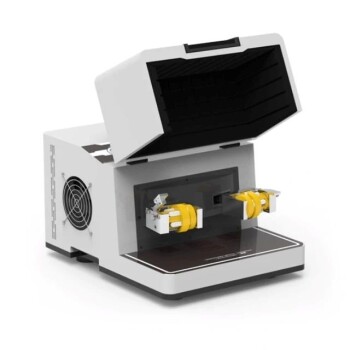
A laboratory ball mill acts as the critical refinement stage in the preparation of raw materials for bio-composite coatings. It utilizes mechanical grinding to reduce raw substances—such as coral-derived materials—into ultra-fine powders with particle sizes typically below 100 microns, while simultaneously dispersing these particles into stable mixtures or suspensions.
The ball mill does not merely crush material; it transforms raw inputs into reactive, high-surface-area components. By ensuring thorough de-agglomeration and uniform distribution, this process directly dictates the physical strength, drug release consistency, and coating density of the final bio-composite.
Optimizing Material Properties via Size Reduction
Achieving Micro-Scale Precision
The primary function of the ball mill is the mechanical reduction of particle size.
For materials like coral, the mill refines the substance into a powder with particle sizes below 100 microns.
Enhancing Chemical Reactivity
This reduction in size results in a significant increase in the specific surface area of the material.
A larger surface area exposes more of the material to reactants, which enhances the efficiency of subsequent chemical transformations required to synthesize the final coating material.
Ensuring Homogeneity in the Matrix
Uniform Distribution within Polymers
In bio-composite coatings, such as those involving a poly(lactic acid) (PLA) polymer matrix, consistency is paramount.
Ball milling ensures that bioactive particles, like hydroxyapatite, are uniformly distributed throughout the polymer.
This uniformity prevents structural weak points, directly improving the physical strength of the composite and ensuring consistent drug release profiles.
Creating Stable Suspensions
For processes like electrophoretic deposition (EPD), the ball mill serves as a high-shear mixer.
It combines powders (such as (Co,Mn)3O4) with solvents like ethanol and isopropanol during extended mechanical grinding.
This action de-agglomerates particles to create a highly dispersed, stable suspension, which is a prerequisite for achieving precise thickness control and high density in the final coating.
Understanding the Trade-offs
Process Duration and Stability
Achieving a truly stable suspension or a perfectly uniform powder is not instantaneous.
Extended mechanical grinding is often required to fully de-agglomerate particles and prevent them from settling or clumping, which can lengthen production timelines.
Impact on Coating Integrity
If the milling process is cut short or performed incorrectly, the resulting suspension will lack stability.
This leads to uneven coatings with variable density, undermining the mechanical protection and performance the coating is designed to provide.
Making the Right Choice for Your Goal
To maximize the quality of your bio-composite coatings, align your milling parameters with your specific performance metrics.
- If your primary focus is Physical Strength: Prioritize grinding to achieve uniform particle distribution within the polymer matrix to eliminate structural defects.
- If your primary focus is Chemical Reactivity: Ensure your milling cycle reduces particle size below 100 microns to maximize specific surface area.
- If your primary focus is Coating Uniformity (EPD): Focus on extended grinding with appropriate solvents to achieve a fully de-agglomerated, stable suspension.
Mastering the ball milling process transforms variable raw materials into a consistent, high-performance foundation for advanced bio-applications.
Summary Table:
| Feature | Impact on Bio-Composite Coatings | Key Benefit |
|---|---|---|
| Particle Size Reduction | Reduces materials (e.g., coral) to <100 microns | Increases specific surface area and chemical reactivity |
| Mechanical Grinding | De-agglomerates particles in solvents | Creates stable suspensions for EPD and precise thickness control |
| Uniform Distribution | Ensures bioactive particles are dispersed in polymer matrices | Eliminates structural weak points and stabilizes drug release |
| Extended Milling | Prevents settling and clumping of powders | Guarantees high coating density and consistent physical strength |
Elevate Your Material Synthesis with KINTEK Precision
At KINTEK, we understand that the foundation of high-performance bio-composite coatings lies in the precision of material preparation. Our professional-grade laboratory ball mills, crushing and milling systems, and sieving equipment are engineered to help you achieve ultra-fine particle sizes and perfect homogeneity for your research and production needs.
Whether you are refining coral-derived materials for medical applications or developing stable suspensions for electrophoretic deposition, KINTEK offers the comprehensive tools you need, including:
- Advanced High-Temperature Furnaces (Muffle, Vacuum, CVD) for subsequent heat treatments.
- Precision Hydraulic Presses for pellet preparation.
- Specialized Consumables like ceramics, crucibles, and PTFE products.
Ready to optimize your coating integrity? Contact our technical experts today to find the perfect milling solution and enhance your lab's efficiency with KINTEK’s industry-leading laboratory equipment.
References
- Innocent J. Macha, Wolfgang Müller. Development of antimicrobial composite coatings for drug release in dental, orthopaedic and neural prostheses applications. DOI: 10.1007/s42452-018-0064-1
This article is also based on technical information from Kintek Solution Knowledge Base .
Related Products
- Stainless Steel Laboratory Ball Mill for Dry Powder and Liquid with Ceramic Polyurethane Lining
- Laboratory Planetary Ball Mill Rotating Ball Milling Machine
- Laboratory Ball Mill Jar Mill with Metal Alloy Grinding Jar and Balls
- Laboratory Planetary Ball Mill Cabinet Planetary Ball Milling Machine
- Laboratory Jar Ball Mill with Alumina Zirconia Grinding Jar and Balls
People Also Ask
- How do laboratory ball mills facilitate the mechanochemical synthesis of ZIF-8? Solvent-Free Synthesis Explained
- What is the primary function of a laboratory ball mill in the modification of sulfide-based solid electrolytes with LiPO2F2?
- How does a laboratory ball mill ensure the mixing quality of Mn3Zn0.8Sn0.2N and Ti? Achieve Perfect Homogeneity
- What is the function of a laboratory ball mill in the preparation of AMMCs? Optimize Dispersion & Grain Refinement
- In what way does a laboratory ball mill affect material properties when modifying PHBV/pulp fiber composites?