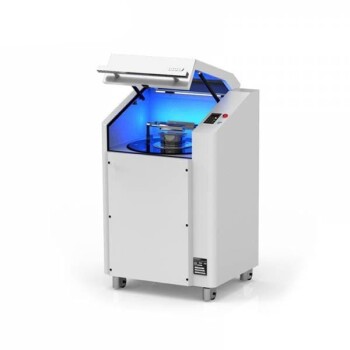
Knowledge How does a planetary ball mill facilitate the Mechanochemical Synthesis of sulfide solid electrolytes? - Anneal-Free
Author avatar

Tech Team · Kintek Solution

Updated 3 days ago

How does a planetary ball mill facilitate the Mechanochemical Synthesis of sulfide solid electrolytes? - Anneal-Free


A planetary ball mill eliminates the need for high-temperature annealing by utilizing a specialized two-step mechanical grinding protocol. This process leverages controlled kinetic energy to first vitrify raw materials and subsequently generate sufficient internal heat for in-situ crystallization, creating high-performance solid electrolytes directly within the milling jar.

The core mechanism relies on transitioning from low-energy to high-energy inputs. This shift drives the precursor materials from an amorphous state into a glass-ceramic structure containing Argyrodite crystals, effectively replacing thermal ovens with kinetic force.

The Mechanics of Kinetic Energy Transfer

The planetary ball mill is not merely a mixer; it is a high-energy reactor that facilitates Mechanochemical Synthesis (MCS).

Opposing Rotation Dynamics

The system consists of grinding jars ("planets") situated on a circular platform ("sun wheel"). Crucially, the jars rotate on their own axes in the opposite direction to the sun wheel's rotation.

High-Frequency Impact

This counter-rotation creates intense centrifugal forces. The grinding media (typically zirconia balls) are subjected to high-frequency impacts and friction against the jar walls and the material.

Reaction Activation

This physical bombardment does more than pulverize; it provides the activation energy required to break chemical bonds. It increases the specific surface area and chemical reactivity of precursors such as Lithium Sulfide ($Li_2S$) and Phosphorus Pentasulfide ($P_2S_5$).

The Two-Step Anneal-Free Process

To achieve an anneal-free synthesis, the process must be carefully staged. A single continuous speed is often insufficient for the complex structural changes required.

Step 1: Low-Energy Vitrification

The process begins with a low-energy grinding stage. The primary goal here is vitrification (amorphization).

During this phase, the crystalline structures of the raw materials are broken down. This results in a homogeneous, amorphous mixture where the components are intimately blended at the atomic level, but no new crystal phases have formed yet.

Step 2: High-Energy In-Situ Crystallization

The second stage shifts to high-energy grinding. This increase in kinetic intensity generates significant localized heat and mechanical stress.

This energy triggers in-situ crystallization. Specifically, it allows Argyrodite crystals to precipitate and grow within the glass matrix created in step one.

The Glass-Ceramic Result

The final output is a glass-ceramic composite. Because the crystallization energy was supplied mechanically rather than thermally, the material achieves high ionic conductivity without the need for post-synthesis high-temperature annealing.

Understanding the Trade-offs

While mechanochemical synthesis offers a streamlined path to solid electrolytes, it presents specific engineering challenges that must be managed.

Contamination Risks

The high-energy impacts required for crystallization can degrade the grinding media. This may introduce impurities (such as zirconia) into the electrolyte, which can impede ionic conductivity.

Parameter Sensitivity

The success of the "anneal-free" method relies heavily on the precise timing of the switch between low and high energy. If the high-energy phase is too short, crystallization is incomplete; if too long, the structure may degrade or overheat uncontrolled.

Scalability Limitations

Planetary ball milling is a batch process. Scaling this two-step protocol up for mass production requires distinct engineering solutions compared to continuous thermal processes.

Making the Right Choice for Your Goal

To effectively utilize MCS for sulfide electrolytes, align your milling parameters with your specific material requirements.

  • If your primary focus is High Ionic Conductivity: Prioritize the optimization of the high-energy second stage to ensure maximum formation of the conductive Argyrodite crystal phase.
  • If your primary focus is Phase Purity: Extend the low-energy first stage to ensure complete amorphization and homogenization of precursors before initiating crystallization.
  • If your primary focus is Process Efficiency: Utilize the ball mill's ability to combine mixing, reacting, and crystallizing into a single pot operation, eliminating the transfer steps associated with furnace annealing.

By mastering the transition between vitrification and crystallization, you can produce highly conductive solid electrolytes closer to room temperature conditions.

Summary Table:

Stage Energy Level Primary Objective Resulting Material State
Step 1: Vitrification Low Break crystalline bonds & homogenize Homogeneous Amorphous Mixture
Step 2: Crystallization High Trigger in-situ crystal growth Glass-Ceramic (Argyrodite)
Result N/A Eliminate thermal annealing High Ionic Conductivity Electrolyte

Revolutionize Your Battery Research with KINTEK

Eliminate the bottleneck of high-temperature annealing and accelerate your material discovery. KINTEK specializes in precision planetary ball mills, crushing and milling systems, and high-pressure reactors designed to handle the rigorous demands of mechanochemical synthesis.

Whether you are developing next-generation sulfide solid electrolytes or refining battery research consumables, our equipment ensures the precise kinetic energy control needed for in-situ crystallization.

Ready to optimize your lab’s efficiency? Contact KINTEK today for expert guidance and high-performance solutions!

Related Products

People Also Ask

Related Products

Laboratory Horizontal Planetary Ball Mill Milling Machine

Laboratory Horizontal Planetary Ball Mill Milling Machine

Improve sample uniformity with our Horizontal Planetary Ball Mills. KT-P400H reduces sample deposition and KT-P400E has multi-directional capabilities. Safe, convenient and efficient with overload protection.

Laboratory Planetary Ball Mill Rotating Ball Milling Machine

Laboratory Planetary Ball Mill Rotating Ball Milling Machine

KT-P400E is a desktop multi-directional planetary ball mill with unique grinding and mixing capabilities. It offers continuous and intermittent operation, timing, and overload protection, making it ideal for various applications.

High Energy Planetary Ball Mill Milling Machine for Laboratory

High Energy Planetary Ball Mill Milling Machine for Laboratory

The biggest feature is that the high energy planetary ball mill can not only perform fast and effective grinding, but also has good crushing ability

High Energy Planetary Ball Mill Milling Machine for Laboratory

High Energy Planetary Ball Mill Milling Machine for Laboratory

Experience fast and effective sample processing with the F-P2000 high-energy planetary ball mill. This versatile equipment offers precise control and excellent grinding capabilities. Perfect for laboratories, it features multiple grinding bowls for simultaneous testing and high output. Achieve optimal results with its ergonomic design, compact structure, and advanced features. Ideal for a wide range of materials, it ensures consistent particle size reduction and low maintenance.

High Energy Planetary Ball Mill for Laboratory Horizontal Tank Type Milling Machine

High Energy Planetary Ball Mill for Laboratory Horizontal Tank Type Milling Machine

KT-P4000H uses the unique Y-axis planetary motion trajectory, and utilizes the collision, friction and gravity between the sample and the grinding ball to have a certain anti-sinking ability, which can obtain better grinding or mixing effects and further improve the sample output.

Laboratory Jar Ball Mill with Alumina Zirconia Grinding Jar and Balls

Laboratory Jar Ball Mill with Alumina Zirconia Grinding Jar and Balls

Grind to perfection with alumina/zirconia grinding jars and balls. Available in volume sizes from 50ml to 2500ml, compatible with various mills.

Laboratory Planetary Ball Mill Cabinet Planetary Ball Milling Machine

Laboratory Planetary Ball Mill Cabinet Planetary Ball Milling Machine

The vertical cabinet structure combined with ergonomic design enables users to obtain the best comfortable experience in standing operation. The maximum processing capacity is 2000ml, and the speed is 1200 revolutions per minute.

High-Energy Omnidirectional Planetary Ball Mill Milling Machine for Laboratory

High-Energy Omnidirectional Planetary Ball Mill Milling Machine for Laboratory

The KT-P4000E is a new product derived from the vertical high-energy planetary ball mill with a 360° swivel function. Experience faster, uniform, and smaller sample output results with 4 ≤1000ml ball mill jars.

Laboratory Ball Mill Jar Mill with Metal Alloy Grinding Jar and Balls

Laboratory Ball Mill Jar Mill with Metal Alloy Grinding Jar and Balls

Grind and mill with ease using metal alloy grinding jars with balls. Choose from 304/316L stainless steel or tungsten carbide and optional liner materials. Compatible with various mills and features optional functions.

Laboratory Micro Tissue Grinding Mill Grinder

Laboratory Micro Tissue Grinding Mill Grinder

KT-MT10 is a miniature ball mill with a compact structure design. The width and depth are only 15X21 cm, and the total weight is only 8 kg. It can be used with a minimum 0.2ml centrifuge tube or a maximum 15ml ball mill jar.

Hybrid High Energy Vibratory Ball Mill for Lab Use

Hybrid High Energy Vibratory Ball Mill for Lab Use

KT-BM400 is used for rapid grinding or mixing of dry, wet and frozen small amount of samples in the laboratory. It can be configured with two 50ml ball mill jars

Laboratory High Throughput Tissue Grinding Mill Grinder

Laboratory High Throughput Tissue Grinding Mill Grinder

KT-MT is a high-quality, small, and versatile tissue grinder used for crushing, grinding, mixing, and cell wall breaking in various fields, including food, medical, and environmental protection. It is equipped with 24 or 48 2ml adapters and ball grinding tanks and is widely employed for DNA, RNA, and protein extraction.

Laboratory Ten-Body Horizontal Jar Mill for Lab Use

Laboratory Ten-Body Horizontal Jar Mill for Lab Use

The Ten-body horizontal jar mill is for 10 ball mill pots (3000ml or less). It has frequency conversion control, rubber roller movement, and PE protective cover.

Laboratory Disc Cup Vibratory Mill for Sample Grinding

Laboratory Disc Cup Vibratory Mill for Sample Grinding

The vibrating disc mill is suitable for non-destructive crushing and fine grinding of samples with large particle sizes, and can quickly prepare samples with analytical fineness and purity.

Small Cryogenic Grinder Cryomill Cryogrinder with Liquid Nitrogen for Laboratory Use

Small Cryogenic Grinder Cryomill Cryogrinder with Liquid Nitrogen for Laboratory Use

Our KINTEK Cryomilling is perfect for small runs and R&D trials. With a versatile cryogenic system, it can handle a variety of materials, including plastics, rubber, pharmaceuticals, and food grades. Plus, our specialized hydraulic laboratory crushers ensure accurate results through multiple passes, making it suitable for XRF analysis. Get finely-powdered samples with ease!

Liquid Nitrogen Cryogenic Grinder Mill Cryomill Airflow Ultrafine Pulverizer

Liquid Nitrogen Cryogenic Grinder Mill Cryomill Airflow Ultrafine Pulverizer

Discover the Liquid Nitrogen Cryogenic Grinding Machine, perfect for lab use, ultra-fine pulverization, and preserving material properties. Ideal for pharmaceuticals, cosmetics, and more.

Laboratory Grinding Mill Mortar Grinder for Sample Preparation

Laboratory Grinding Mill Mortar Grinder for Sample Preparation

KT-MG200 mortar grinder can be used for mixing and homogenizing powder, suspension, paste and even viscous samples. It can help users realize the ideal operation of sample preparation with more regularization and higher repeatability.

Vacuum Hot Press Furnace Machine for Lamination and Heating

Vacuum Hot Press Furnace Machine for Lamination and Heating

Experience clean and precise lamination with Vacuum Lamination Press. Perfect for wafer bonding, thin-film transformations, and LCP lamination. Order now!

HFCVD Machine System Equipment for Drawing Die Nano-Diamond Coating

HFCVD Machine System Equipment for Drawing Die Nano-Diamond Coating

The nano-diamond composite coating drawing die uses cemented carbide (WC-Co) as the substrate, and uses the chemical vapor phase method ( CVD method for short ) to coat the conventional diamond and nano-diamond composite coating on the surface of the inner hole of the mold.

Benchtop Laboratory Freeze Dryer for Lab Use

Benchtop Laboratory Freeze Dryer for Lab Use

Premium benchtop laboratory freeze dryer for lyophilization, preserving samples with ≤ -60°C cooling. Ideal for pharmaceuticals & research.


Leave Your Message