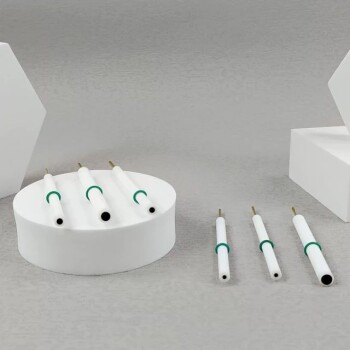
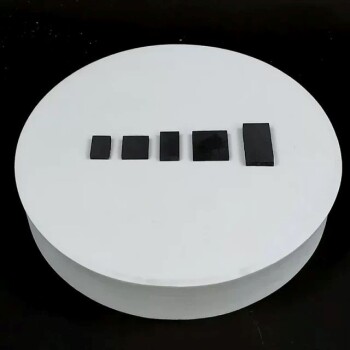
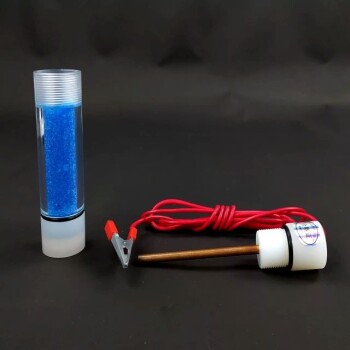
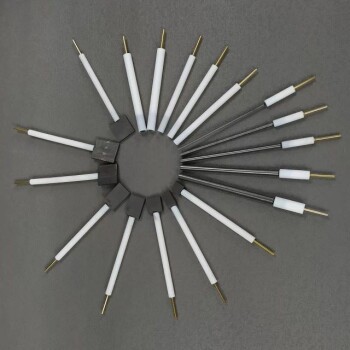
The glassy carbon electrode (GCE) serves as an ideal, inert substrate that ensures the electrochemical performance measured during testing belongs solely to the biomass-derived catalyst. By offering a wide electrochemical potential window and exceptional chemical stability, the GCE prevents the substrate from participating in redox reactions. This isolation is critical for accurately characterizing the intrinsic activity of biomass carbon-based materials, such as their performance in oxygen evolution or reduction reactions.
The core advantage of a glassy carbon electrode is its ability to act as a "blank canvas," providing high electrical conductivity without adding background noise or catalytic activity. This allows for the precise measurement of a catalyst's true electrochemical properties across a broad range of pH levels and potentials.
The Electrochemical Integrity of Glassy Carbon
A Wide and Stable Electrochemical Window
The GCE possesses a wide electrochemical window, meaning it remains stable and non-reactive across a broad range of voltages. This property is essential when testing biomass catalysts for high-potential reactions like the Oxygen Evolution Reaction (OER) or the Oxygen Reduction Reaction (ORR). Because the substrate does not decompose or react, researchers can be certain that the observed signals originate entirely from the catalyst.
Exceptional Chemical Inertness
Glassy carbon is highly resistant to corrosion in both alkaline electrolytes (like 1 M KOH) and acidic electrolytes (such as 0.1 M HClO4). It does not exhibit inherent catalytic activity for hydrogen evolution or oxygen reduction, which eliminates background interference. This inertness ensures that the substrate does not contribute extra capacitance or catalyze side reactions that would skew performance data.
High Electrical Conductivity
Despite its chemical stability, glassy carbon maintains excellent electrical conductivity. It serves as an efficient current collector, facilitating rapid electron transfer between the biomass catalyst and the external circuit. This ensures that the measured kinetic data reflects the catalyst's capabilities rather than resistance within the testing setup.
Physical and Structural Benefits for Catalyst Evaluation
Flat and Non-Porous Surface Structure
The surface of a GCE is dense, non-porous, and can be precision-polished to a mirror-like finish. This flatness ensures tight physical contact between the biomass carbon slurry and the electrode surface. A smooth surface is vital for calculating the electrochemical active surface area (ECSA) accurately, as it provides a consistent physical foundation.
Uniform Catalyst Film Loading
The uniform nature of the GCE surface allows for the creation of a consistent, thin catalyst ink layer. This uniformity ensures maximum exposure of active sites within the biomass carbon-based material. Consistent loading is a prerequisite for achieving reproducible results, especially during Rotating Disk Electrode (RDE) tests where hydrodynamic flow must be uniform.
Durability and Reusability
Glassy carbon is characterized by high mechanical hardness and resistance to wear. It can be repeatedly polished and reused for multiple evaluations without losing its structural integrity. This makes it a cost-effective and reliable standard for benchmarking different biomass-derived carbon formulations.
Understanding the Trade-offs
Sensitivity to Surface Preparation
The accuracy of a GCE-based test is highly dependent on the quality of the manual polishing process. Residual contaminants or scratches on the surface can lead to inconsistent catalyst adhesion or unexpected background currents.
Mechanical Fragility
While chemically robust, glassy carbon is brittle and can crack or chip if subjected to mechanical shock or improper handling. It also requires specific "ink" formulations (often involving Nafion) to ensure the biomass carbon stays attached to the smooth surface during high-speed rotation.
Limitations in Full-Scale Simulation
While excellent for fundamental kinetic studies, a GCE does not mimic the gas diffusion properties of real-world fuel cell or electrolyzer hardware. It is a tool for evaluating material properties rather than predicting the performance of a final, high-surface-area device like a membrane electrode assembly.
How to Apply This to Your Project
Recommendations for Catalyst Testing
- If your primary focus is fundamental kinetic studies: Use a high-purity GCE to isolate the catalyst’s intrinsic activity without interference from the current collector.
- If your primary focus is alkaline OER/ORR evaluation: Leverage the GCE’s stability in 1 M KOH to ensure your biomass-derived cobalt or nitrogen-doped sites are the only source of catalytic current.
- If your primary focus is reproducibility across samples: Implement a rigorous, multi-step polishing protocol (using alumina slurries) to ensure every biomass carbon sample is tested on an identical surface.
Choosing a glassy carbon electrode ensures that your biomass catalyst's performance is measured with the highest degree of technical accuracy and zero substrate interference.
Summary Table:
| Feature | Advantage for Catalyst Testing | Impact on Research Accuracy |
|---|---|---|
| Chemical Inertness | No background catalytic activity | Ensures measured performance is solely from the catalyst |
| Wide Potential Window | Stable across high/low voltages | Allows reliable OER/ORR testing in various pH levels |
| High Conductivity | Facilitates rapid electron transfer | Reflects true catalyst kinetics without circuit resistance |
| Non-Porous Surface | Smooth, mirror-like finish | Enables accurate ECSA calculation and uniform ink loading |
| Mechanical Hardness | Highly durable and reusable | Cost-effective standard for repeated benchmarking |
Elevate Your Electrochemical Research with KINTEK
Precision in biomass catalyst evaluation starts with high-quality substrates and reliable laboratory environments. KINTEK specializes in providing the essential tools for advanced material science, from high-purity glassy carbon electrodes and electrolytic cells to the high-temperature muffle and tube furnaces required for biomass carbonization.
Whether you are performing fundamental kinetic studies or optimizing OER/ORR performance, our comprehensive portfolio—including reactors, autoclaves, and precision crushing systems—is designed to ensure your results are reproducible and accurate.
Maximize your lab's efficiency and data integrity today. Contact KINTEK to discuss your equipment needs and discover how our specialized solutions can empower your next breakthrough.
References
- Tengfei Meng, Yupei Zhao. Study on Nitrogen-Doped Biomass Carbon-Based Composite Cobalt Selenide Heterojunction and Its Electrocatalytic Performance. DOI: 10.3390/met13040767
This article is also based on technical information from Kintek Solution Knowledge Base .
Related Products
- Glassy Carbon Electrochemical Electrode
- Glassy Carbon Sheet RVC for Electrochemical Experiments
- Conductive Carbon Cloth Carbon Paper Carbon Felt for Electrodes and Batteries
- Copper Sulfate Reference Electrode for Laboratory Use
- Graphite Disc Rod and Sheet Electrode Electrochemical Graphite Electrode
People Also Ask
- How do the glassy carbon electrode, SCE, and graphite rod work together in an enzymatic fuel cell? Optimize EFC Testing
- Why is glassy carbon selected for mediator-assisted indirect oxidation of glycerol? The Key to Unbiased Research
- What are the functions of a glassy carbon electrode in CV testing of antioxidants? Enhance Your Redox Analysis Accuracy
- What characteristics make glassy carbon electrodes suitable as anodes? Ideal for Pure Molten Salt Electrolysis
- What are the primary physicochemical reasons for selecting a carbon electrode as the anode in aluminum recovery? 5 Keys