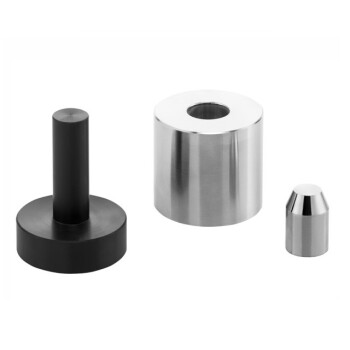
A nylon die functions primarily as an electrically insulating molding sleeve used to contain solid-state battery components during high-pressure assembly and testing. It serves as the structural wall of the test cell, strictly confining the electrolyte powder while mechanically guiding the steel plungers to prevent electrical shorts during compaction.
Core Takeaway: The nylon die is essential for decoupling mechanical pressure from electrical conductivity. It allows you to apply the high uniaxial pressure required for solid-state lamination while simultaneously isolating the current collectors, ensuring that electrochemical data (such as impedance spectroscopy) remains accurate and free from short-circuit interference.
The Critical Role of Electrical Isolation
Preventing Short Circuits
The primary function of the nylon die is to act as a non-conductive barrier. In a typical test setup, steel plungers are used to compress the battery stack; these plungers also serve as the current collectors (positive and negative terminals).
Isolating Current Collectors
If a metal die were used without a liner, the top and bottom plungers would make electrical contact with the die walls, creating a short circuit. The nylon die isolates these plungers, forcing the electrical current to pass solely through the battery materials (cathode, electrolyte, and anode).
Enabling In-Situ Measurements
By preventing external electrical pathways, the nylon die enables precise electrochemical measurements during the pressing process. This isolation is specifically required for sensitive techniques like electrochemical impedance spectroscopy, where even minor leakage currents would corrupt the data.
Mechanical Functions During Compaction
Confining the Electrolyte Powder
Solid-state electrolytes often begin as loose powders that must be densified into a solid pellet. The nylon die serves as the molding container, holding the powder in a defined column and preventing lateral escape while vertical pressure is applied.
Guiding Uniaxial Pressure
The die ensures that the pressure applied by the hydraulic press is transferred uniaxially (in one direction) to the sample. This guidance is critical for securing the multi-layer structure of the battery, ensuring the cathode, electrolyte, and anode remain perfectly aligned.
Facilitating Uniform Lamination
To function correctly, solid-state batteries require tight physical and chemical integration to eliminate gaps at the interfaces. The dimensional stability of the nylon die helps distribute pressure uniformly across these interface layers, promoting better contact and ion transfer.
Understanding the Trade-offs
Material Limits and Deformation
While nylon is capable of withstanding the mechanical stress of standard battery testing, it is significantly softer than steel. If the pressure exceeds the material's yield strength, the die may experience radial deformation (bulging), which can cause the plungers to jam or the sample dimensions to become inaccurate.
Thermal Constraints
Nylon has a lower melting and softening point compared to ceramic or metal dies. This restricts the range of temperatures you can use during testing; high-temperature sintering or testing protocols may degrade the die's structural integrity or insulating properties.
Making the Right Choice for Your Goal
To ensure the validity of your solid-state battery experiments, apply the nylon die based on your specific testing parameters:
- If your primary focus is electrochemical accuracy: Use a nylon die to guarantee complete electrical isolation of the plungers for noise-free impedance spectroscopy.
- If your primary focus is high-pressure densification: Monitor the die for deformation, as excessive pressure may compromise the dimensional precision required for uniform lamination.
- If your primary focus is multi-layer integration: Rely on the nylon die to maintain alignment of the anode, cathode, and electrolyte while eliminating interfacial gaps.
Ideally, the nylon die acts as a silent partner: physically containing the immense pressure of the press while remaining electrically invisible to your measurement instruments.
Summary Table:
| Function Category | Specific Role | Impact on Battery Testing |
|---|---|---|
| Electrical | Electrical Insulation | Prevents short circuits between plungers; ensures accurate impedance data. |
| Mechanical | Powder Containment | Holds electrolyte powder in a defined column; prevents lateral leakage. |
| Pressure | Uniaxial Guidance | Directs hydraulic force vertically to ensure uniform pellet densification. |
| Interface | Lamination Support | Promotes tight physical contact between cathode, electrolyte, and anode layers. |
Elevate Your Battery Research with KINTEK Precision Solutions
Don't let electrical shorts or mechanical deformation compromise your solid-state battery data. KINTEK specializes in high-performance laboratory equipment, providing the precision hydraulic presses, battery research tools, and specialized consumables like nylon dies and PTFE products needed for accurate electrochemical analysis. Whether you are densifying electrolytes or conducting in-situ impedance spectroscopy, our expertise in high-pressure systems ensures your results are reliable and reproducible.
Ready to optimize your battery assembly process? Contact KINTEK today to find the perfect equipment and consumables for your lab!
Related Products
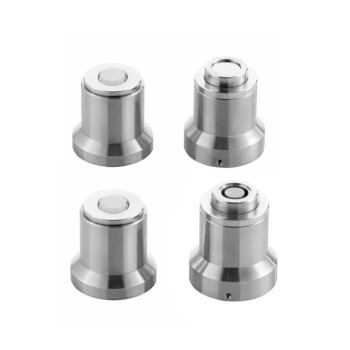
- Button Battery Tablet Press Sealing Mold for Lab Use
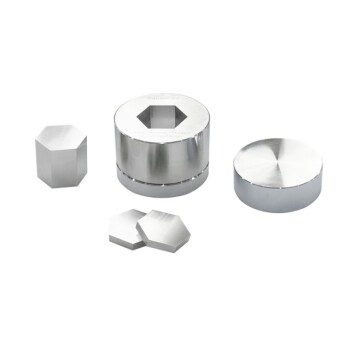
- Polygon Press Mold for Lab
- Button Battery Disassembly and Sealing Mold for Lab Use
- XRF & KBR plastic ring lab Powder Pellet Pressing Mold for FTIR
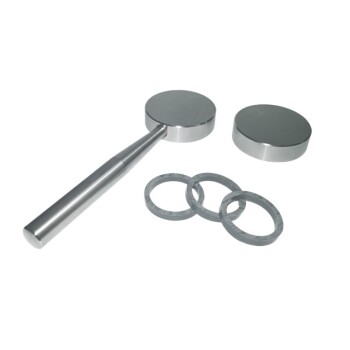
- Ring Press Mold for Lab Applications
People Also Ask
- What role do battery test molds or coin cell cases play? Optimize Your All-Solid-State Battery Assembly Today
- What is the function of a tablet press? Transforming Powder into Precise, Uniform Tablets
- What is tablet pressing in pharmaceutical industry? The Core Process for Producing Solid Oral Dosage Forms
- What is the difference between single punch and rotary tablet press? Choose the Right Machine for Your Lab or Production
- What are pill presses called? The Correct Term is Tablet Press for Pharmaceutical Manufacturing