High-precision battery testing systems and electrochemical workstations function as complementary validation tools to determine the true efficacy of modified battery electrodes. While testing systems focus on macroscopic performance metrics like long-term durability and capacity retention, electrochemical workstations provide the necessary diagnostic insights into the microscopic kinetics and interfacial behaviors driving those results.
By combining these technologies, researchers can move beyond simple pass/fail metrics. They can correlate the overall lifespan of a battery with specific fundamental mechanisms, such as changes in ion diffusion rates and interfacial impedance.
Validating Macroscopic Performance
To determine if an electrode modification is commercially viable, you must test its physical endurance. High-precision battery testing systems are the standard for these macro-level evaluations.
Assessing Long-Term Durability
Testing systems are primarily used to conduct long-term charge-discharge cycles. This process involves repeatedly charging and draining the battery to simulate real-world usage over an extended period.
The data gathered here is critical for verifying capacity retention. It reveals whether the modified electrode can maintain its energy storage capabilities over hundreds of cycles without significant degradation.
Evaluating Rate Performance
Beyond simple longevity, these systems assess how well the electrode performs under different electrical loads.
Rate performance evaluations determine if the modified electrode allows the battery to charge or discharge quickly without losing capacity. This verifies the durability of the electrode structure under varying stress conditions.
Analyzing Microscopic Kinetics
While testing systems tell you how the battery performs, electrochemical workstations explain why. These tools analyze the fundamental chemistry occurring at the electrode-electrolyte interface.
Diagnosing Impedance Changes
Electrochemical workstations are essential for performing Electrochemical Impedance Spectroscopy (EIS). This technique measures the opposition to current flow within the cell.
By analyzing ohmic and interfacial impedance, researchers can identify specific resistance points. This highlights changes in the electrode's conductivity or the formation of resistive layers at the interface.
Measuring Charge Transfer and Diffusion
To understand the speed of chemical reactions, workstations measure Critical Current Density (CCD) and other kinetic parameters.
These measurements accurately assess the kinetics of charge transfer. They also quantify ion diffusion, revealing how easily ions move across the electrode-electrolyte interface, which is a key factor in overall battery power and efficiency.
Understanding the Trade-offs
While both systems are vital, relying on one without the other leads to incomplete data.
The Limitation of "Black Box" Testing
Using only a high-precision testing system provides excellent data on lifespan but acts as a "black box" regarding failure mechanisms. If a battery fails after 500 cycles, the testing system confirms the failure but cannot explain if it was due to electrolyte depletion or electrode fracturing.
The Snapshot Limitation of Workstations
Conversely, electrochemical workstations provide deep insight into kinetics but typically offer only a "snapshot" of performance at a specific moment. Excellent EIS results at cycle 1 do not guarantee stability at cycle 500. Therefore, impedance spectroscopy must often be performed intermittently during long-term cycling to provide a complete picture.
Making the Right Choice for Your Goal
To effectively evaluate modified electrodes, you must select the right measurement protocol for your specific objective.
- If your primary focus is Commercial Viability: Prioritize high-precision testing systems to demonstrate high capacity retention and stable rate performance over hundreds of cycles.
- If your primary focus is Fundamental Mechanism Analysis: Prioritize electrochemical workstations (EIS and CCD) to isolate changes in charge transfer kinetics and ion diffusion rates at the interface.
The most robust evaluations always integrate both methods to link the physical durability of the electrode to its underlying electrochemical efficiency.
Summary Table:
| Evaluation Level | Tool Used | Key Metrics Measured | Research Objective |
|---|---|---|---|
| Macroscopic | High-Precision Testing System | Capacity retention, cycle life, rate performance | Commercial viability & durability |
| Microscopic | Electrochemical Workstation | EIS, charge transfer, ion diffusion, impedance | Kinetic mechanisms & interface behavior |
Elevate Your Battery Research with KINTEK Precision
Bridge the gap between macroscopic performance and microscopic kinetics with KINTEK’s advanced laboratory solutions. Whether you are characterizing modified electrodes or developing next-generation energy storage, our comprehensive portfolio—including high-precision battery research tools, electrochemical testing consumables, and specialized high-temperature furnaces—provides the accuracy your data demands.
Our value to your lab:
- Total System Support: From pellet presses for electrode preparation to high-performance battery testing setups.
- Unmatched Precision: Specialized equipment designed to isolate fundamental mechanisms like ion diffusion and interfacial impedance.
- Reliable Durability: High-quality ceramics, crucibles, and PTFE consumables that withstand rigorous testing environments.
Ready to optimize your battery evaluations? Contact KINTEK today to discuss your equipment needs!
Related Products
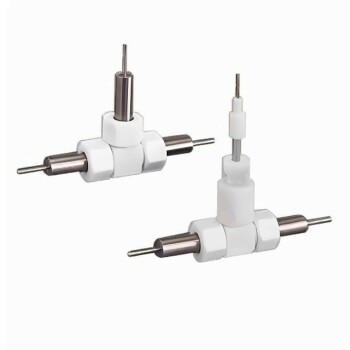
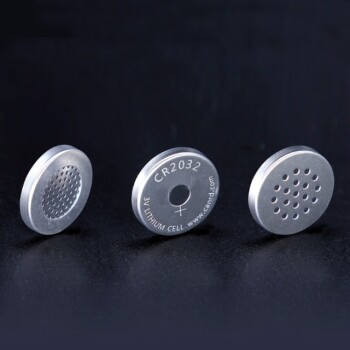
- Customizable Swagelok Type Test Cells for Advanced Battery Research Electrochemical Analysis
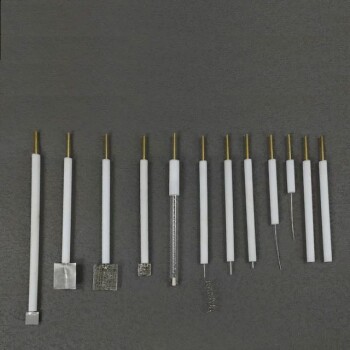
- Platinum Sheet Electrode for Battery Lab Applications
- Glassy Carbon Electrochemical Electrode
- Laboratory CVD Boron Doped Diamond Materials
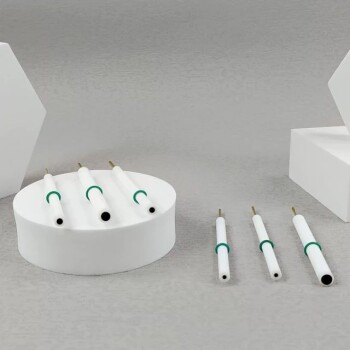
- Platinum Auxiliary Electrode for Laboratory Use
People Also Ask
- How does a standardized electrochemical test cell assist in MOx/CNTf electrode screening? Optimize Material Ratios
- Why is a dedicated electrochemical test cell necessary for carbon steel? Ensure Precise Geothermal Corrosion Data
- What is the difference between a voltaic cell and an electrochemical cell? Understand the Two Types of Energy Conversion
- How do the electrochemical cell and three-electrode testing system collaborate? Optimize Zinc Anode Deposition Control
- Why must the electrochemical cell be continuously purged with nitrogen? Ensure Precision in Ni-Cr Corrosion Tests