To ensure effective sterilization, standard autoclave operation relies on a precise combination of heat, pressure, and duration. The baseline requirement involves generating saturated steam at a pressure of approximately 15 pounds per square inch (psi) to achieve a chamber temperature of at least 250°F (121°C), maintained for a cycle duration of 30 to 60 minutes.
The central principle of autoclaving is that high temperature, not pressure, kills microorganisms. Pressure is merely the tool that allows steam to reach the necessary 121°C, while the duration ensures that this lethal temperature penetrates the entire volume of the load.
The Critical Interplay of Parameters
To operate an autoclave correctly, you must view temperature, pressure, and time not as separate settings, but as dependent variables that ensure total microbial elimination.
Temperature: The Primary Target
The biological goal of the cycle is to reach a lethal temperature for microorganisms.
While water typically boils at 100°C, this is insufficient for sterilization. The target standard is 250°F (121°C). Some advanced cycles or specific materials may utilize higher temperatures up to 275°F (135°C) to reduce processing time, but 121°C remains the universal baseline.
Pressure: The Thermal Enabler
You cannot achieve the required 121°C using steam at standard atmospheric pressure.
To raise the boiling point of water to the target temperature, the chamber must be pressurized. The standard operating pressure is approximately 15 psi (1.1 kg/cm² or 103 kPa). It is crucial to remember that pressure itself is not the sterilizing agent; it is the mechanism that allows the steam to become hot enough to sterilize.
Time: The Variable Factor
The duration of the cycle is the most variable parameter, as it depends heavily on what you are sterilizing.
While the theoretical minimum "holding time" to kill bacteria at 121°C is often cited as 15 to 20 minutes, standard operating procedures generally prescribe a total cycle time of 30 to 60 minutes.
This extended window accounts for the time required for steam to penetrate bulky items, thick wrapping, or large volumes of liquid.
Common Pitfalls to Avoid
When determining your cycle parameters, you must balance efficiency against the risk of sterilization failure.
Underestimating Load Density
A common error is assuming the "minimum" time applies to all loads.
Bulky loads, such as biohazard waste or wrapped instruments, create barriers to steam penetration. If you rely on the minimum 15-minute holding time for a dense load, the center of the package may never reach 121°C. Always err on the side of the 30-60 minute window for complex loads.
Ignoring Liquid Volume
Liquids possess high thermal inertia; they take longer to heat up and longer to cool down.
Processing large volumes of liquid requires extended cycle times to ensure the liquid itself—not just the chamber air—reaches the target temperature for the required 15 minutes.
Misunderstanding Pressure's Role
Operators sometimes focus too heavily on the pressure gauge.
If air pockets remain in the chamber (due to improper loading), the pressure gauge may read 15 psi, but the actual temperature in those air pockets will be lower than 121°C. Saturated steam contact is essential.
Making the Right Choice for Your Goal
Select your specific time and temperature settings based on the nature of the materials you are processing.
- If your primary focus is standard laboratory equipment or glassware: Adhere to the robust standard of 121°C at 15 psi for a full 30 to 60 minutes to guarantee safety margins.
- If your primary focus is small, non-porous items: You may be able to utilize the lower end of the time spectrum (holding time of 15-20 minutes) once the temperature is reached.
- If your primary focus is large liquid volumes: You must extend the cycle time significantly to account for heat transfer lag and ensure the liquid holds at 121°C for at least 15 minutes.
Consistency in these three parameters is the only way to ensure the complete elimination of microbial life.
Summary Table:
| Parameter | Standard Requirement | Purpose |
|---|---|---|
| Temperature | 121°C (250°F) | Primary agent for microbial elimination |
| Pressure | 15 psi (103 kPa) | Enables steam to reach temperatures above boiling |
| Time | 30 - 60 Minutes | Ensures heat penetration for varied load densities |
| Target | Saturated Steam | Guarantees uniform heat transfer to all surfaces |
Maximize Your Sterilization Efficiency with KINTEK
Precise control over temperature and pressure is non-negotiable for laboratory safety and research integrity. KINTEK specializes in high-performance laboratory equipment, including high-temperature high-pressure reactors and autoclaves designed to meet the most rigorous sterilization standards.
Whether you are processing glassware, biohazard waste, or complex liquid volumes, our comprehensive range of cooling solutions, crushing systems, and thermal equipment ensures your lab operates at peak performance.
Ready to upgrade your lab's capabilities? Contact our experts today to find the perfect autoclave or high-pressure solution tailored to your specific research needs.
Related Products
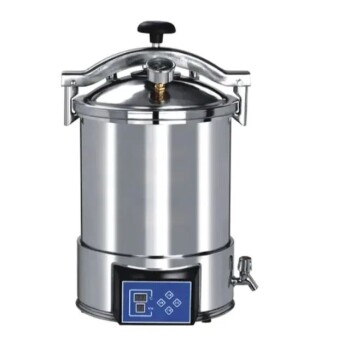
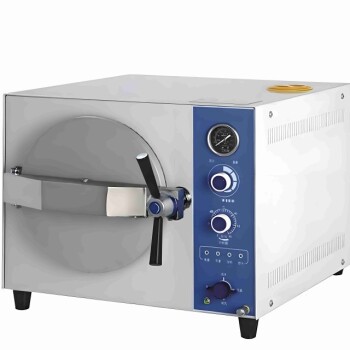
- Portable High Pressure Laboratory Autoclave Steam Sterilizer for Lab Use
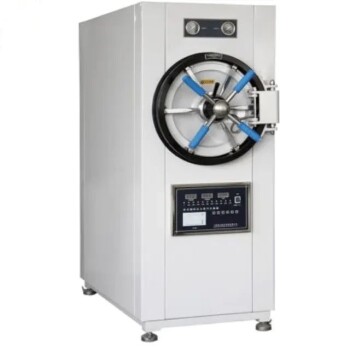
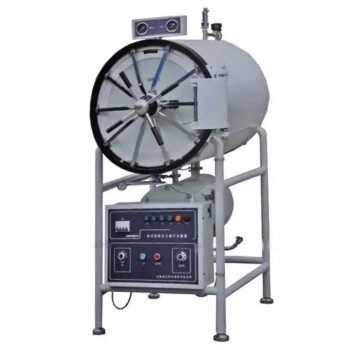
- Laboratory Horizontal Autoclave Steam Sterilizer Lab Microcomputer Sterilizer
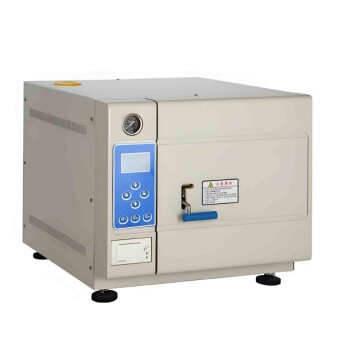
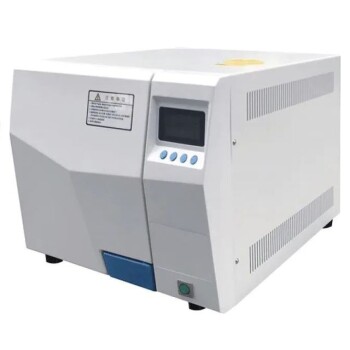
- Desktop Fast High Pressure Laboratory Autoclave Sterilizer 16L 24L for Lab Use
- Portable Digital Display Automatic Laboratory Sterilizer Lab Autoclave for Sterilization Pressure
- Desktop Fast Laboratory Autoclave Sterilizer 35L 50L 90L for Lab Use
People Also Ask
- Why is a laboratory high-pressure autoclave sterilizer necessary? Ensure Accuracy in Antibacterial Research
- What is the role of a laboratory high-pressure autoclave in the conversion of furfural to piperidine? Optimize Yields
- What are the two types of autoclave used in the laboratory? Gravity vs. Pre-Vacuum Explained
- What precautions should be taken during autoclave in laboratory? A Complete Safety Guide to Prevent Burns and Explosions
- What extreme conditions does a laboratory autoclave simulate? Testing Wear Resistance of Nuclear Fuel Cladding