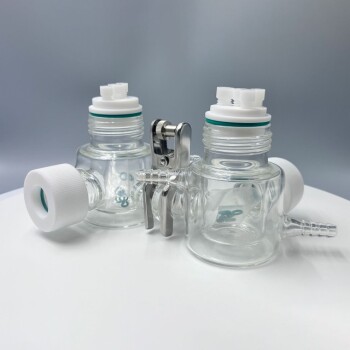
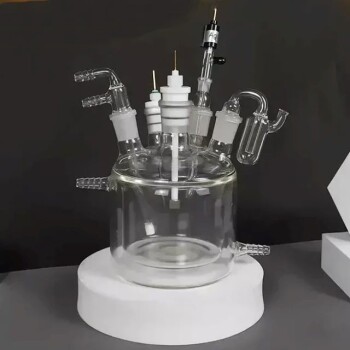
The double-layer glass reactor offers two decisive technical advantages for electroless nickel-phosphorus plating: material inertness and thermal precision. Specifically, the glass construction prevents the plating solution from depositing nickel onto the reactor walls, significantly reducing chemical waste. Simultaneously, the double-layer jacket enables the circulation of heat transfer fluids, ensuring the strict temperature control required for stable reaction kinetics and uniform coating thickness.
By combining an inert material surface with superior thermal regulation, this reactor design directly addresses the two most critical challenges in electroless plating: preventing spontaneous bath decomposition and maintaining consistent reaction speeds.
Preventing Solution Loss and Decomposition
The primary struggle in electroless nickel plating is maintaining the stability of the chemical bath. The reactor material plays a massive role in this stability.
The Inert Nature of Glass
Glass acts as a passive container for the reactive solution. Unlike certain metals or roughened plastics, the smooth glass surface effectively prevents nickel from precipitating on the inner walls of the reactor.
Avoiding Invalid Solution Loss
When nickel deposits on the tank walls, it depletes the bath without plating the intended ductile iron parts. This is known as invalid loss.
By inhibiting this "plate-out," the glass reactor ensures the nickel remains in the solution. This maximizes the efficiency of the chemicals and extends the operational life of the plating bath.
Precision Temperature Management
Electroless plating is a chemical reduction reaction that is highly sensitive to heat. The double-layer structure provides a mechanism for exacting control.
The Mechanics of the Double-Layer Jacket
The "double-layer" refers to a jacket surrounding the main vessel. This space allows for the continuous circulation of heat transfer fluids.
Rather than using immersion heaters that create hot spots, this jacket provides even, gentle heating or cooling from all sides.
Optimizing Reaction Kinetics
Temperature directly dictates the speed of the chemical deposition. If the bath is too cool, the reaction stalls; if it is too hot, the bath may decompose spontaneously.
The jacketed system allows operators to precisely control the temperature of the plating solution. This ensures the reaction occurs under optimal kinetic conditions at all times.
Ensuring Coating Uniformity
A stable process leads to a predictable result. Because the temperature does not fluctuate efficiently, the deposition rate remains constant.
This stability results in a uniform coating thickness across the ductile iron substrate, ensuring high-quality part performance.
Operational Considerations and Trade-offs
While the double-layer glass reactor provides superior process control, it is essential to acknowledge the limitations inherent to the equipment.
Fragility and Handling
Glass provides excellent chemical resistance but lacks the mechanical robustness of stainless steel or polypropylene.
Operators must exercise extreme caution during loading and unloading of heavy ductile iron parts to avoid catastrophic breakage of the reactor.
Thermal Shock Risks
Although the jacket facilitates heat transfer, rapid changes in fluid temperature can stress the glass.
Temperature changes should be ramped gradually to prevent thermal shock, which could crack the inner vessel layer.
Making the Right Choice for Your Goal
Selecting the right reactor depends on prioritizing efficiency versus durability.
- If your primary focus is Solution Efficiency: Choose this reactor to minimize invalid nickel loss and prevent expensive chemical waste due to wall precipitation.
- If your primary focus is Part Quality: Rely on the double-layer jacket to maintain the strict thermal stability required for uniform, high-tolerance coatings.
The double-layer glass reactor is the superior choice when process stability and chemical economy are prioritized over mechanical durability.
Summary Table:
| Technical Feature | Benefit for Electroless Plating | Impact on Quality |
|---|---|---|
| Inert Glass Surface | Prevents nickel deposition on reactor walls | Minimizes chemical waste & bath depletion |
| Double-Layer Jacket | Uniform circulation of heat transfer fluids | Ensures stable reaction kinetics & speed |
| Thermal Precision | Eliminates hot spots from immersion heaters | Guaranteed uniform coating thickness |
| Chemical Resistance | High stability against corrosive plating baths | Extends the operational life of the bath |
Elevate Your Material Science with KINTEK Precision Solutions
Maximize your chemical efficiency and achieve flawless coating uniformity with KINTEK’s advanced laboratory equipment. Whether you are optimizing electroless nickel-phosphorus plating or conducting complex chemical syntheses, our double-layer glass reactors provide the inertness and thermal stability your research demands.
Beyond glass reactors, KINTEK offers a comprehensive range of high-performance tools, including:
- High-Temperature Furnaces & Reactors: Muffle, vacuum, and CVD systems.
- Material Processing: Crushing, milling, and hydraulic presses (pellet, hot, isostatic).
- Electrochemical Tools: Specialized electrolytic cells and electrodes.
- Thermal Control: ULT freezers, freeze dryers, and cooling solutions.
Ready to reduce chemical waste and improve part quality? Contact KINTEK today to consult with our experts on the ideal equipment for your laboratory or pilot plant.
References
- Igor Forestier, Y. Wouters. Study of Electroless Nickel Coatings on EN-GJS-500-7 Spheroidal Graphite Cast Iron. DOI: 10.3390/coatings8070239
This article is also based on technical information from Kintek Solution Knowledge Base .
Related Products
- Visual High-Pressure Reactor for In-Situ Observation
- H-Type Double-Layer Optical Electrolytic Electrochemical Cell with Water Bath
- Customizable Laboratory High Temperature High Pressure Reactors for Diverse Scientific Applications
- Multifunctional Electrolytic Electrochemical Cell Water Bath Single Layer Double Layer
- Double Layer Five-Port Water Bath Electrolytic Electrochemical Cell
People Also Ask
- How do high-pressure reactors enhance biochar redox activity? Optimize Surface Functionalization and Energy Density
- What is the purpose of a high-pressure reactor in oleophilic GO modification? Optimize Grafting and Oil Dispersion.
- How does a high-pressure reactor facilitate reductive amidation? Maximize Yield & Speed in Tandem Reactions
- How does a high-pressure reactor assist in catalytic hydrogenation of 2,6-dimethylnitrobenzene? Optimize Your Process
- What is the significance of using a high-pressure reactor for the treatment of rice husk? Boost Furfural Yield & Speed