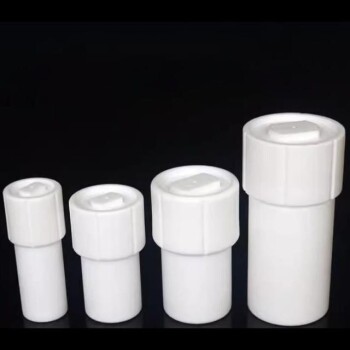
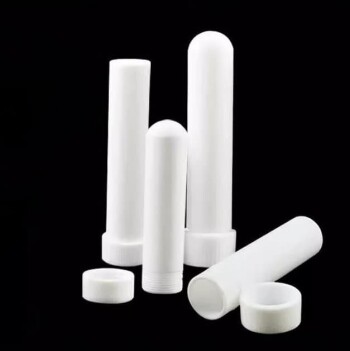
The primary function of a Polytetrafluoroethylene (PTFE) lined stainless steel high-pressure autoclave is to create a controlled hydrothermal environment that withstands extreme conditions while maintaining absolute chemical purity.
The stainless steel outer shell provides the mechanical strength to contain high pressures, allowing reaction solvents to reach temperatures (e.g., 220°C) well above their atmospheric boiling points. Simultaneously, the PTFE (Teflon) inner liner acts as a chemical shield, protecting the reactor walls from corrosion and preventing metallic contaminants from leaching into the synthesized Zinc Sulfide (ZnS) nanopowder.
Core Insight In the synthesis of nanomaterials like ZnS, the reactor must resolve the conflict between the need for high-pressure physical containment and the need for a chemically inert environment. The PTFE-lined autoclave solves this by decoupling mechanical strength (steel) from chemical resistance (PTFE), ensuring the final product retains high purity and accurate stoichiometry.
The Role of the Physical Environment
To synthesize high-quality ZnS nanopowder, standard atmospheric conditions are often insufficient. The autoclave manipulates pressure and temperature to alter the behavior of the solvents and precursors.
Achieving Subcritical or Supercritical States
The autoclave creates a sealed system that allows the solution to be heated significantly above its boiling point without evaporating. This forces the solvent into a subcritical or supercritical state, which dramatically changes its properties, such as viscosity and solubility.
Accelerating Reaction Kinetics
By maintaining elevated temperatures (such as 220°C or 433 K) under high pressure, the autoclave provides the kinetic energy necessary to decompose precursors. This environment accelerates the reaction rate and promotes the thorough nucleation of raw materials that would otherwise remain unreactive.
Controlling Crystal Morphology
The pressurized environment enables precise control over the crystallization process. By regulating the internal pressure and temperature duration, you can dictate the specific size and morphology of the ZnS nanocrystals, which is essential for optimizing their performance in optical or catalytic applications.
The Critical Function of the PTFE Liner
While the steel shell handles the physics, the PTFE liner manages the chemistry. This component is the primary safeguard for the quality of the nanomaterial.
Ensuring Chemical Inertness
Hydrothermal synthesis often involves acidic or alkaline solutions that are highly corrosive to metals. The PTFE liner is chemically inert, meaning it does not react with strong acids or organic solvents. This prevents the reaction liquid from damaging the structural integrity of the stainless steel vessel.
Preventing Metal Ion Contamination
If the reaction solution were to touch the stainless steel walls directly, corrosion would release iron, chromium, or nickel ions into the mixture. The PTFE liner eliminates this risk, ensuring the purity of the ZnS nanopowder.
Maintaining Stoichiometric Accuracy
For ZnS nanopowder to function correctly, the ratio of Zinc to Sulfur must be precise. By preventing foreign ions from entering the solution and ensuring no reactants are lost to side reactions with the vessel walls, the liner ensures the final product maintains an accurate stoichiometric ratio.
Understanding the Trade-offs
While this equipment is standard for hydrothermal synthesis, it operates within specific material limits that must be respected to avoid failure.
Temperature Limitations of PTFE
Although the stainless steel shell can withstand extreme heat, the PTFE liner is the limiting factor. At temperatures exceeding roughly 250°C, PTFE can deform or degrade. Therefore, this setup is ideal for low-to-medium temperature hydrothermal reactions (e.g., 220°C) but unsuitable for ultra-high-temperature processes.
Pressure vs. Volume
As temperature rises, the internal pressure increases exponentially. The fill volume of the liner is critical; overfilling the liner leaves insufficient headspace for vapor expansion, which can lead to dangerous pressure spikes that exceed the safety rating of the steel shell.
Making the Right Choice for Your Goal
When designing your synthesis protocol for ZnS nanopowder, consider how the autoclave aligns with your specific objectives.
- If your primary focus is High Purity: Rely on the PTFE liner's inertness to prevent metal ion doping, which is critical if the ZnS is intended for sensitive optical or electronic applications.
- If your primary focus is Morphology Control: Utilize the high-pressure capabilities of the steel shell to access supercritical states that allow for the fine-tuning of crystal size and shape.
- If your primary focus is Equipment Longevity: Ensure your reaction temperatures stay well within the PTFE safety margin (typically below 220°C-240°C) to prevent liner deformation and potential leakage.
By leveraging the dual nature of this autoclave, you ensure a synthesis environment that is mechanically robust enough to drive the reaction, yet chemically gentle enough to preserve the integrity of the nanomaterial.
Summary Table:
| Feature | Function in ZnS Synthesis | Benefit |
|---|---|---|
| Stainless Steel Shell | Provides mechanical strength for high-pressure containment | Allows solvents to reach subcritical/supercritical states |
| PTFE (Teflon) Liner | Acts as a chemically inert barrier | Prevents metal ion contamination and corrosion |
| Hydrothermal Control | Regulates temperature and reaction kinetics | Enables precise control over nanocrystal size and morphology |
| Sealed Environment | Prevents evaporation of precursors | Maintains accurate stoichiometric ratios for the final powder |
Elevate Your Material Research with KINTEK
Precise control over purity and morphology is non-negotiable in nanomaterial synthesis. KINTEK specializes in high-performance laboratory equipment, offering a premium range of high-temperature high-pressure reactors and autoclaves designed specifically for demanding hydrothermal processes.
Whether you are synthesizing ZnS nanopowders or developing next-generation battery materials, our PTFE-lined solutions provide the perfect balance of mechanical durability and chemical inertness. Beyond reactors, explore our comprehensive portfolio, including:
- Muffle, Tube, and Vacuum Furnaces for advanced heat treatment.
- Crushing, Milling, and Sieving systems for material preparation.
- Hydraulic Presses and Pellet Dies for sample consolidation.
- PTFE Consumables, Ceramics, and Crucibles for seamless lab operations.
Ready to optimize your synthesis results? Contact our technical experts today to find the ideal equipment solution for your laboratory's unique needs!
Related Products
- Stainless High Pressure Autoclave Reactor Laboratory Pressure Reactor
- Mini SS High Pressure Autoclave Reactor for Laboratory Use
- Laboratory High Pressure Horizontal Autoclave Steam Sterilizer for Lab Use
- Desktop Fast High Pressure Laboratory Autoclave Sterilizer 16L 24L for Lab Use
- Portable High Pressure Laboratory Autoclave Steam Sterilizer for Lab Use
People Also Ask
- Why is a laboratory high-pressure reactor used in the hydrothermal synthesis of hydroxyapatite catalysts?
- What role does a laboratory high-pressure reactor play in the leaching process of spent cathode materials? Optimize Recovery
- Why is a laboratory high-pressure reactor necessary for synthesizing fly ash-based zeolite? Achieve Pure Crystallization
- What conditions do laboratory high-pressure reactors provide for HTC? Optimize Your Biochar Production Processes
- What is the function of a high-pressure reactor autoclave? Enhancing Cu/N Co-Doped Carbon Catalyst Synthesis