
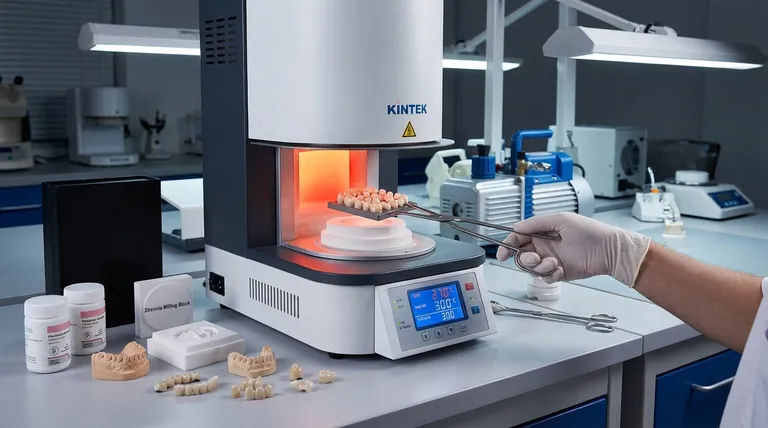
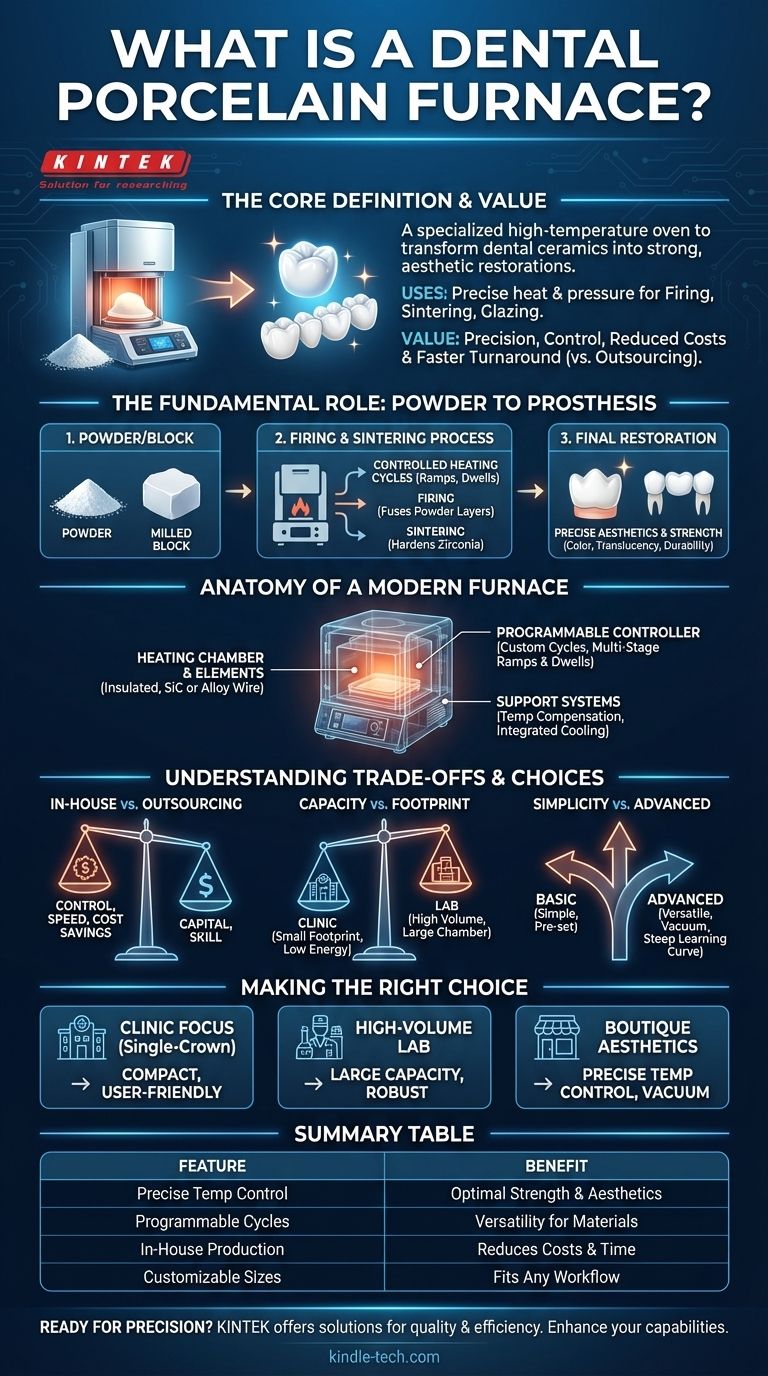
At its core, a dental porcelain furnace is a specialized, high-temperature oven engineered for a single purpose: to transform dental ceramic materials into strong, aesthetic, and perfectly fitted restorations. It uses precise heat and sometimes pressure to fire, sinter, or glaze materials like porcelain powder and zirconia, giving them their final form and durability for use in crowns, bridges, and dentures.
A porcelain furnace is more than just a heat source; it is a precision instrument. Its primary value lies in giving dental labs and clinics direct control over the final structural integrity and aesthetic outcome of ceramic restorations, reducing costs and turnaround times associated with external labs.
The Fundamental Role: From Powder to Prosthesis
A porcelain furnace is the critical final step in the digital or analog workflow of creating ceramic dental work. It takes raw or milled materials and turns them into a finished product ready for the patient.
The Firing and Sintering Process
The furnace executes highly controlled heating cycles. During firing, layers of porcelain powder are fused together to build up the shape and color of a restoration. In sintering, a milled block of zirconia is heated to a specific temperature, causing it to shrink and harden into a dense, incredibly strong final form.
Achieving Precise Aesthetics and Strength
The final color, translucency, and strength of a restoration are not just determined by the material, but by the heating process. The furnace's ability to slowly ramp up temperature, hold it steady (dwell time), and cool down correctly is essential for preventing cracks and achieving the desired optical properties.
Material Processing
This equipment is designed to process the most common materials in aesthetic dentistry. This includes firing dental porcelain powders and performing binder burnout and crystallization for zirconia frameworks.
Anatomy of a Modern Porcelain Furnace
While models vary, they all share core components designed for precision and reliability. Understanding these parts helps in evaluating a furnace's capabilities.
The Heating Chamber and Elements
The core of the furnace is an insulated chamber where restorations are placed. The heating is performed by elements, which can be made from materials like silicon carbide for uniform heating or specialized alloy resistance wire. The chamber's capacity, often measured in liters or by the size of a sintering tray, dictates how many restorations can be processed at once.
The Programmable Controller
Modern furnaces are defined by their digital controllers. A feature like a "4-segment programmer" allows technicians to create custom cycles with multiple stages of heating (ramps) and holding times (dwells). This granular control is critical for working with the wide variety of dental ceramics available today, each with its own unique firing schedule.
Essential Support Systems
High-performance furnaces include features that ensure consistency and longevity. Temperature compensation functions adjust for minor fluctuations to guarantee accurate heat, while integrated cooling systems help bring the chamber down to a safe temperature efficiently, increasing throughput and equipment reliability.
Understanding the Trade-offs
Choosing to integrate a porcelain furnace involves balancing cost, control, and capabilities.
In-House Production vs. Outsourcing
The primary benefit of an in-house furnace is gaining control over quality and timelines, eliminating the delays and communication gaps of using an external lab. This saves money on a per-unit basis but requires an initial capital investment in the equipment and skilled staff to operate it.
Capacity vs. Footprint
A small furnace may be ideal for a dental clinic producing a few single crowns a day. These units have a small footprint and lower energy consumption. In contrast, a large commercial dental lab requires a furnace with a much larger chamber to handle high-volume production of complex frameworks and multiple cases simultaneously.
Simplicity vs. Advanced Features
A basic furnace with a few pre-set programs is simple to operate but limits the types of materials you can use. An advanced model with multi-stage programming and vacuum capabilities offers maximum versatility for high-end aesthetic work but comes with a steeper learning curve and a higher price point.
Making the Right Choice for Your Goal
Selecting the right furnace depends entirely on the strategic goals of your practice or lab.
- If your primary focus is a clinic bringing single-crown production in-house: A compact, reliable furnace with user-friendly programming for common materials is the most efficient choice.
- If your primary focus is a high-volume commercial lab: Prioritize a furnace with a large capacity, robust construction, and advanced programming to maximize throughput and versatility.
- If your primary focus is a boutique practice specializing in high-end aesthetics: Invest in a furnace with exceptionally precise temperature control and vacuum capabilities to perfect the fit and appearance of complex ceramic cases.
Ultimately, investing in the right furnace transforms a practice from a consumer of lab services into a producer of high-quality, customized patient solutions.
Summary Table:
| Feature | Benefit for Your Practice/Lab |
|---|---|
| Precise Temperature Control | Ensures optimal strength and aesthetics for restorations. |
| Programmable Firing Cycles | Offers versatility to work with various ceramic materials. |
| In-House Production Capability | Reduces costs and turnaround times vs. outsourcing. |
| Customizable Chamber Sizes | Fits the workflow of clinics and high-volume labs alike. |
Ready to bring precision and control to your dental restoration workflow?
As a leading provider of dental laboratory equipment, KINTEK understands that the right porcelain furnace is an investment in the quality and efficiency of your practice. Our range of furnaces is designed to meet the specific needs of dental clinics and labs, helping you produce superior crowns, bridges, and dentures in-house.
Let us help you find the perfect solution to enhance your capabilities and grow your business.
Contact our experts today for a personalized consultation!
Visual Guide
Related Products
- Dental Porcelain Zirconia Sintering Ceramic Vacuum Press Furnace
- Dental Porcelain Zirconia Sintering Ceramic Furnace Chairside with Transformer
- Vacuum Dental Porcelain Sintering Furnace
- High Temperature Muffle Oven Furnace for Laboratory Debinding and Pre Sintering
- Molybdenum Vacuum Heat Treat Furnace
People Also Ask
- What is the price of zirconia sintering furnace? Invest in Precision, Not Just a Price Tag
- What is the primary function of a dental sintering furnace? Transform Zirconia into Durable Crowns & Bridges
- What is the sintering temperature of zirconia ceramic? Mastering the 1400°C-1600°C Thermal Profile
- How hot does a dental sintering furnace get? Unlock the Key to Perfect Restorations
- What does sintering do to zirconia? Unlock Its Full Strength and Aesthetic Potential









