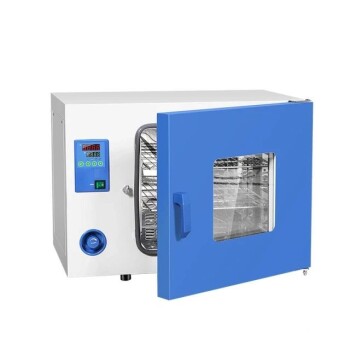
A laboratory blast drying oven serves as a precision reaction environment that transforms a wet chemical coating into a durable hydrophobic shield. Specifically, it provides a constant thermal setting to evaporate excess solvents while simultaneously driving the condensation reactions between fluoroalkylsilane (FAS) molecules and the oxide layer on metal substrates.
Core Takeaway The oven does not merely dry the material; it acts as a catalyst for chemical cross-linking. By maintaining a controlled temperature, it ensures the hydrophobic layer solidifies into a chemically stable, defect-free coating capable of withstanding complex environments.
Driving Chemical Stability
The primary function of the blast drying oven extends beyond simple dehydration. It is the engine for the chemical bonding process required for hydrophobicity.
Facilitating Condensation Reactions
The oven creates the thermodynamic conditions necessary for fluoroalkylsilane (FAS) molecules to react with the substrate.
Heat drives the condensation reaction between the FAS and the oxide layer on the metal surface. This reaction is the fundamental mechanism that anchors the hydrophobic coating to the material.
Accelerating Cross-Linking
At specific settings, such as 70 °C, the oven accelerates the solidification of the membrane layer.
This thermal energy promotes cross-linking, turning a loose molecular arrangement into a rigid network. This results in the formation of stable chemical bonds that significantly enhance the layer's durability.
Managing Physical Integrity
While chemical bonding occurs, the oven simultaneously manages the physical transition of the coating from a liquid state to a solid structure.
Controlled Solvent Removal
During the film-forming stage, the oven regulates the evaporation rate of solvents used in the coating process.
This controlled dehydration converts the coated sol layer into a solid gel layer (xerogel). Without thermal regulation, solvents might evaporate unevenly, leading to structural inconsistencies.
Defect Prevention
Precise regulation of temperature and humidity helps prevent the gel layer from shrinking excessively.
Rapid or uncontrolled shrinkage often leads to micro-cracks or peeling. By slowing and stabilizing solvent removal, the oven ensures the formation of ultra-fine, pinhole-free filtration layers.
Understanding the Trade-offs
While the blast drying oven is essential for curing, improper usage parameters can degrade membrane performance.
The Risk of Thermal Shock
If the temperature is set too high or ramps up too quickly, the solvent may evaporate faster than the gel network can stabilize.
This rapid evaporation causes structural stress, resulting in the micro-cracks mentioned earlier. This compromises the hydrophobicity and mechanical integrity of the membrane.
Incomplete Curing
Conversely, insufficient temperature or drying time will fail to drive the condensation reaction to completion.
This leaves unreacted FAS molecules and weak chemical bonds. The resulting membrane may look hydrophobic initially but will lack the durability to survive in complex application environments.
Making the Right Choice for Your Goal
The curing process is a balance between driving chemical reactions and maintaining physical structure. Adjust your oven settings based on your specific membrane requirements.
- If your primary focus is Durability: Prioritize sustaining the target temperature (e.g., 70 °C) for the full recommended cycle to maximize chemical cross-linking and bond stability.
- If your primary focus is Surface Homogeneity: Focus on a gradual ramp-up of temperature to control solvent evaporation rates, ensuring a pinhole-free, crack-resistant surface.
Success depends on using thermal energy to drive chemical bonding without physically shocking the delicate gel structure.
Summary Table:
| Function Category | Role in Curing Process | Impact on Membrane Performance |
|---|---|---|
| Chemical Bonding | Drives condensation of FAS & substrate | Ensures long-term durability & chemical stability |
| Cross-Linking | Accelerates molecular network formation | Creates a rigid, stable, and wear-resistant shield |
| Solvent Removal | Controlled evaporation (Sol-to-Gel) | Prevents structural inconsistencies and shrinkage |
| Integrity Control | Temperature & humidity regulation | Minimizes micro-cracks, peeling, and pinholes |
Elevate Your Membrane Research with KINTEK Precision
Achieving the perfect hydrophobic shield requires more than just heat; it requires the absolute thermal stability and uniform airflow found in KINTEK laboratory blast drying ovens. Whether you are accelerating chemical cross-linking or managing delicate solvent evaporation, our advanced thermal solutions ensure your coatings remain defect-free and chemically resilient.
Beyond drying ovens, KINTEK offers a comprehensive suite of laboratory excellence, including:
- High-Temperature Furnaces: Muffle, tube, and vacuum systems for advanced material synthesis.
- Sample Preparation: Precision crushing, milling, and hydraulic presses for consistent substrates.
- Specialized Reactors: High-temperature high-pressure reactors and autoclaves for complex chemical processing.
- Processing Tools: Cooling solutions, homogenizers, and high-quality PTFE or ceramic consumables.
Ready to optimize your curing parameters and ensure repeatable results? Contact our technical experts today to find the ideal equipment for your laboratory's unique requirements.
References
- Sara Claramunt, Roland Dittmeyer. Fabrication and Characterization of Hydrophobic Porous Metallic Membranes for High Temperature Applications. DOI: 10.3390/pr9050809
This article is also based on technical information from Kintek Solution Knowledge Base .
Related Products
- Laboratory Scientific Electric Heating Blast Drying Oven
- 23L Laboratory Vacuum Drying Oven
- 56L Vertical Laboratory Vacuum Drying Oven
- High Temperature Muffle Oven Furnace for Laboratory Debinding and Pre Sintering
People Also Ask
- How does a laboratory electric drying oven contribute to the formation of the initial coating? Expert Insights
- What role does a precision laboratory drying oven play in the synthesis of GO-PANI nanocomposites? Protect Material Integrity
- What role does a laboratory drying oven play in the preparation of zinc oxide nanoparticle precursors?
- What is the necessity of using a laboratory drying oven when processing MoO3/GO composite nanopowders? Find out here.
- What is the role of a laboratory drying oven in cellulose citrate production? Ensure Material Stability & Purity