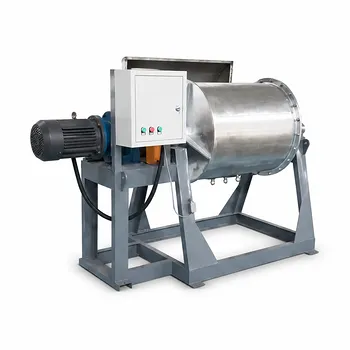
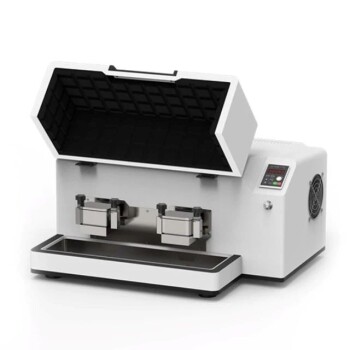
The laboratory mechanical ball milling system acts as a high-energy reactor that facilitates the precise mixing, particle refinement, and surface modification of perovskite and noble metal powders. By utilizing intense mechanical impact forces, the system ensures uniform component dispersion at the micrometer scale while inducing critical mechanochemical changes that enhance the catalytic efficiency of the resulting composite.
Mechanical ball milling transforms raw powders into high-performance catalysts by combining physical size reduction with the creation of new, chemically active interfaces between perovskite and noble metal phases.
Achieving Precision Dispersion and Refinement
High-Energy Mixing of Components
The primary role of the ball mill is to vigorously mix perovskite particles with noble metal powders, such as ruthenium or palladium. High-energy impact forces ensure that these disparate materials are distributed uniformly at the micrometer scale, which is critical for consistent catalytic performance.
Particle Size Reduction and Uniformity
Extended milling durations, sometimes lasting up to 48 hours in planetary systems, are used to eliminate large grains and refine the powder. This process results in a micron-level particle size distribution, which is essential for creating dense, high-quality ceramic structures or membrane green bodies.
Breaking Down Powder Agglomerates
After processes like drying or calcination, powders often form clumps that hinder processing. Short-duration milling effectively breaks these agglomerates, restoring the material to a fine, flowable state that is easier to handle in subsequent manufacturing steps.
Engineering the Catalyst Interface
Inducing Lattice Distortions
The mechanochemical action of the ball mill goes beyond simple mixing by physically stressing the crystal structures. This can induce lattice distortions within the perovskite, which often leads to improved electron transfer efficiency during battery charging and discharging cycles.
Creating New Active Sites
By forcing the perovskite and noble metal particles into tight contact, the milling process creates new active sites at the contact interfaces. These interfaces are often where the most significant catalytic activity occurs, particularly in applications like lithium-oxygen batteries.
Increasing Specific Surface Area
As the mechanical impact crushes and refines the powders, the total specific surface area of the particles increases. This provides more available sites for chemical reactions, directly improving the material's effectiveness in photocatalytic or electrochemical applications.
Understanding the Trade-offs and Limitations
Risk of Material Contamination
The high-energy nature of ball milling involves constant contact between the powder and the milling media (balls and vial). Over time, small amounts of the milling media can wear down, potentially introducing impurities into the catalyst that may alter its chemical properties.
Structural Over-Processing
While lattice distortion can be beneficial, excessive milling can lead to the complete collapse of the desired crystal structure. If the material becomes too amorphous, it may lose the specific perovskite characteristics required for high-performance catalysis.
Heat Generation and Phase Changes
The friction and impact within the mill generate significant heat. Without proper cooling or intermittent milling cycles, this thermal energy can trigger unintended phase transitions or the oxidation of sensitive noble metal components.
Applying Ball Milling to Your Catalyst Project
Making the Right Choice for Your Goal
To maximize the effectiveness of your laboratory ball milling system, align your milling parameters with your specific objective:
- If your primary focus is Maximizing Catalytic Activity: Prioritize high-energy settings to induce lattice distortions and maximize the creation of active sites at the contact interfaces.
- If your primary focus is Structural Uniformity: Utilize longer, controlled milling durations (such as 48 hours) to eliminate large grains and achieve a tight micron-level particle size distribution.
- If your primary focus is Improving Processability: Use short-duration milling specifically to break up post-drying agglomerates and restore powder flowability for better loading density.
By mastering the balance between mechanical impact and material integrity, researchers can leverage ball milling to bridge the gap between raw chemical precursors and high-efficiency composite catalysts.
Summary Table:
| Key Function | Mechanism | Impact on Catalyst Performance |
|---|---|---|
| High-Energy Mixing | Micrometer-scale dispersion | Ensures uniform distribution of noble metals within the perovskite matrix. |
| Particle Refinement | Size reduction & surface area increase | Increases available reaction sites for improved electrochemical activity. |
| Mechanochemical Action | Lattice distortion induction | Enhances electron transfer efficiency and creates new active interfaces. |
| De-agglomeration | Breaking powder clumps | Restores flowability and improves loading density for manufacturing. |
Elevate Your Material Research with KINTEK Precision
Optimize your catalyst synthesis with KINTEK’s high-performance laboratory mechanical ball milling systems. Whether you are refining perovskite structures or engineering complex noble metal composites, our crushing and milling solutions provide the energy control and reliability essential for high-stakes research.
Beyond milling, KINTEK offers a comprehensive laboratory portfolio, including:
- High-Temperature Furnaces: Muffle, tube, and vacuum systems for precise calcination.
- Material Processing: Hydraulic presses, sieving equipment, and high-pressure reactors.
- Research Consumables: High-purity ceramics, crucibles, and PTFE products.
Ready to achieve superior particle uniformity and enhanced catalytic efficiency? Contact KINTEK today to consult with our experts and find the perfect equipment configuration for your laboratory.
References
- Lulu Lyu, Yong‐Mook Kang. Recent advances in perovskite oxide electrocatalysts for Li–O<sub>2</sub> batteries. DOI: 10.1039/d3ey00028a
This article is also based on technical information from Kintek Solution Knowledge Base .
Related Products
- High-Energy Omnidirectional Planetary Ball Mill Milling Machine for Laboratory
- Laboratory Horizontal Planetary Ball Mill Milling Machine
- High-Energy Omnidirectional Planetary Ball Mill Machine for Laboratory
- Laboratory Planetary Ball Mill Cabinet Planetary Ball Milling Machine
- Laboratory Planetary Ball Mill Rotating Ball Milling Machine
People Also Ask
- How does a planetary ball mill solve mixing challenges with PEO? Unlock solid-state synthesis for insoluble dopants
- What is the role of a planetary ball mill in preparing doped high-nickel cathode materials? Enhance Battery Stability
- Why is a planetary ball mill used for LNMO precursor powders? Optimize Particle Uniformity & Battery Performance
- What is the function of a planetary ball mill in the solid-state synthesis of LiTa2PO8? Achieve High-Purity Electrolytes
- What is the critical role of a planetary ball mill in the processing of inorganic fillers? Enhance Battery Performance