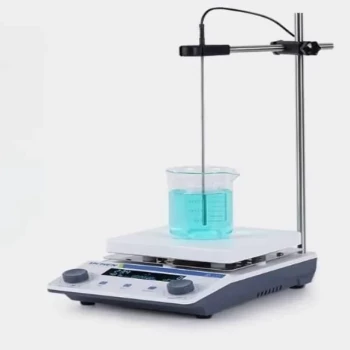
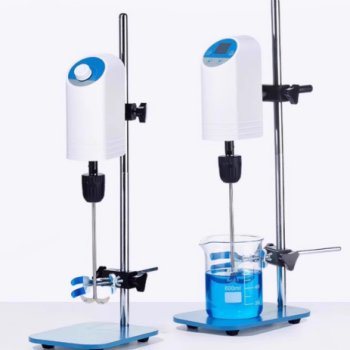
The primary function of a magnetic stirrer during the coprecipitation of MgAl-LDH is to provide continuous, vigorous agitation that forces the rapid diffusion of magnesium and aluminum salt solutions into the base solution. This mechanical action ensures molecular-level uniform mixing, preventing localized concentration gradients that would otherwise lead to inconsistent material properties.
Core Takeaway The magnetic stirrer acts as a homogeneity enforcer, creating a consistent chemical environment that is essential for the uniform nucleation of crystals. Without this vigorous mixing, the final product would suffer from irregular grain sizes and uneven chemical composition.
Achieving a Uniform Chemical Environment
To synthesize high-quality Layered Double Hydroxides (LDH), you must control the environment at the moment of reaction.
Rapid Diffusion
When the Mg and Al salt solutions are added to the base, the reaction occurs almost instantly. The magnetic stirrer provides the mechanical power necessary to disperse these reactants immediately upon contact.
Molecular-Level Mixing
Simple macroscopic blending is insufficient for nanomaterials. The stirrer ensures that mixing occurs at the molecular level, creating a homogenous solution where metal ions are evenly distributed before precipitation fully sets in.
Eliminating Localized Gradients
Without vigorous stirring, "hot spots" of high concentration can form near the injection point. Continuous agitation eliminates these gradients, ensuring the pH and metal ion concentrations are identical throughout the entire reaction vessel.
Controlling Nucleation and Growth
The physical properties of the final MgAl-LDH material are determined by how the crystals are born and how they grow.
Uniform Nucleation
The creation of crystal nuclei (nucleation) is highly sensitive to local chemical conditions. By maintaining a uniform environment, the magnetic stirrer ensures that all nuclei generate simultaneously and under the same conditions.
Regulating Grain Size
Uniform nucleation directly influences the final particle size. When nuclei form uniformly, they consume reactants at a similar rate, resulting in a narrow and controlled grain size distribution in the final product.
Understanding the Risks of Inadequate Mixing
While the primary goal is uniformity, it is important to understand the consequences of failing to maintain vigorous stirring.
Localized Segregation
If the mixing speed is too low, the diffusion rate will lag behind the reaction rate. This leads to component segregation, where the ratio of Magnesium to Aluminum may vary within different crystals in the same batch.
Abnormal Grain Growth
Inconsistent mixing creates pockets of varying supersaturation. This causes some crystals to grow abnormally large while others remain small, destroying the dispersibility and consistency of the final powder.
Making the Right Choice for Your Goal
When setting up your coprecipitation apparatus, consider how the stirring parameters align with your specific material requirements.
- If your primary focus is High Purity and Homogeneity: Ensure the magnetic stirrer is set to a vigorous speed to maximize shear force and molecular diffusion, preventing phase segregation.
- If your primary focus is Particle Size Consistency: Maintain a constant, unvarying stirring speed throughout the entire addition process to ensure a stable nucleation environment.
Ultimately, the magnetic stirrer is not just a mixer; it is the primary control mechanism for determining the structural integrity and uniformity of your MgAl-LDH crystals.
Summary Table:
| Feature | Impact on MgAl-LDH Preparation |
|---|---|
| Rapid Diffusion | Prevents localized concentration gradients at injection points. |
| Molecular Mixing | Ensures even distribution of metal ions for phase purity. |
| Nucleation Control | Facilitates simultaneous crystal birth for uniform grain size. |
| Gradient Elimination | Maintains consistent pH and ion concentration throughout the vessel. |
| Structural Integrity | Prevents component segregation and abnormal grain growth. |
Elevate Your Materials Research with KINTEK Precision
Achieving the perfect MgAl-LDH structure requires more than just chemistry; it requires the right mechanical environment. KINTEK specializes in high-performance laboratory equipment designed to meet the rigorous demands of advanced material synthesis.
Whether you are performing complex coprecipitation or scaling up production, our comprehensive range of magnetic stirrers, homogenizers, and shakers ensures the molecular-level uniformity your research deserves. Beyond mixing, KINTEK offers a full suite of solutions including:
- High-Temperature Furnaces & Reactors: From vacuum and CVD furnaces to high-pressure autoclaves.
- Processing Equipment: Advanced crushing, milling, and hydraulic presses for pellet preparation.
- Lab Essentials: Specialized electrolytic cells, electrodes, and durable ceramics/crucibles.
Ready to optimize your lab's performance? Contact our experts today to discover how KINTEK’s precision tools can enhance your chemical consistency and research outcomes.
References
- Yanhui Cao, Jianchun Liu. Insight into the Preparation of MgAl-Layered Double Hydroxide (LDH) Intercalated with Nitrates and Chloride Adsorption Ability Study. DOI: 10.3390/app12094492
This article is also based on technical information from Kintek Solution Knowledge Base .
Related Products
- Laboratory Small Constant Temperature Heated Magnetic Stirrer Heater and Stirrer
- Custom PTFE Teflon Parts Manufacturer for Magnetic Stirring Bar
- Three-dimensional electromagnetic sieving instrument
- High Performance Laboratory Stirrers for Diverse Applications
- Custom PTFE Teflon Parts Manufacturer for PTFE Stirring Bar Recovery Rod
People Also Ask
- What role does a magnetic stirrer with heating play in ZnO nanoparticle synthesis? Precision Control for Quality Results
- What role does a constant temperature heating magnetic stirrer play in MFC-HAp synthesis? Achieve Material Homogeneity
- What is the function of a laboratory magnetic stirrer in Ni–Cr–P electrodeposition? Optimize Ion Transport & Coating
- Why is a laboratory magnetic stirrer required for benzoic acid esters? Boost Reaction Speed & Yield with High RPM
- What role does a laboratory magnetic stirrer play in TiO2 and TiO2-Ag sol preparation? Master Chemical Kinetics