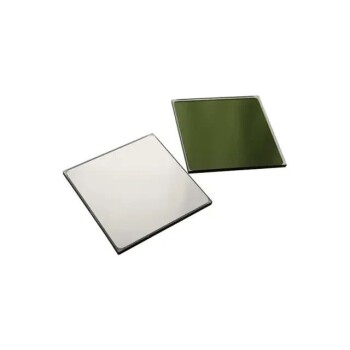
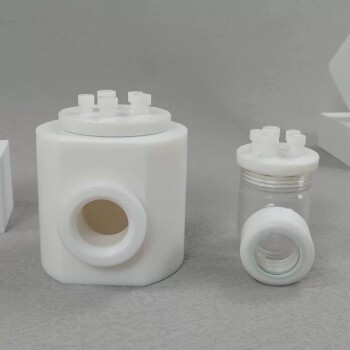
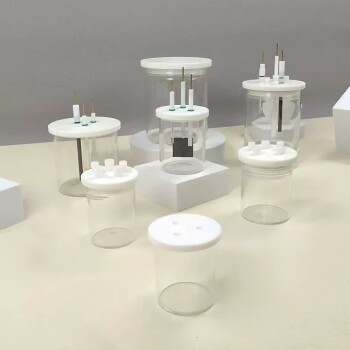
A photoelectrochemical reactor equipped with a quartz window serves as a precision optical interface designed to allow full-spectrum light to reach the photoelectrode without attenuation. By utilizing quartz rather than standard glass, the reactor ensures that the specific wavelengths necessary for exciting the semiconductor material—particularly in the ultraviolet and visible ranges—are transmitted to the photocathode surface with virtually zero loss.
Core Takeaway The quartz window is not merely a transparent barrier; it is an active enabler of accurate data. By preventing the absorption of high-energy photons, it maximizes the separation of photogenerated electron-hole pairs, allowing researchers to determine the true efficiency, bandgap energy, and hydrogen evolution potential of nanostructured materials like copper oxide.
The Physics of Light Transmission
Maximizing Photon Availability
In water splitting research, the quality of light hitting the sample is as critical as the sample itself.
Standard glass absorbs a significant portion of ultraviolet (UV) light. A quartz window, however, offers exceptionally high transmittance across both UV and visible wavebands.
This ensures that the light source—whether actual sunlight or a simulated Xenon lamp—illuminates the working electrode with its full intensity and spectral range preserved.
Driving Electron-Hole Pair Generation
The primary function of the reactor is to facilitate the photoelectric effect within the semiconductor.
When high-energy photons pass through the quartz window and strike the nanostructured copper oxide (or titanium dioxide) surface, they excite electrons.
This excitation creates photogenerated electron-hole pairs. Because the quartz window minimizes light loss, the generation rate of these pairs is maximized, leading to more effective charge separation and migration to the electrolyte interface.
Critical Experimental Metrics
Accurate Photocurrent Density
To evaluate a material, researchers must measure the electrical current generated by light (photocurrent).
If the reactor window absorbs light, the measured current will be artificially low.
The quartz window ensures that the resulting current-voltage curves accurately reflect the material's intrinsic capabilities, rather than the limitations of the reactor vessel.
Evaluating Hydrogen Evolution
The ultimate goal of PEC water splitting is the production of hydrogen fuel.
The efficiency of this chemical reaction relies on the successful migration of charge carriers.
By ensuring unhindered illumination, the quartz-equipped reactor allows for a precise calculation of hydrogen evolution efficiency and bandgap energy, serving as an essential tool for benchmarking performance.
Common Pitfalls and Trade-offs
The "Standard Glass" Error
A common oversight in reactor design is substituting quartz with borosilicate or soda-lime glass to reduce costs.
This is a critical error for wide-bandgap materials like TiO2, which rely heavily on UV light for excitation.
Using non-quartz glass acts as an unintended filter, effectively "starving" the reaction of the energy required to drive chlorine or hydrogen evolution, leading to false negative results regarding the material's potential.
Cleaning and Maintenance
While optically superior, quartz requires careful handling compared to standard glass.
It must be kept meticulously clean; even minor surface contamination can alter its refractive properties and transmission rates, negating the benefits of the material.
Making the Right Choice for Your Experiment
To ensure your data is valid and your material is given a fair evaluation, align your reactor choice with your specific research goals.
- If your primary focus is accurate efficiency benchmarking: You must use a quartz window to ensure the current-voltage curves reflect the true photoelectric conversion efficiency without optical interference.
- If your primary focus is UV-active materials (like TiO2): Quartz is non-negotiable, as standard glass will block the high-energy photons required to excite the photocatalyst.
- If your primary focus is full-spectrum solar simulation: The quartz window is essential to allow the complete range of wavelengths from a Xenon lamp to reach the sample surface.
The integrity of your photoelectrochemical data begins with the transparency of your optical window.
Summary Table:
| Feature | Quartz Window Specification | Impact on PEC Research |
|---|---|---|
| Light Transmission | High UV and Visible waveband (200nm - 2500nm) | Full-spectrum illumination for semiconductor excitation |
| Energy Loss | Near-zero photon attenuation | Maximizes electron-hole pair generation efficiency |
| Data Integrity | High optical clarity | Ensures accurate photocurrent & bandgap measurements |
| Application | Solar simulation & UV-active materials | Ideal for TiO2, CuO, and wide-bandgap photocatalysts |
Elevate Your PEC Research with KINTEK Precision
Don't let inferior optical interfaces compromise your results. KINTEK specializes in high-performance laboratory equipment, providing researchers with the precision-engineered photoelectrochemical reactors, electrolytic cells, and high-quality electrodes needed for groundbreaking water splitting studies.
Our extensive portfolio includes:
- Optical Solutions: Quartz-equipped reactors for maximum UV-VIS transmittance.
- Thermal & Pressure Control: High-temperature furnaces and high-pressure autoclaves for material synthesis.
- Sample Preparation: Precision crushing, milling systems, and hydraulic presses (isostatic/pellet).
- Advanced Research Tools: Battery research consumables, cooling solutions (ULT freezers), and homogenization equipment.
Ensure your data reflects the true potential of your materials. Contact KINTEK today to discover how our expert-grade consumables and reactors can accelerate your hydrogen evolution and solar energy projects.
References
- Damian Giziński, Tomasz Czujko. Nanostructured Anodic Copper Oxides as Catalysts in Electrochemical and Photoelectrochemical Reactions. DOI: 10.3390/catal10111338
This article is also based on technical information from Kintek Solution Knowledge Base .
Related Products
- Visual High-Pressure Reactor for In-Situ Observation
- Optical Window Glass Substrate Wafer Quartz Plate JGS1 JGS2 JGS3
- Optical Window Glass Substrate Wafer Single Double Sided Coated K9 Quartz Sheet
- Side Window Optical Electrolytic Electrochemical Cell
- CF Ultra-High Vacuum Observation Window Window Flange High Borosilicate Glass Sight Glass
People Also Ask
- How do high-pressure reactors enhance biochar redox activity? Optimize Surface Functionalization and Energy Density
- What is the purpose of a high-pressure reactor in oleophilic GO modification? Optimize Grafting and Oil Dispersion.
- How does a high-pressure reactor facilitate reductive amidation? Maximize Yield & Speed in Tandem Reactions
- How does a high-pressure reactor assist in catalytic hydrogenation of 2,6-dimethylnitrobenzene? Optimize Your Process
- What is the significance of using a high-pressure reactor for the treatment of rice husk? Boost Furfural Yield & Speed