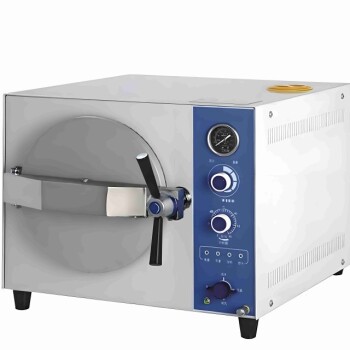
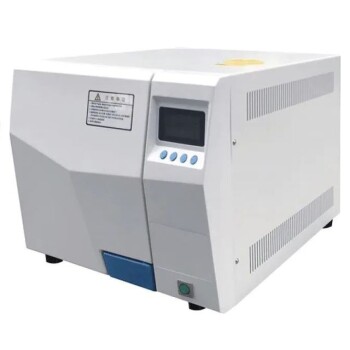
The PTFE-lined high-pressure autoclave serves as the critical reaction chamber for controlling the crystallization of tungsten precursors. It provides a sealed environment that maintains the high temperatures and pressures required for precursor solutions to undergo hydrolysis and directional growth. By enabling reactions at temperatures well above the solvent's boiling point, it facilitates the formation of organized, regular WO3 nanorod arrays on substrates like carbon fiber paper.
The autoclave creates a subcritical hydrothermal environment that promotes anisotropic crystal growth while simultaneously protecting sample purity through its chemically inert liner. This setup is the fundamental requirement for transforming dissolved tungsten salts into structured, high-aspect-ratio nanorods.
Creating a Subcritical Reaction Environment
Elevating Boiling Points and Kinetic Energy
Hydrothermal synthesis of WO3 requires temperatures that frequently exceed the standard boiling point of the solvent. The sealed autoclave prevents the solvent from evaporating, forcing it into a subcritical state where its physical properties change.
Driving Precursor Hydrolysis
These high-energy conditions are essential for the hydrolysis of tungsten precursors. Without the thermal energy and pressure provided by the autoclave, the chemical transformation from a liquid precursor to a solid oxide would be incomplete or non-existent.
Facilitating Directional Growth (Anisotropy)
Controlled Nucleation on Substrates
The high-pressure environment regulates how tungsten trioxide nucleates on the surface of substrates like carbon fiber paper. This pressure ensures that growth initiates uniformly across the entire surface rather than forming disordered clusters in the bulk solution.
Promotion of Nanorod Morphology
The autoclave environment encourages anisotropic growth, where crystals extend preferentially along a specific longitudinal axis. This mechanism is what allows the material to develop into high-aspect-ratio nanorod arrays rather than simple spherical particles.
Ensuring Chemical Purity and Structural Safety
The Protective Role of the PTFE Liner
Polytetrafluoroethylene (PTFE) is used as an internal liner because it is highly resistant to corrosion and chemical attack. This liner prevents the precursor solution from reacting with the metal body of the reactor, which eliminates the risk of metallic impurity contamination.
Structural Integrity of the Stainless Steel Shell
While the PTFE liner handles the chemistry, the external stainless steel shell manages the mechanical stress of the reaction. This dual-layer design ensures the system remains safe and stable under the intense internal pressures generated during the heating cycle.
Understanding the Trade-offs and Risks
Thermal Limitations of PTFE
While chemically stable, PTFE has a strict maximum operating temperature, typically around 200°C to 220°C. Exceeding these limits can cause the liner to soften or deform, potentially leading to a seal failure or the release of fluorinated vapors.
Pressure Management and Cycle Time
High-pressure reactions carry inherent safety risks if the autoclave is not properly maintained or if the cooling phase is rushed. Furthermore, the thermal mass of the stainless steel shell means it takes significant time to heat and cool, which limits the speed of experimental iterations.
How to Optimize Your Hydrothermal Synthesis
To achieve the best results with WO3 nanorod arrays, align your autoclave parameters with your specific structural goals:
- If your primary focus is uniform array distribution: Ensure the substrate is positioned securely within the PTFE liner to allow for unobstructed flow of the precursor solution under pressure.
- If your primary focus is maximum chemical purity: Always inspect the PTFE liner for cracks or discoloration before use to prevent the leaching of metal ions from the outer shell.
- If your primary focus is high-aspect-ratio nanorods: Carefully control the ramp-up and soak times at subcritical temperatures to favor directional crystal growth over rapid, random nucleation.
By mastering the high-pressure environment within the autoclave, you gain precise control over the nanostructure and performance of your tungsten trioxide arrays.
Summary Table:
| Feature | Function in WO3 Synthesis | Benefit to Research |
|---|---|---|
| PTFE Liner | Chemical resistance and insulation | Prevents metallic contamination; ensures high chemical purity. |
| Stainless Steel Shell | Structural pressure containment | Maintains subcritical conditions needed for precursor hydrolysis. |
| Subcritical Environment | Increased kinetic energy and solubility | Promotes anisotropic growth for high-aspect-ratio nanorods. |
| Sealed System | Prevents solvent evaporation | Allows reactions to occur well above the solvent's boiling point. |
| Thermal Control | Regulated nucleation rates | Ensures uniform array distribution across substrates like carbon paper. |
Elevate Your Nanomaterial Research with KINTEK Precision
Achieving the perfect nanostructure requires equipment that provides uncompromising control and purity. KINTEK specializes in high-performance laboratory solutions tailored for advanced material science. Whether you are synthesizing WO3 nanorod arrays or exploring complex chemical vapor deposition, our equipment is built to deliver repeatable, high-quality results.
Our extensive portfolio includes:
- Hydrothermal Excellence: High-temperature high-pressure reactors, autoclaves, and chemically inert PTFE products, ceramics, and crucibles.
- Thermal Processing: A full range of high-temperature furnaces, including muffle, tube, vacuum, CVD, and PECVD systems.
- Sample Preparation: Precision crushing and milling systems, sieving equipment, and hydraulic presses (pellet, hot, isostatic).
- Advanced Research Tools: Electrolytic cells, electrodes, battery research consumables, and cooling solutions like ULT freezers and freeze dryers.
Ready to optimize your synthesis parameters? Contact KINTEK today to discover how our specialized equipment and consumables can enhance your lab's efficiency and drive your next breakthrough!
References
- Xiaozhong Zheng, Yong Wang. Tailoring a local acid-like microenvironment for efficient neutral hydrogen evolution. DOI: 10.1038/s41467-023-39963-8
This article is also based on technical information from Kintek Solution Knowledge Base .
Related Products
- Laboratory High Pressure Horizontal Autoclave Steam Sterilizer for Lab Use
- Stainless High Pressure Autoclave Reactor Laboratory Pressure Reactor
- Portable High Pressure Laboratory Autoclave Steam Sterilizer for Lab Use
- Desktop Fast High Pressure Laboratory Autoclave Sterilizer 16L 24L for Lab Use
- Laboratory High Pressure Steam Sterilizer Vertical Autoclave for Lab Department
People Also Ask
- Why is a laboratory high-pressure autoclave sterilizer necessary? Ensure Accuracy in Antibacterial Research
- What is the role of a laboratory high-pressure autoclave in the conversion of furfural to piperidine? Optimize Yields
- What is the primary function of a laboratory autoclave in the pre-treatment of medical plastic waste for liquid fuel?
- What is an autoclave laboratory equipment? The Ultimate Guide to Steam Sterilization
- What is a laboratory autoclave? A Guide to Sterilization with Pressurized Steam