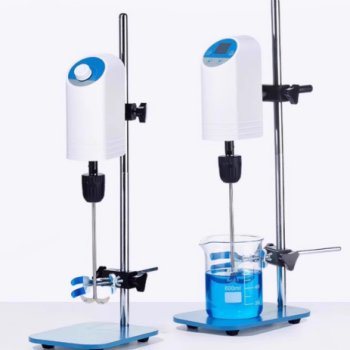
The primary function of a reactor equipped with a high-speed paddle stirrer is to generate intense shear forces that ensure the rapid, molecular-level mixing of reactants. Operating at speeds up to 1800 rpm, this specific equipment forces magnesium sulfate and sodium hydroxide solutions to interact uniformly the instant they come into contact.
By dominating the reaction environment with high-intensity shear, this mixing method acts as the central control mechanism for product quality. It regulates the crystallization process to prevent uneven growth, ensuring the final magnesium hydroxide precursor exhibits uniform particle size and superior dispersibility.
The Mechanics of High-Shear Mixing
Generating Intense Shear Forces
The core operational feature of this reactor is its ability to reach rotational speeds of 1800 rpm. At these velocities, the paddle stirrer creates a high-energy environment within the reaction vessel.
Achieving Molecular-Level Distribution
This mechanical energy is translated into fluid dynamics that drive the molecular-level distribution of the chemical inputs. It ensures that the magnesium sulfate and sodium hydroxide solutions are homogenized immediately, rather than relying on slower, passive diffusion.
Controlling Crystallization and Quality
Regulating Nucleation
The high-speed environment is critical for controlling the nucleation process, the initial step where crystals begin to form. By standardizing the energy and distribution of reactants, the system ensures distinct and controlled crystal inception.
Preventing Abnormal Grain Growth
Without intense mixing, "hotspots" of high chemical concentration can form within the reactor. The high-speed stirrer eliminates these localized high concentrations, effectively preventing abnormal grain growth that would otherwise degrade the material's structural integrity.
Ensuring Particle Uniformity
The direct result of this controlled environment is a magnesium hydroxide precursor with a uniform particle size distribution. This uniformity is essential for downstream applications where consistency is key.
Enhancing Dispersibility
Because the particles are formed under uniform conditions without abnormal agglomeration, the final product demonstrates good dispersibility. This characteristic is often a defining metric for the quality of the precipitated magnesium hydroxide.
Understanding the Risks of Improper Mixing
The Danger of Localized Concentrations
If the stirrer fails to maintain sufficient speed or shear, the process is susceptible to localized high concentrations. In these stagnant or low-flow zones, reactants pool together unevenly.
Consequences for Particle Structure
These concentration variances are the primary cause of abnormal grain growth. If the shear force is not maintained, the system loses control over the particle size distribution, leading to an inconsistent and potentially unusable product.
Making the Right Choice for Your Goal
To optimize your magnesium hydroxide precipitation process, align your mixing parameters with your specific quality targets:
- If your primary focus is Particle Uniformity: Ensure your reactor maintains high RPM (approaching 1800) to eliminate localized concentration gradients that cause uneven growth.
- If your primary focus is Product Dispersibility: Prioritize intense shear forces to achieve molecular-level distribution of the sodium hydroxide and magnesium sulfate immediately upon contact.
High-speed mixing is not just about agitation; it is the precise engineering tool used to dictate the microscopic architecture of your final product.
Summary Table:
| Feature | Function in Precipitation Process | Impact on Product Quality |
|---|---|---|
| 1800 RPM Speed | Generates intense shear forces | Ensures molecular-level reactant distribution |
| Rapid Mixing | Eliminates localized high concentrations | Prevents abnormal grain growth and hotspots |
| Nucleation Control | Regulates initial crystal formation | Guarantees uniform particle size distribution |
| High Shear Energy | Prevents particle agglomeration | Enhances final product dispersibility |
Elevate Your Chemical Synthesis with KINTEK Precision
Achieving the perfect crystal structure requires more than just mixing; it requires the high-intensity shear and thermal precision found in KINTEK’s high-temperature high-pressure reactors and autoclaves. Whether you are optimizing magnesium hydroxide precipitation or developing advanced precursors, our specialized equipment is designed to eliminate localized concentration gradients and ensure absolute product uniformity.
Why choose KINTEK for your laboratory and production needs?
- Comprehensive Reactor Solutions: From high-speed stirring to CVD and PECVD systems.
- Precision Engineering: Optimized for high-shear, molecular-level homogenization.
- Full Lab Integration: We offer everything from crushing and milling systems to cooling solutions and essential ceramics.
Don't let improper mixing compromise your material integrity. Contact KINTEK today to find the perfect reactor for your application!
References
- Agnieszka A. Pilarska, Teofil Jesionowski. Use of MgO to Promote the Oxyethylation Reaction of Lauryl Alcohol. DOI: 10.2478/pjct-2014-0027
This article is also based on technical information from Kintek Solution Knowledge Base .
Related Products
- High Performance Laboratory Stirrers for Diverse Applications
- Custom PTFE Teflon Parts Manufacturer for Magnetic Stirring Bar
- Benchtop High Speed Small Lab Centrifuge for Serum Separation and Low Temperature Dehydration
- Mini SS High Pressure Autoclave Reactor for Laboratory Use
- Customizable High Pressure Reactors for Advanced Scientific and Industrial Applications
People Also Ask
- How does a laboratory stirrer influence MOF product quality? Master Precision in Non-Solvothermal Synthesis
- What critical role does a Laboratory Stirrer play during leaching? Enhance Titanium-Magnesium Waste Recovery
- What is the primary function of laboratory stirring equipment in the preparation of compost leachate? Optimize Extraction
- What is a laboratory mixer? A Guide to Achieving Perfect Sample Homogeneity
- What is a laboratory mixer used for? Choose the Right Tool for Liquids or Solids