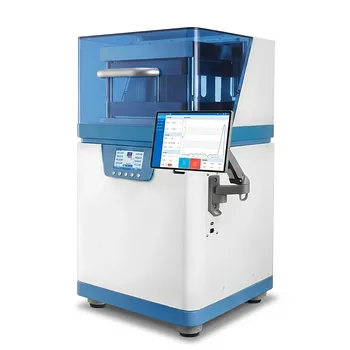
In the preparation of supercapacitor electrode materials, a stainless steel high-pressure reactor functions as a hydrothermal synthesis vessel that facilitates the transformation of precursors into high-surface-area carbon or metal-oxide structures. It creates a sealed, high-pressure environment where water or solvents can reach temperatures well above their boiling points, driving chemical reactions that are impossible at atmospheric pressure.
Core Takeaway: The high-pressure reactor enables hydrothermal carbonization (HTC) and nanostructure synthesis, allowing for the precise control of surface functional groups and crystalline phases that define a supercapacitor's energy density and power performance.
Facilitating Hydrothermal Carbonization (HTC)
Conversion of Biomass Precursors
The reactor utilizes water as a reaction medium under high pressure and moderate temperatures to convert organic precursors, such as peanut shells, into hydrochar. This process uses the high-pressure environment to break down complex organic structures into carbon-rich materials.
Structural Reorganization
Under these pressurized conditions, the carbon structures undergo significant reorganization. This serves as a critical precursor step for obtaining activated carbon with the high specific surface area required for effective ion storage in supercapacitors.
Development of Surface Functional Groups
The hydrothermal process is unique because it produces hydrochar rich in surface functional groups. These groups improve the wettability of the electrode in aqueous electrolytes and can contribute to pseudocapacitance, further enhancing the material's electrochemical performance.
Enhancing Material Synthesis and Reactivity
Increased Solubility and Reaction Speed
By subjecting reactants to temperatures often reaching 300°C and pressures up to 90 bar, the reactor significantly increases the solubility and reactivity of precursors. This allows for one-step chemical reactions that produce single-phase powders at lower temperatures than traditional solid-state methods.
Precise Doping and Phase Purity
In the synthesis of metal-oxide electrodes (like Cd-doped Ag2O), the sealed environment ensures that dopants are effectively integrated into the crystal lattice. This results in high phase purity and crystallinity, which are essential for maintaining stable performance over thousands of charge-discharge cycles.
Prevention of Solvent Loss
The reactor’s sealed architecture prevents the evaporation of volatile solvents and reactants. This is crucial for maintaining the precise stoichiometric ratios needed to achieve a specific molecular weight or chemical composition in the resulting polymer or composite matrix.
Understanding the Trade-offs and Constraints
Material Corrosion and Longevity
While stainless steel is robust, constant exposure to high-temperature aqueous solutions and corrosive precursors (like hydrogen sulfide or chlorides) can lead to stress corrosion cracking. Expert maintenance and the use of protective liners (like PTFE) are often required to prevent contamination of the electrode materials.
Thermal Inertia and Heating Lag
Stainless steel reactors have significant thermal mass, meaning they heat up and cool down slowly. This can make it difficult to achieve "instantaneous" reaction quenching, which may lead to unwanted grain growth in certain sensitive nanomaterials.
Safety and Pressure Management
Operating at high pressures (e.g., 0.6 MPa to 9 MPa) requires rigorous safety protocols and precision pressure control. Any failure in the sealing performance or pressure-resistant architecture can lead to hazardous energy release and the loss of expensive precursor materials.
How to Apply This to Your Project
Making the Right Choice for Your Goal
- If your primary focus is Biomass-Derived Carbon: Use the reactor for hydrothermal carbonization at moderate temperatures to maximize the density of oxygen-containing functional groups.
- If your primary focus is Metal-Oxide Nanostructures: Leverage the high-pressure environment to ensure high crystallinity and uniform doping within the metal lattice.
- If your primary focus is High-Throughput Production: Prioritize reactors with integrated mechanical stirring and rapid cooling systems to ensure reaction uniformity and decrease cycle times.
By mastering the high-pressure hydrothermal environment, researchers can bridge the gap between raw precursors and the sophisticated nanostructures required for next-generation energy storage.
Summary Table:
| Key Function | Benefit to Supercapacitor Materials | Practical Application |
|---|---|---|
| Hydrothermal Carbonization | Converts biomass into carbon-rich hydrochar | Biomass-derived activated carbon |
| Structural Reorganization | Creates high specific surface area | Enhanced ion storage & energy density |
| Surface Functionalization | Improves wettability and adds pseudocapacitance | Aqueous electrolyte performance |
| Phase Purity Control | Ensures uniform doping and crystalline stability | Metal-oxide electrode synthesis |
| Sealed Environment | Prevents solvent loss and maintains stoichiometry | Precise polymer/composite matrices |
Elevate Your Energy Storage Research with KINTEK
Precision is the backbone of high-performance supercapacitor development. KINTEK specializes in advanced laboratory equipment, offering a premium range of high-temperature high-pressure reactors and autoclaves designed to master hydrothermal synthesis and carbonization.
Whether you are synthesizing metal-oxide nanostructures or converting biomass into high-surface-area carbon, our equipment ensures the safety, pressure control, and thermal stability your research demands. Beyond reactors, we provide a complete ecosystem for material science, including:
- Muffle, Tube, and Vacuum Furnaces for high-temperature treatment.
- Crushing, Milling, and Sieving Systems for precursor preparation.
- Hydraulic Pellet Presses for electrode fabrication.
- Electrolytic Cells and Battery Research Tools for electrochemical testing.
Ready to scale your synthesis and achieve superior material performance? Contact our experts at KINTEK today to find the ideal solution for your laboratory’s unique requirements.
References
- Radhika Mandala, Venkateswara R. Kode. From Waste to Strength: Unveiling the Mechanical Properties of Peanut-Shell-Based Polymer Composites. DOI: 10.3390/jcs7080307
This article is also based on technical information from Kintek Solution Knowledge Base .
Related Products
- Stainless High Pressure Autoclave Reactor Laboratory Pressure Reactor
- Mini SS High Pressure Autoclave Reactor for Laboratory Use
- High Pressure Laboratory Autoclave Reactor for Hydrothermal Synthesis
- Customizable High Pressure Reactors for Advanced Scientific and Industrial Applications
- Portable High Pressure Laboratory Autoclave Steam Sterilizer for Lab Use
People Also Ask
- Why is a laboratory high-pressure reactor used in the hydrothermal synthesis of hydroxyapatite catalysts?
- What role does a laboratory high-pressure reactor play in the leaching process of spent cathode materials? Optimize Recovery
- Why is a laboratory high-pressure reactor necessary for synthesizing fly ash-based zeolite? Achieve Pure Crystallization
- What conditions do laboratory high-pressure reactors provide for HTC? Optimize Your Biochar Production Processes
- What is the function of a high-pressure reactor autoclave? Enhancing Cu/N Co-Doped Carbon Catalyst Synthesis