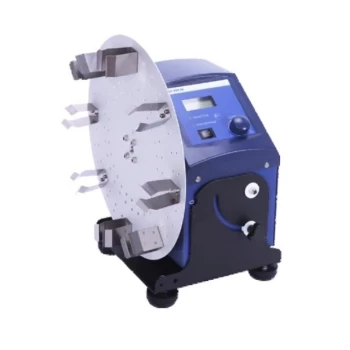
The primary function of an eccentric shaft mixer in this process is to execute complex, multi-dimensional motions that deeply blend micron-sized metal powders with nano-sized particles. By operating over an extended duration, such as eight hours, it integrates iron, copper, nickel, and tin with vanadium nitride (VN) to create a homogeneous composite.
Core Insight: While standard mixers achieve general blending, the eccentric shaft mixer is specifically required to break up the stubborn agglomeration of nano-powders. Its complex motion guarantees the microscopic uniformity necessary to form a stable nanocrystalline structure in the final material.
The Challenge of Mixing Different Scales
Handling Multi-Scale Components
The preparation of Fe–Cu–Ni–Sn–VN composites involves a significant disparity in particle sizes. You are combining micron-scale metal powders (the matrix) with nano-scale vanadium nitride (the reinforcement).
Breaking Nano-Agglomeration
Nano-powders naturally tend to clump together, or agglomerate, due to surface forces. The eccentric shaft mixer is critical because its motion provides the energy needed to break up these agglomerations.
Achieving Deep Mixing
Unlike simple stirring, this process ensures that the nano-particles are not just sitting next to the metal particles but are dispersed uniformly among them. This deep mixing prevents "hot spots" of reinforcement material and weak points of pure metal.
The Mechanism of Action
Complex Multi-Dimensional Motion
The mixer does not rely on a simple rotational axis. It utilizes an eccentric shaft to generate multi-dimensional movement.
Extended Processing Time
The process is time-intensive, often requiring cycles as long as eight hours. This duration is necessary to ensure that every portion of the powder mixture is subjected to the complex forces required for de-agglomeration.
Foundation for Nanocrystalline Structure
The ultimate goal of this rigorous mixing is to prepare the material for its final solid form. Uniform distribution at this stage is the prerequisite for achieving a uniform nanocrystalline structure in the finished composite.
Understanding the Trade-offs: Eccentric vs. Standard Mixing
The Limitation of Simple Tumbling
In standard powder metallurgy, such as mixing Titanium and Chromium Carbide, a V-type mixer is often sufficient. These mixers rely on simple tumbling motions to achieve macroscopic uniformity.
Precision vs. General Blending
While a V-type mixer ensures the overall feed composition is stable, it may lack the complex force vectors required to de-agglomerate nano-particles.
Choosing Complexity for Performance
The eccentric shaft mixer is a more intensive solution designed for a higher tier of difficulty. It is employed specifically when microscopic distribution of nano-materials is the defining factor for the material's success.
Making the Right Choice for Your Goal
When selecting mixing equipment for composite powder preparation, consider the scale of your materials:
- If your primary focus is Macroscopic Uniformity: A standard V-type mixer using tumbling motion is likely sufficient for blending micron-scale powders effectively.
- If your primary focus is Nano-Dispersion: You must use an eccentric shaft mixer to utilize multi-dimensional motion for breaking up nano-agglomerates and ensuring microscopic homogeneity.
The quality of your final nanocrystalline structure is directly determined by the uniformity of your initial powder dispersion.
Summary Table:
| Feature | Eccentric Shaft Mixer | Standard V-Type Mixer |
|---|---|---|
| Primary Motion | Multi-dimensional / Complex | Simple Tumbling |
| Mixing Focus | Microscopic Uniformity | Macroscopic Uniformity |
| Nano-Dispersion | High (Breaks agglomerates) | Low (Limited force) |
| Ideal Application | Nano-reinforced composites | Micron-scale powder blends |
| Typical Duration | Long (e.g., 8 Hours) | Short to Moderate |
Elevate Your Material Research with KINTEK Precision Mixing
Achieving perfect microscopic homogeneity is critical for the integrity of your nanocrystalline structures. At KINTEK, we understand that standard blending isn't enough for advanced Fe–Cu–Ni–Sn–VN composites.
Our extensive portfolio goes beyond high-performance crushing and milling systems to include specialized laboratory equipment designed for the most demanding research environments. Whether you are developing next-generation batteries using our battery research tools, synthesizing materials in our CVD/PECVD furnaces, or requiring the precise force of our isostatic hydraulic presses, KINTEK provides the reliability you need.
Ready to eliminate nano-agglomeration and optimize your powder metallurgy? Contact our laboratory specialists today to discover how our comprehensive range of equipment and consumables can accelerate your breakthroughs.
Related Products
- Laboratory Disc Rotary Mixer for Efficient Sample Mixing and Homogenization
- Laboratory Vortex Mixer Orbital Shaker Multifunctional Rotation Oscillation Mixer
- Laboratory Oscillating Orbital Shaker
- High Performance Laboratory Stirrers for Diverse Applications
- High Performance Lab Homogenizer for Pharma Cosmetics and Food R&D
People Also Ask
- What is a laboratory mixer used for? Choose the Right Tool for Liquids or Solids
- What is a laboratory mixer? A Guide to Achieving Perfect Sample Homogeneity
- What are laboratory mixers used for? Achieve Perfect Sample Homogeneity and Reliable Results
- How does a high-efficiency homogenizing mixer contribute to the preparation of Tobermorite and Xonotlite precursors?
- Why is precision mixing required for concrete corrosion studies? Ensure Data Integrity through Homogenization