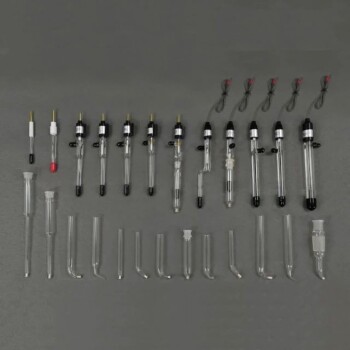
The primary objective of combining a Saturated Calomel Electrode (SCE) with a Luggin Capillary is to dramatically minimize the error caused by solution resistance, known as the ohmic drop (IR Drop). By positioning the capillary tip close to the sample surface, this setup ensures that the potential signals recorded by your workstation are accurate reflections of the true electrode potential, rather than artifacts of the distance the current must travel.
By bridging the physical gap between the reference electrode and the sample surface, this setup isolates the true electrochemical behavior of the material from the interference of solution resistance. This accuracy is vital for detecting subtle phenomena, such as radiation-induced local corrosion sensitivity.
The Mechanics of Accurate Measurement
To understand why this combination is necessary, one must look at the distinct role each component plays in eliminating measurement error.
The Role of the Saturated Calomel Electrode (SCE)
The SCE serves as your stable reference point. In any electrochemical test, you need a known, constant potential to measure against.
The SCE provides this stability, allowing the workstation to detect changes in the sample's potential without ambiguity.
The Function of the Luggin Capillary
While the SCE provides stability, it cannot always be placed physically close to the sample without disrupting the environment. The Luggin Capillary acts as a conductive bridge.
Its tip is positioned very close to the irradiated stainless steel surface (the working electrode). This brings the point of measurement physically near the reaction interface.
Minimizing the IR Drop
The distance between the reference point and the sample creates electrical resistance in the solution.
When current flows, this resistance creates a voltage drop (IR Drop) that distorts your data. By using a Luggin Capillary to minimize the distance current must travel to be "sensed," you effectively minimize the resistance included in the measurement.
Why Interface Accuracy Matters
The ultimate goal of this setup is to ensure data integrity at the sample-electrolyte interface.
Isolating True Potential
In corrosion testing, particularly with irradiated stainless steel, the electrochemical signals can be minute.
If the IR Drop is not minimized, it can mask the small shifts in potential that indicate the onset of local corrosion.
Enabling Sensitivity
High-precision evaluation requires removing "noise" from the system.
The SCE and Luggin Capillary combination removes the noise of solution resistance, allowing for the precise evaluation of radiation-induced corrosion sensitivity.
Understanding the Trade-offs
While this setup is critical for accuracy, improper implementation can introduce new errors.
The Risk of Shielding
While the text emphasizes placing the tip "close" to the surface, placing it too close can block the current path.
This phenomenon, known as shielding, alters the local chemistry and current distribution at the measurement point, potentially creating false data about the corrosion rate.
Solution Conductivity Limits
The effectiveness of reducing IR Drop is also dependent on the conductivity of the electrolyte.
In highly resistive solutions, even a Luggin Capillary may not fully eliminate IR Drop, and mathematical compensation via the workstation may still be required.
Making the Right Choice for Your Goal
Correctly deploying this setup requires balancing proximity with non-interference.
- If your primary focus is Precision Corrosion Testing: Position the Luggin Capillary tip at a distance roughly equivalent to its outer diameter from the sample surface to minimize IR Drop without causing shielding.
- If your primary focus is General Potential Monitoring: Ensure the SCE is fully saturated and the capillary is free of air bubbles to maintain a stable connection to the solution.
This combination is the industry standard for converting raw electrical signals into reliable material science data.
Summary Table:
| Component | Primary Function | Key Benefit |
|---|---|---|
| Saturated Calomel Electrode (SCE) | Provides a stable, constant reference potential. | Ensures a reliable baseline for measurement. |
| Luggin Capillary | Acts as a conductive bridge close to the sample. | Bridges the gap between reference and working electrodes. |
| The Combination | Reduces Ohmic Drop (IR Drop) from solution resistance. | Isolates true potential for sensitive corrosion analysis. |
Elevate Your Electrochemical Research Precision with KINTEK
Accurate data starts with the right equipment. Whether you are analyzing radiation-induced corrosion or developing new materials, KINTEK provides the high-performance tools you need. Our specialized range includes electrolytic cells and electrodes, high-temperature high-pressure reactors and autoclaves, and advanced battery research consumables designed for maximum sensitivity.
From precise laboratory setups to custom ceramics and crucibles, KINTEK is your partner in scientific excellence. Don't let solution resistance mask your results—equip your lab with industry-leading technology today.
Contact KINTEK for Expert Solutions
References
- Talal A. Aljohani, Fuad Khoshnaw. Characterization of gamma-ray irradiation influence on the corrosion behaviour of austenitic stainless steel. DOI: 10.1016/j.mtcomm.2020.101242
This article is also based on technical information from Kintek Solution Knowledge Base .
Related Products
- Reference Electrode Calomel Silver Chloride Mercury Sulfate for Laboratory Use
- Copper Sulfate Reference Electrode for Laboratory Use
- Platinum Auxiliary Electrode for Laboratory Use
- Gold Disc Electrode
People Also Ask
- What is the function of a reference electrode? Master Precision in Three-Electrode Reactor Reconstruction
- What is the recommended maintenance for the filling solution of a reference electrode? A Guide to Stable & Accurate Readings
- Which electrode is used as a ground reference? Master the Key to Accurate Electrochemical Measurements
- What is the reference electrode in potentiometry? The Key to Stable & Accurate Measurements
- Which electrode is used as a reference? A Guide to Accurate Electrochemical Measurements