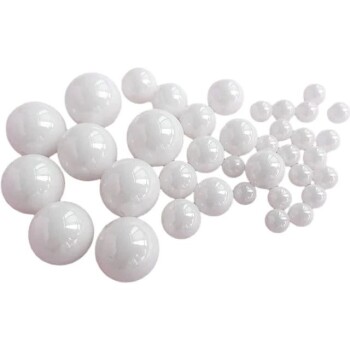
The physical mechanism for selecting grinding media is defined by the generation and transfer of high kinetic energy within the milling vial. This energy translates into intense impact and shear forces, which are required to fracture hard ZrC particles and mechanically fuse them into the ductile aluminum.
The effectiveness of grinding media is determined by its density and hardness, which govern the magnitude of impact forces. These forces must be sufficient to refine coarse carbides to sub-micron levels and embed them deeply into the aluminum matrix.
The Physics of Energy Transfer
The Role of High Kinetic Energy
When the milling vial is in motion, the grinding media (balls) acquire significant kinetic energy.
The magnitude of this energy is directly proportional to the mass (density) and velocity of the media.
Generating Impact and Shear Forces
As the media moves, it collides with the interior walls of the vial and other media balls.
These collisions trap the powder mixture, subjecting it to compressive impact forces and lateral shear forces.
This mechanical action is the primary driver for structural changes within the composite powder.
Matching Media Properties to Materials
Breaking Down Hard Ceramics (ZrC)
Zirconium Carbide (ZrC) is an extremely hard ceramic material.
To effectively reduce the particle size of coarse ZrC, the grinding media must possess sufficient hardness.
If the media is softer than the ceramic reinforcement, the media will wear down rather than fracturing the ZrC into the desired sub-micron sizes.
Embedding into the Ductile Matrix (Al)
The aluminum matrix is soft and ductile compared to the ceramic reinforcement.
High-density media ensures that the impact force is strong enough to physically embed the fractured ZrC particles into the aluminum.
This process prevents the ceramic particles from merely sitting on the surface, ensuring a true composite structure.
Understanding the Trade-offs
Balancing Impact with Wear
While high-density media (like steel) provides maximum kinetic energy, it introduces the risk of contamination.
The intense impact forces can cause the grinding media itself to degrade, introducing iron or other impurities into your aluminum matrix.
Media Hardness vs. Vial Life
Using extremely hard ceramic media reduces contamination but can transfer excessive stress to the milling vial.
If the media is significantly harder than the vial material, you risk damaging the container walls, which can lead to equipment failure or further sample contamination.
Optimizing Your Milling Strategy
To select the correct media, you must weigh the need for impact force against the purity requirements of your final composite.
- If your primary focus is rapid particle refinement: Prioritize high-density media (such as steel) to maximize the kinetic energy and impact force applied to the ZrC particles.
- If your primary focus is compositional purity: Prioritize ceramic media that matches the hardness of the reinforcement to prevent metallic contamination from wear debris.
Selecting the right media is a balance of physics and material compatibility to achieve a uniform, high-strength dispersion.
Summary Table:
| Factor | Physical Mechanism | Impact on ZrC-Al Composite |
|---|---|---|
| Media Density | Kinetic Energy (E = ½mv²) | Higher density provides the force needed to embed ZrC into Al |
| Media Hardness | Material Displacement | Must exceed ZrC hardness to fracture particles without media wear |
| Impact Force | Compressive Stress | Refines coarse carbides to sub-micron levels for better dispersion |
| Shear Force | Lateral Friction | Promotes mechanical alloying and uniform mixing of the matrix |
Elevate Your Material Research with KINTEK’s Precision Systems
Achieving the perfect dispersion in ZrC-reinforced aluminum matrix composites requires more than just physics—it requires high-performance equipment. KINTEK specializes in advanced laboratory solutions designed for the most demanding milling and crushing applications.
Whether you need high-density steel or ceramic grinding media, industrial-grade crushing and milling systems, or precise sieving equipment to verify particle refinement, we provide the tools that ensure consistency and purity. Our portfolio also extends to high-temperature furnaces and hydraulic presses for the final sintering and forming of your composite materials.
Ready to optimize your milling strategy and eliminate contamination? Contact our technical experts today to find the ideal equipment configuration for your lab's specific needs.
Related Products
- Precision Machined Zirconia Ceramic Ball for Engineering Advanced Fine Ceramics
- Hexagonal Boron Nitride HBN Ceramic Ring
- Ceramic Evaporation Boat Set Alumina Crucible for Laboratory Use
- Boron Nitride (BN) Ceramic Plate
- Alumina Al2O3 Ceramic Crucible Semicircle Boat with Lid for Engineering Advanced Fine Ceramics
People Also Ask
- What are the applications of zirconia ceramics? Unlock High-Performance Solutions for Extreme Environments
- Why are zirconia milling balls preferred for P2-type layered oxides? Ensure High Purity and Grinding Efficiency
- What is the purpose of using zirconia milling balls of different diameters? Optimize Solid Electrolyte Processing
- Why are zirconia grinding jars and balls required for solid-state electrolyte powders? Ensure High Purity & Performance
- Why are zirconia grinding balls preferred for LLZTO milling? Ensure Material Purity & High Ionic Conductivity