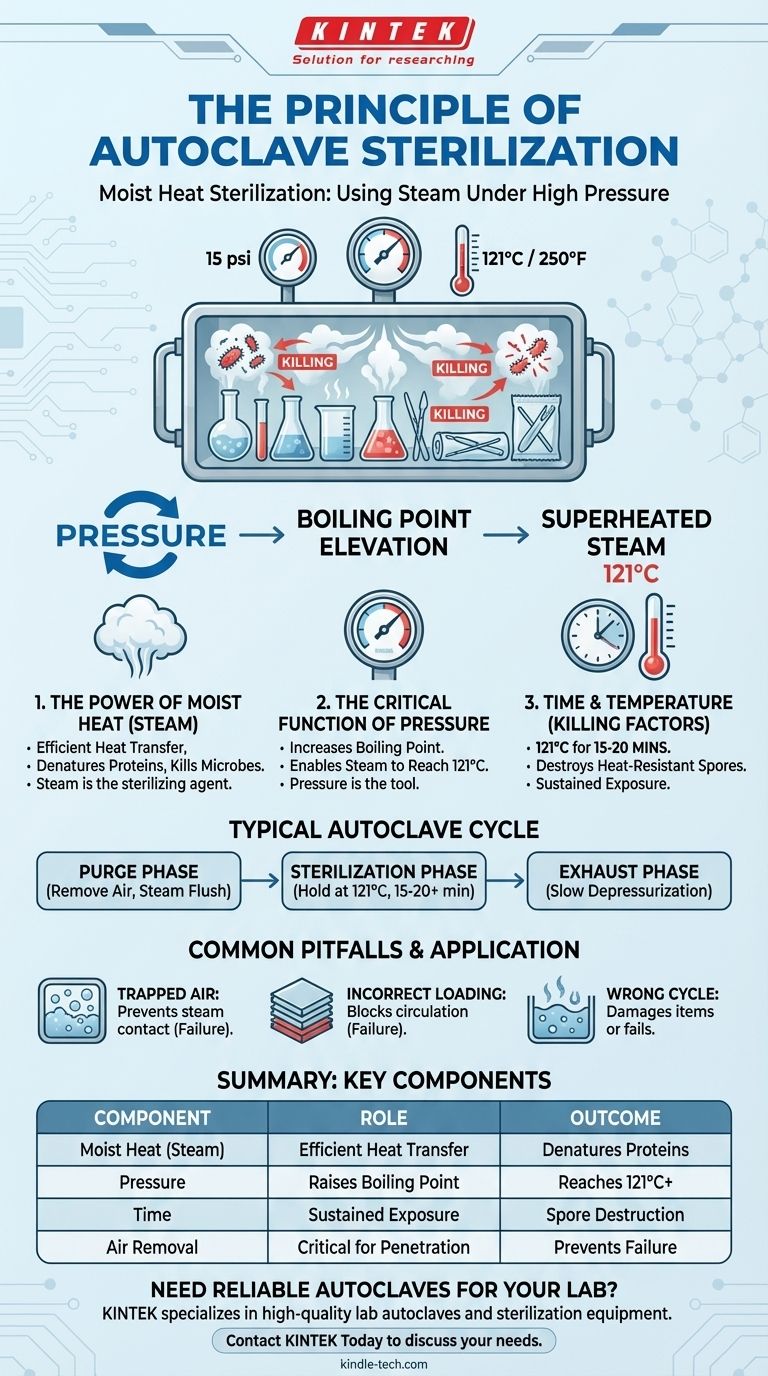
The fundamental principle of an autoclave is moist heat sterilization. It uses steam under high pressure to achieve temperatures far above the normal boiling point of water, which rapidly and effectively kills all forms of microbial life, including resilient spores. The pressure itself is not the sterilizing agent; it is the tool used to create superheated steam.
The core concept to grasp is the relationship between pressure and temperature. By increasing the pressure inside a sealed chamber, an autoclave prevents water from boiling at 100°C (212°F), allowing the steam to reach sterilizing temperatures of 121°C (250°F) or higher.
Deconstructing the Sterilization Process
To truly understand how an autoclave works, you must see how its three key components—moist heat, pressure, and time—work in concert to achieve complete sterilization.
The Power of Moist Heat (Steam)
Moist heat is significantly more effective at sterilization than dry heat. This is because steam is a highly efficient carrier of thermal energy.
When steam condenses on the cooler surface of an object, it rapidly transfers a large amount of heat. This process quickly denatures and coagulates essential proteins and enzymes within microbial cells, leading to their death.
The Critical Function of Pressure
Pressure is the enabling factor in the autoclave process. At standard atmospheric pressure, water boils at 100°C, a temperature that is not sufficient to kill all bacterial spores.
By sealing the chamber and pumping in steam, the autoclave increases the internal pressure. This forces the boiling point of water upward. It is this high-pressure environment that allows the steam to remain gaseous at the required sterilizing temperature of 121°C.
The Killing Factors: Temperature and Time
The actual sterilization is a function of exposing microorganisms to a specific high temperature for a designated amount of time.
A standard and widely validated cycle is maintaining a temperature of 121°C (250°F) for at least 15-20 minutes. This combination of extreme heat and sustained exposure ensures the destruction of even the most heat-resistant bacterial endospores.
How a Typical Autoclave Cycle Works
An autoclave doesn't just instantly apply heat and pressure. It follows a precise, multi-stage process to ensure that steam properly contacts all surfaces of the items inside.
Stage 1: The Purge Phase
Before sterilization can begin, all air must be removed from the chamber. Trapped air creates cool pockets that steam cannot penetrate, leading to sterilization failure.
The autoclave purges this air by flushing the chamber with steam, effectively pushing the cooler, heavier air out through a vent.
Stage 2: The Sterilization Phase
Once all air is removed, the chamber's exhaust valve closes, causing pressure and temperature to rise to the desired setpoint.
The cycle timer begins only after the target temperature is reached. The load is held at this temperature for the entire duration of the programmed time to ensure complete sterilization.
Stage 3: The Exhaust Phase
After the sterilization time is complete, the chamber's exhaust valve opens. Steam is slowly released, allowing the pressure to return to ambient levels.
This depressurization must be done carefully to prevent liquids from boiling over or sealed containers from breaking.
Common Pitfalls and Key Parameters
Achieving successful sterilization requires strict adherence to validated parameters. Misunderstanding the process can easily lead to failed cycles and a false sense of security.
Trapped Air is the Enemy
The most common cause of autoclave failure is improper air removal. If air remains in the chamber or within complex instruments, it prevents steam from making direct contact, leaving those areas unsterilized.
Incorrect Loading
Overloading the autoclave or packing items too densely can also impede steam circulation. This creates barriers that block steam penetration, resulting in incomplete sterilization of the load.
Wrong Cycle Selection
Different materials require different cycles. Sterilizing liquids, for instance, requires a much slower exhaust phase than sterilizing dry goods to prevent the liquids from boiling out of their containers. Using the wrong cycle can damage the items or lead to ineffective sterilization.
Applying This to Your Goal
Understanding the core principles allows you to use and interpret the autoclave process correctly, whether you are in a lab, a clinic, or a manufacturing setting.
- If your primary focus is passing an exam: Remember that pressure's only job is to raise the boiling point of water, allowing moist heat (steam) to reach the 121°C required to kill microbes.
- If your primary focus is operating an autoclave: Always ensure the autoclave is not overloaded and that steam can circulate freely to displace all air from the chamber.
- If your primary focus is validating a process: Recognize that temperature, pressure, and time are all critical, and a failure in one parameter invalidates the entire sterilization cycle.
Ultimately, mastering the principle of the autoclave is about understanding that it is a precisely controlled scientific process, not just a high-temperature wash.
Summary Table:
| Key Component | Role in Sterilization |
|---|---|
| Moist Heat (Steam) | Efficiently transfers heat, denatures microbial proteins |
| Pressure | Raises water's boiling point, enabling steam to reach 121°C+ |
| Time | Sustained exposure at high temperature ensures spore destruction |
| Air Removal | Critical for steam penetration; trapped air causes failure |
Need Reliable Autoclaves for Your Lab?
Understanding autoclave principles is one thing; having equipment that performs reliably is another. KINTEK specializes in high-quality lab autoclaves and sterilization equipment, ensuring your processes meet strict validation standards. Our products are designed for efficient air removal, precise temperature control, and consistent results—critical for labs in research, healthcare, and manufacturing.
Contact KINTEK today to discuss your sterilization needs and ensure your lab operates with confidence and safety.
Visual Guide
Related Products
- Laboratory High Pressure Steam Sterilizer Vertical Autoclave for Lab Department
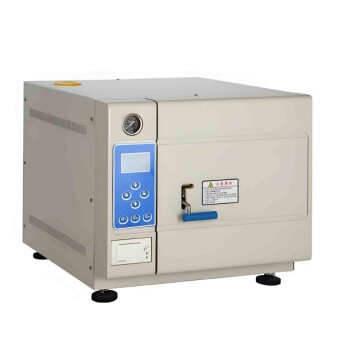
- Desktop Fast Laboratory Autoclave Sterilizer 35L 50L 90L for Lab Use
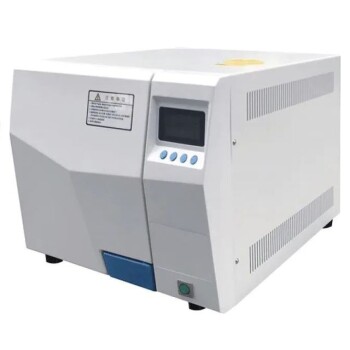
- Desktop Fast Laboratory Autoclave Sterilizer 20L 24L for Lab Use
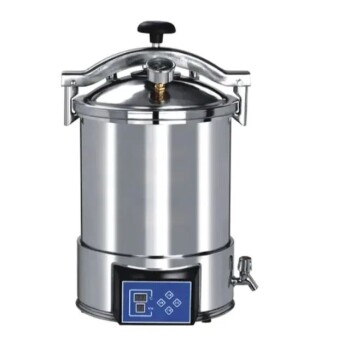
- Portable Digital Display Automatic Laboratory Sterilizer Lab Autoclave for Sterilization Pressure
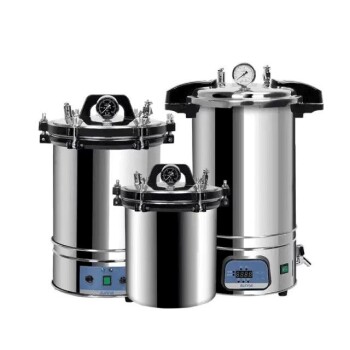
- Portable High Pressure Laboratory Autoclave Steam Sterilizer for Lab Use
People Also Ask
- Is a UV sterilizer as good as an autoclave? The Critical Difference Between Sterilization and Disinfection
- Can autoclave sterilize liquid? Master Safe and Effective Liquid Sterilization
- What is the pressure required in an autoclave? Achieve Sterile Results with 15 PSI
- What is the temperature of autoclave in microbiology lab? Achieve Sterile Conditions with 121°C
- What are the advantages of using an autoclave in the lab? Achieve Unmatched Sterilization for Your Lab